

Protein homology search ESM-2 embedding: P69905
Run P69905 (hemoglobin alpha) in BioQ to list its 8 nearest Swiss-Prot neighbours in ESM-2 space, with cosine scores and UniProt records, as of 2026-11-06.
Data as of November 6, 2026 · By the BioQ team
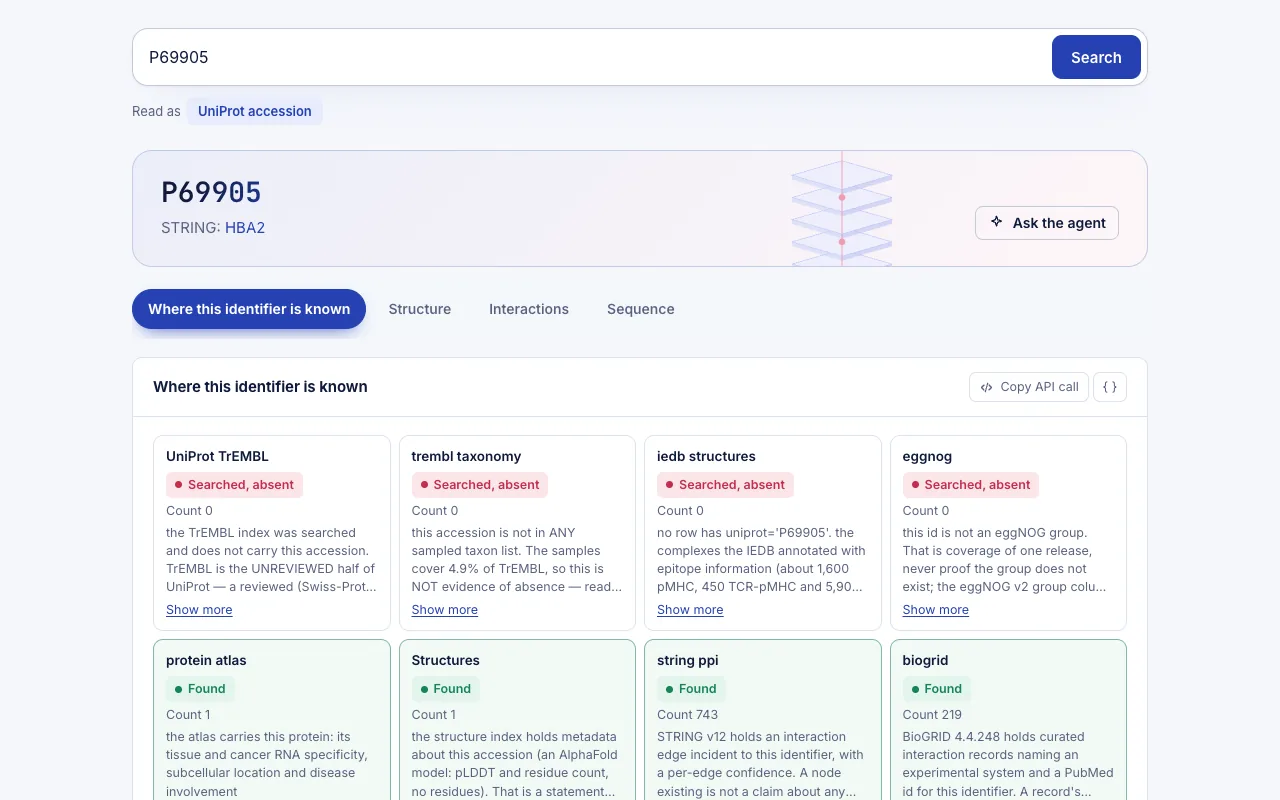
For P69905 (hemoglobin alpha), a protein homology search ESM-2 embedding in BioQ returns 8 Swiss-Prot neighbours, with cosine scores running from 1.0 down to 0.9992. The data are as of 2026-11-06. The engine took 0.45 seconds in total, across 2 queries.
What we asked
The task is common. You have a protein, and you want to know whether Swiss-Prot holds anything related to it. Often a sequence search is the obvious tool. A protein language model gives a second view: each Swiss-Prot entry is a point in embedding space, and you list the points closest to yours.
This example uses a public, well-known protein so that you can check every line of the result. The query is the UniProt accession P69905, which is human hemoglobin subunit alpha (entry name HBA_HUMAN). We ask for the 8 nearest Swiss-Prot proteins in ESM-2 space. We also pull the UniProt records for the gene HBA1, so the neighbour list can be read next to curated entries.
What BioQ returned
The neighbour block uses the ESM-2 650M embeddings of Swiss-Prot. It shows 8 rows. The first is the query itself, which is expected: the nearest point to any protein is that protein.
| UniProt accession | Cosine similarity |
|---|---|
| P69905 | 1 |
| P69906 | 1 |
| P69907 | 1 |
| Q9TS35 | 0.9996 |
| P01923 | 0.9995 |
| P63107 | 0.9992 |
| P63108 | 0.9992 |
| P67817 | 0.9992 |
Three accessions score 1.0: P69905, P69906 and P69907. After them come Q9TS35 at 0.9996, P01923 at 0.9995, and P63107, P63108 and P67817 at 0.9992. The tool's own note applies here: a cosine is high for almost everything, so it ranks neighbours and is not a percentage identity.
The second block draws on UniProt for the gene HBA1. It holds 26 Swiss-Prot records, and the opening rows are below.
| Accession | Entry name | Length (aa) |
|---|---|---|
| P69905 | HBA_HUMAN | 142 |
| P01946 | HBA_RAT | 142 |
| P83270 | HBA1_ANAMI | 143 |
| Q1AGS5 | HBA1_ARCGL | 143 |
| Q1AGS9 | HBA1_BORSA | 143 |
Here P69905 is HBA_HUMAN at 142 residues, and the rat entry P01946 (HBA_RAT) is also 142 residues. The next three entries, from other species, are 143 residues. This is a quick consistency check: the family you expect from the gene name is present in UniProt, with lengths close to your query.
What it means and how to read it
Read the ranking, not the number. All the scores sit between 0.9992 and 1.0, so the absolute value tells you very little. What carries information is the order and where the list drops. A flat list of near-identical scores, like this one, says only that these proteins are close to the query relative to the rest of Swiss-Prot. It does not say how close in terms of sequence identity.
Check each neighbour in its UniProt entry. The neighbour table gives accessions only. Open P69906, P69907, Q9TS35, P01923, P63107, P63108 and P67817 and read the protein name, organism and family annotation. The facts here do not state what these entries are, so do not assume. If most neighbours turn out to be the same family as your query, that supports a family-level link. If one is unrelated by name and function, treat it as a lead to test, not a finding.
MMseqs2 vs ESM-2. Alignment tools such as MMseqs2 report identity, coverage and an E-value for each hit, and you can inspect the alignment itself. Protein language model embeddings work differently. They compare learned representations of whole sequences, so they can place proteins near each other even when the alignment signal is weak. That is why people use them for remote homology. The two are complementary. This result does not compare them on your protein, so run both when the question matters and see where they agree.
The manual route versus one query. Done by hand, this task means looking up the accession in UniProt, finding or generating embeddings for Swiss-Prot, computing similarities, and then returning to UniProt to read each neighbour. Here one query, P69905, reached 2 distinct resources: the ESM-2 embedding index of Swiss-Prot and UniProt. The engine time was 0.45 seconds in total. That figure is engine time only. It does not include the time you spend reading the results, and we make no claim about the manual route's duration.
How to reproduce it in BioQ
- Open BioQ and paste the UniProt accession into the search box. For your own protein, use its Swiss-Prot accession. If you only have a new sequence, the nearest-neighbour approach needs an accession that is already in the index.
- Run the query below as written.
P69905- Read the neighbour table first. Note where the cosine values begin to fall, and note any accession you do not recognise.
- Open the UniProt records for the unfamiliar accessions. Compare name, organism and length with your query.
- If a neighbour looks interesting, run a sequence-alignment search such as MMseqs2 for that pair to get identity and an E-value. Then ask BioQ for the neighbour's gene to see what the other data layers say.
Every answer in BioQ names its source, so the table you export carries the embedding release (ESM-2 650M embeddings of Swiss-Prot) and the UniProt origin of the records.
Limits: what the data do not show
- A cosine similarity is not sequence identity, and it is not a probability of homology. In this example every score is very high, so a threshold on the raw value would not separate related from unrelated proteins.
- The list shows 8 neighbours because that is what was requested. It does not show how many Swiss-Prot proteins are related to your query, and a protein just outside the list may still be related.
- The embedding only covers Swiss-Prot. A related protein that is not in Swiss-Prot cannot appear.
- The result does not tell you about function, structure or evolutionary direction. Similar embeddings can reflect shared domains, composition or family membership, and the table does not say which.
- Hemoglobin alpha is a well-studied, highly conserved family. A less characterised protein may give a flatter, less interpretable list, and this example cannot tell you how your protein will behave.
- The 26 UniProt records for HBA1 are a count of entries returned for that gene name. They are not a measure of how many distinct proteins exist in the family.
- The numbers reflect the data as of 2026-11-06. Later releases of UniProt or the embeddings may change the list.
Data and method
The numbers on this page were read from the BioQ engine on 2026-11-06 (2 queries, 0.5 s of engine time in total). The tables are generated by code from the engine's answers; the text only restates them.
/neighbourhood, /uniprot
Run the same query yourself: P69905
For research use only. This page summarises public data and is not medical advice.
BioQ is an AI search engine and agent with one goal: making biology research 100X faster. Ask in the web app, over the REST API, or from Claude, ChatGPT or Cursor through MCP.
Queries used
Frequently asked questions
How do I find proteins related to my protein using ESM-2 embeddings?
Enter the Swiss-Prot accession, for example P69905, in BioQ. It returns the nearest Swiss-Prot proteins in ESM-2 space; this example returned 8, with cosine values from 1.0 to 0.9992.
Is the cosine value the same as percent identity?
No. The cosine only ranks neighbours, and it is high for almost everything. In this example all 8 values lie between 0.9992 and 1.0, so identity needs an alignment tool.
How is an ESM-2 neighbour search different from MMseqs2?
MMseqs2 aligns sequences and reports identity and an E-value. The ESM-2 search compares learned embeddings, which can pick up remote homology. This example does not compare the two on your protein, so check promising neighbours with an alignment.
How long did the P69905 query take?
The engine time was 0.45 seconds in total, for 2 queries drawing on 2 distinct resources. That is engine time only, not reading time.
How many UniProt records does HBA1 have in this result?
The UniProt block lists 26 Swiss-Prot records for the gene HBA1. The human entry P69905 (HBA_HUMAN) is 142 residues long.
Sources
Results come from public databases as of the date shown and may change. BioQ gives research information, not medical advice.
More from the blog
MDM2 vs MDM4: dependency and drugs side by side
MDM2 vs MDM4 in DepMap 24q4 Chronos data and drug annotations: 384 of 1178 cell lines depend on MDM2, 142 on MDM4; 12 drugs listed for MDM2, 1 for MDM4.
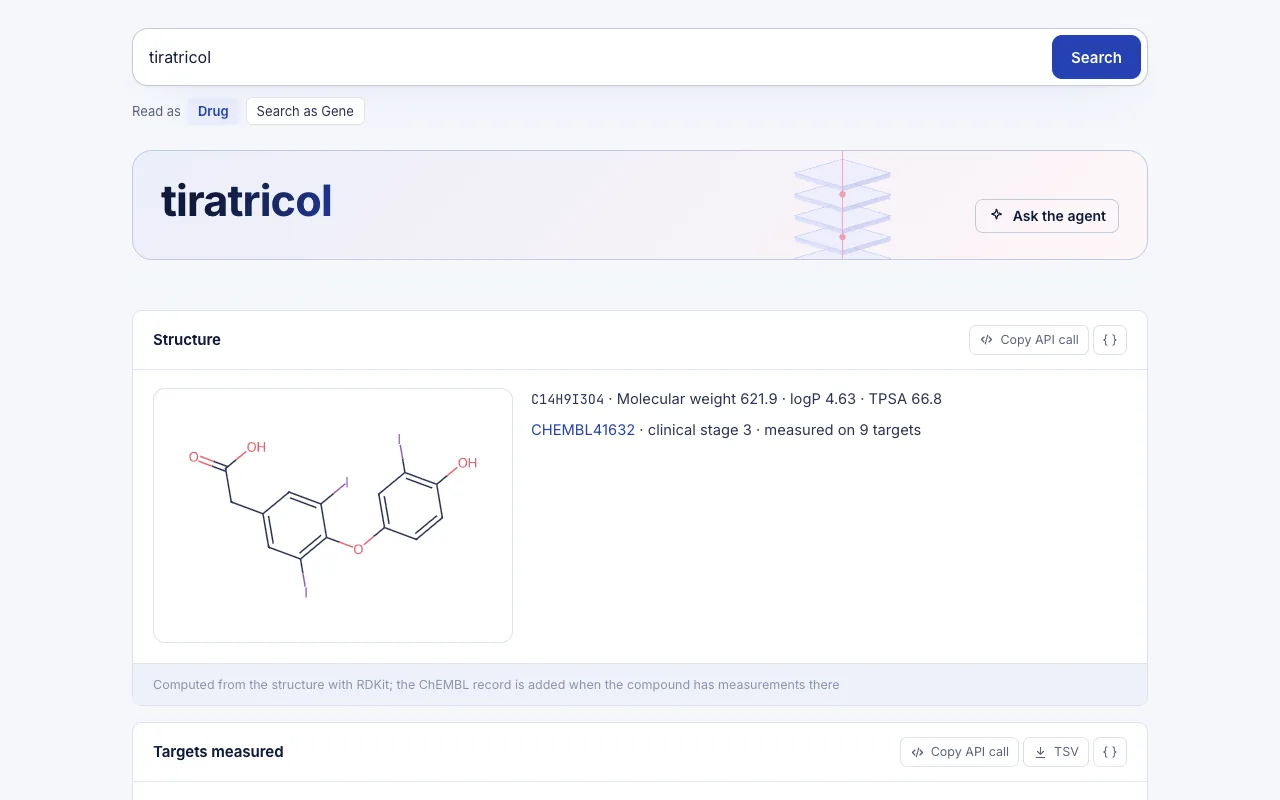
Tiratricol FDA approval: targets and potency in BioQ
Tiratricol FDA approval (Emcitate): ChEMBL shows 68 targets, THRB and THRA top by pChEMBL, and 3 registered trials on ClinicalTrials.gov, as of 2026-11-17.
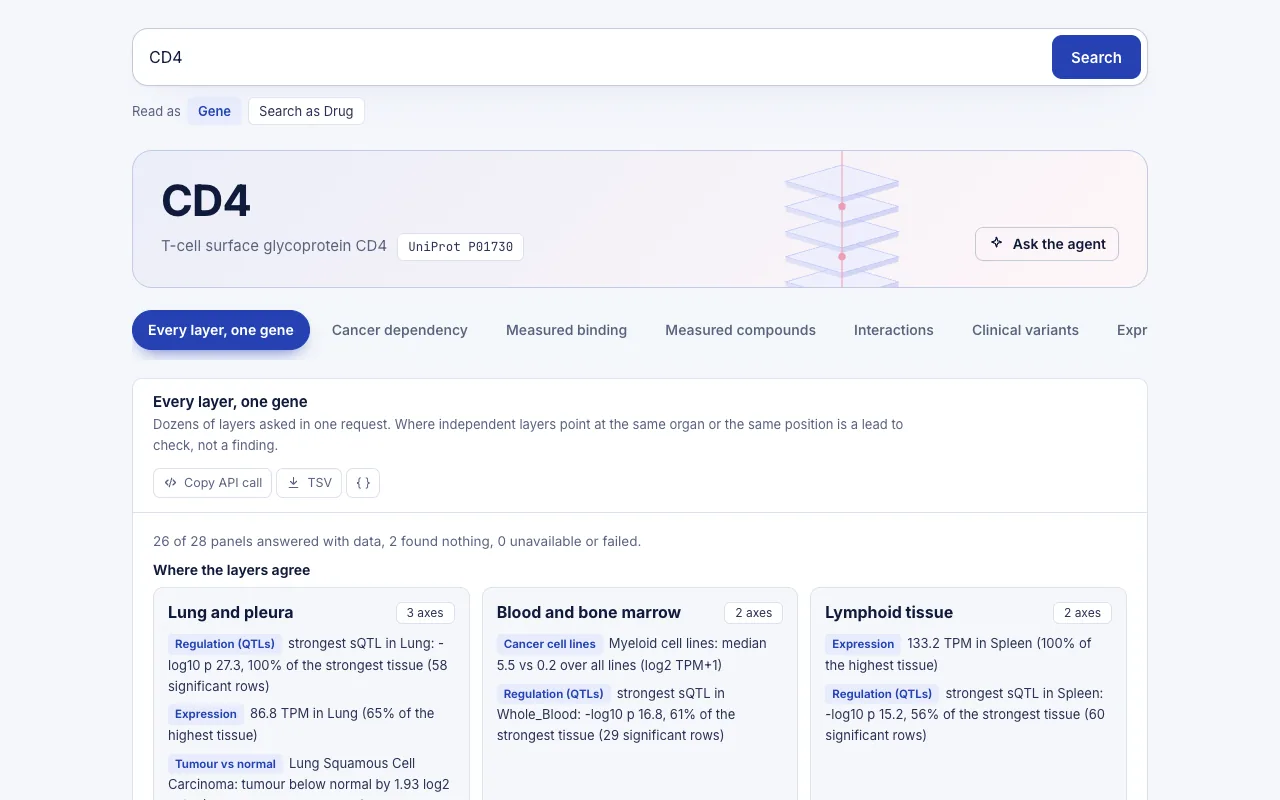
CD4 new study: CAR-NK cells and HIV rebound in context
A CD4-based CAR-NK paper on HIV rebound, placed in context with BioQ data on CD4: DepMap dependency, Open Targets diseases, drugs and Reactome pathways.