

Zanubrutinib CLL trial NCT07899398 explained
Trial watch on NCT07899398, a phase 2 zanubrutinib study in CLL, with ChEMBL potency and ClinicalTrials.gov counts for the drug as of 2026-11-13.
Data as of November 13, 2026 · By the BioQ team
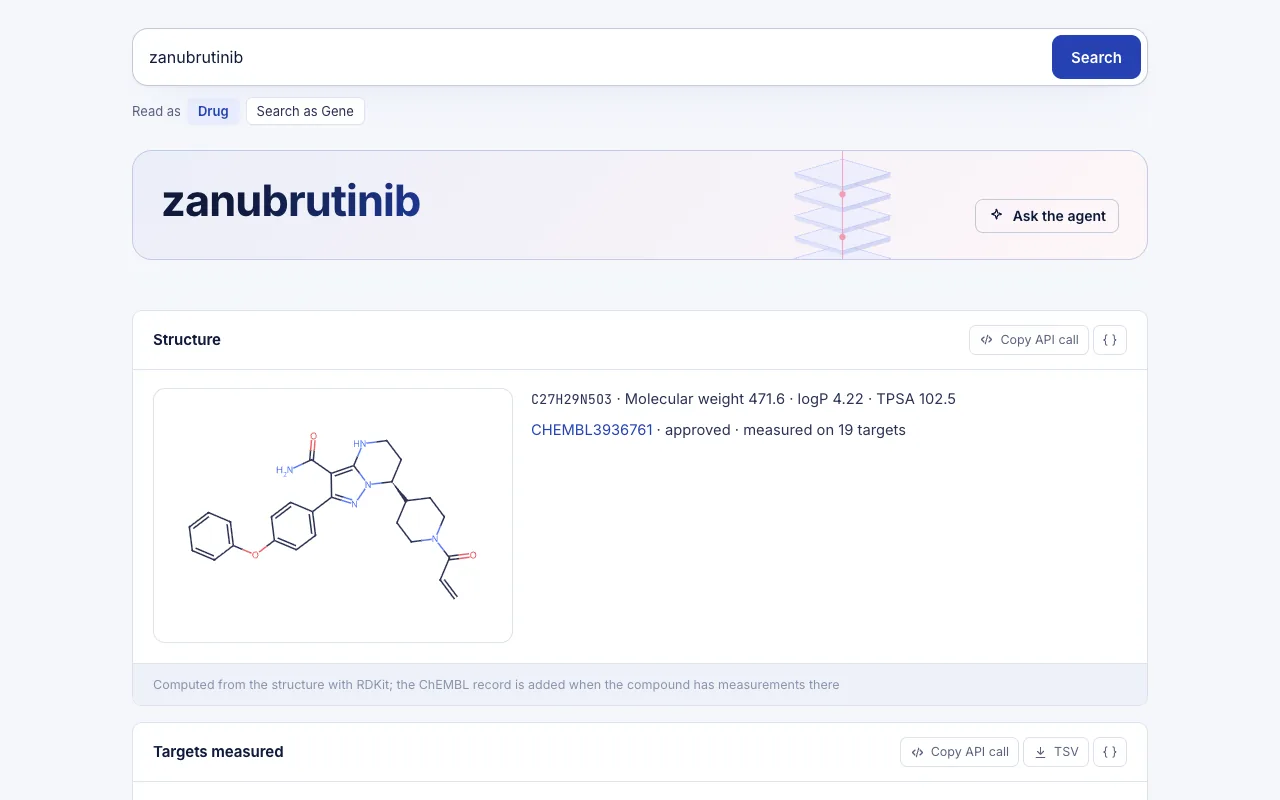
NCT07899398 is a phase 2 trial from the German CLL Study Group that tests zanubrutinib in older or frail patients with treatment-naïve CLL. In ChEMBL, BTK is the strongest measured target of zanubrutinib, with a top pChEMBL of 9.52 from 19 exact measurements. ClinicalTrials.gov lists 140 studies of the drug, 94 of them phase 2. All data are as of 2026-11-13.
What we asked about the zanubrutinib CLL trial
The registry entry describes a fitness-adapted strategy in patients with previously untreated CLL who are older, frail, or both. Two regimens are named: continuous zanubrutinib alone, or a time-limited combination of zanubrutinib with sonrotoclax. The sponsor is the German CLL Study Group, the phase is PHASE2, and the listed start date falls after the data date of this article. As far as the registry shows, the trial has therefore not started.
For a trial watch we wanted to know what is already established about the intervention before any results exist. We asked three things:
- Which targets has zanubrutinib been measured against, and how potently?
- How many other trials of zanubrutinib are registered, and at what phase?
- Which compound record does the name resolve to, so that data from different resources refer to the same molecule?
We did not query sonrotoclax, because the single query is about zanubrutinib.
What BioQ returned
The query zanubrutinib drew on 3 distinct resources: ChEMBL for potency, ClinicalTrials.gov for registered studies and PubChem for identity. The engine ran 3 queries in 0.54 seconds in total.
Identity. PubChem resolves the name to CID 135565884 with InChIKey RNOAOAWBMHREKO-QFIPXVFZSA-N and 15 synonyms. The ChEMBL identifier is CHEMBL3936761. Matching identifiers across resources is what allows the potency and trial results below to be read as one compound.
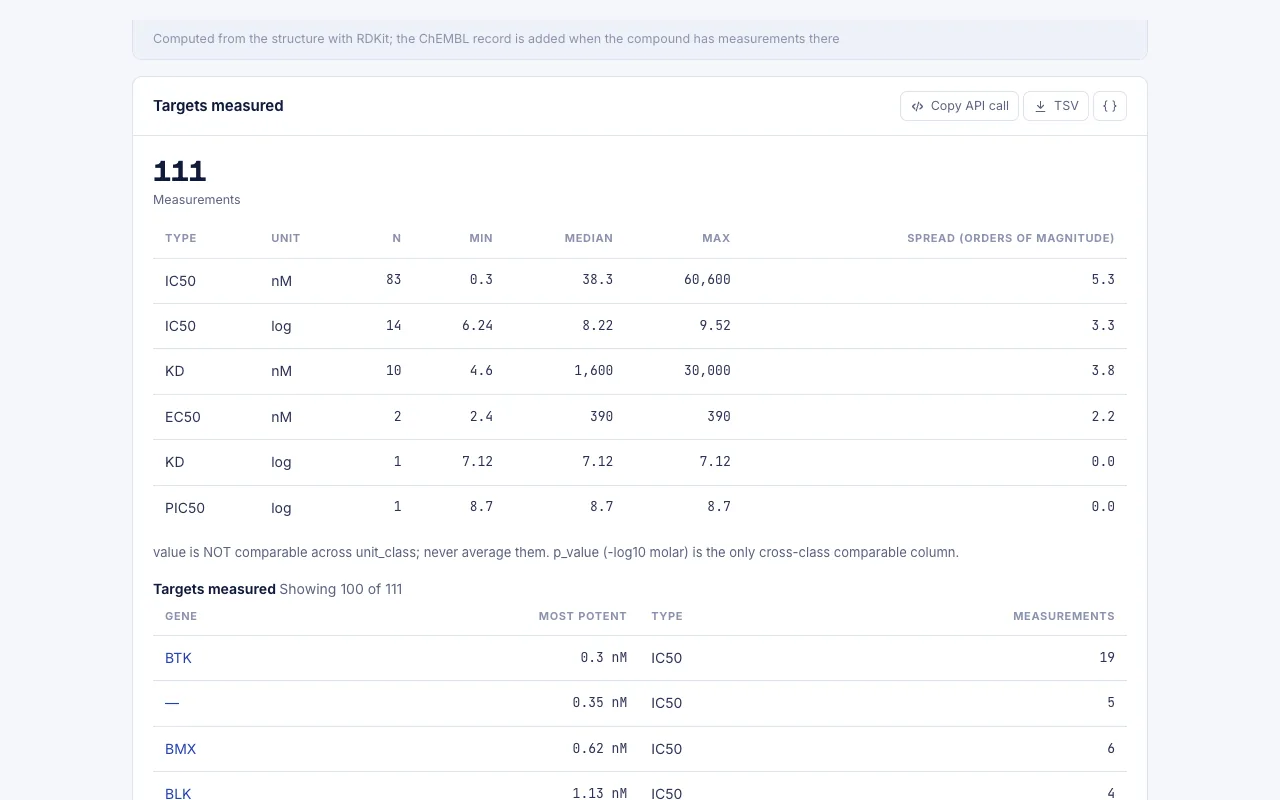
Potency. ChEMBL holds measurements against 29 targets for this compound, and 24 of them have at least one exact value (not a "greater than" or "less than" entry). The table shows the eight strongest. pChEMBL is the negative logarithm of the molar potency, so a higher value means a stronger measured effect.
| ChEMBL target | Gene | Best pChEMBL | Type | Exact measurements |
|---|---|---|---|---|
| CHEMBL5251 | BTK | 9.52 | IC50 | 19 |
| CHEMBL4483285 | — | 9.46 | IC50 | 1 |
| CHEMBL4483266 | — | 9.44 | IC50 | 2 |
| CHEMBL3834 | BMX | 9.21 | IC50 | 6 |
| CHEMBL2250 | BLK | 8.95 | IC50 | 4 |
| CHEMBL3009 | ERBB4 | 8.8 | IC50 | 4 |
| CHEMBL4246 | TEC | 8.77 | IC50 | 7 |
| CHEMBL203 | EGFR | 8.62 | IC50 | 11 |
Other trials. The ClinicalTrials.gov snapshot matches 140 studies with zanubrutinib as an intervention: 28 in phase 1, 94 in phase 2 and 15 in phase 3. The table below is only a page of six of these. The facts do not break down the remaining studies by phase.
| Trial | Phase | Status | Sponsor | Start | Enrollment |
|---|---|---|---|---|---|
| NCT02914938 | PHASE1 | TERMINATED | MEI Pharma, Inc. | 2016-10 | 97 |
| NCT06669143 | PHASE2 | NOT_YET_RECRUITING | Ruijin Hospital | 2024-11 | 19 |
| NCT06021977 | PHASE2 | UNKNOWN | Institute of Hematology & Blood Diseases | 2023-09 | 33 |
| NCT05979948 | PHASE2 | UNKNOWN | Shanghai Changzheng Hospital | 2023-08 | 60 |
| NCT06695013 | PHASE2 | RECRUITING | Ruijin Hospital | 2024-11 | 144 |
| NCT04899570 | PHASE2 | UNKNOWN | Peking Union Medical College Hospital | 2021-04 | 20 |
What it means and how to read it
BTK leads the list with a top pChEMBL of 9.52 and 19 exact IC50 measurements. That is the largest number of exact measurements in the table, so it is also the best-supported value. It agrees with the use of zanubrutinib as a BTK-directed drug in a B-cell malignancy, and it is the pharmacological premise of the continuous monotherapy arm of NCT07899398.
The table also shows that the measured profile is not limited to BTK. BMX (9.21), BLK (8.95), ERBB4 (8.8), TEC (8.77) and EGFR (8.62) all have exact IC50 values in the same range. Two further ChEMBL targets, CHEMBL4483285 (9.46) and CHEMBL4483266 (9.44), have no gene symbol in this view. Each is backed by only 1 or 2 exact measurements, so their high values are less certain than the BTK value. When you compare targets, read the value together with the number of exact measurements.
The trial landscape gives context for the new entry. Zanubrutinib is already studied broadly, and phase 2 is the largest group among the 140 studies. The six rows shown are all phase 1 or phase 2 and have varied statuses (terminated, recruiting, not yet recruiting, unknown). A status of UNKNOWN in the registry means the record has not been verified recently. It does not mean the trial failed.
A dependency analysis of the target in cancer cell lines, which some trial watches include, is not part of this result. We therefore make no statement about BTK dependency in CLL models.
How to reproduce it in BioQ
- Open BioQ and enter the compound name as the query:
zanubrutinib- Open the targets view and read the ranked list of ChEMBL targets. Check the number of exact measurements next to each pChEMBL value.
- Open the trials view and filter by phase or status. Use the identifier NCT07899398 to find the German CLL Study Group entry.
- Check the compound record for the PubChem and ChEMBL identifiers, so that you know the results belong to the same molecule.
- Note the source and release shown beside each block (ChEMBL, ClinicalTrials.gov snapshot, PubChem) when you cite the numbers.
Done by hand, the same steps mean searching 3 separate resources and reconciling identifiers between them. Here the 3 resources answered in 0.54 seconds of engine time.
Limits: what the data do not show
- The data describe the drug and the registry, not the trial's outcome. NCT07899398 has no results, and nothing here suggests how either arm will perform.
- Potency values come from assays reported in the literature, under different conditions. A high pChEMBL in an enzyme or cell assay does not translate directly into activity in people.
- The table shows the eight strongest targets only. Of the 29 targets with measurements, the remaining ones are not listed here.
- Two high-potency entries have no gene symbol and few exact measurements, so we do not interpret them.
- The ClinicalTrials.gov table is one page of the matched studies. Counts by phase reflect registry fields and may include studies in which zanubrutinib is only one component of a combination.
- Nothing in this article is medical advice or a statement about treatment decisions.
Data and method
The numbers on this page were read from the BioQ engine on 2026-11-13 (3 queries, 0.5 s of engine time in total). The tables are generated by code from the engine's answers; the text only restates them.
/chembl_potency, /clinicaltrials, /compound
Sources
- A Trial to Evaluate the Efficacy and Safety of a Fitness-adapted Thera-py Approach With Either Continuous Zanubrutinib Monotherapy or Time-limited Zanubrutinib + Sonrotoclax in Older and/or Frail Patients With Treatment-naïve CLL (2026) — https://clinicaltrials.gov/study/NCT07899398
Run the same query yourself: zanubrutinib
For research use only. This page summarises public data and is not medical advice.
BioQ is an AI search engine and agent with one goal: making biology research 100X faster. Ask in the web app, over the REST API, or from Claude, ChatGPT or Cursor through MCP.
Queries used
Frequently asked questions
What does the NCT07899398 trial test?
It is a phase 2 trial from the German CLL Study Group in older and/or frail patients with treatment-naïve CLL. It compares continuous zanubrutinib alone with a time-limited combination of zanubrutinib and sonrotoclax. The registered start date is after 2026-11-13, the data date of this article.
What is the main target of zanubrutinib in ChEMBL?
BTK, with a top pChEMBL of 9.52 from 19 exact IC50 measurements. ChEMBL lists 29 targets for the compound, 24 of them with at least one exact measurement.
How many clinical trials of zanubrutinib are registered?
The ClinicalTrials.gov snapshot matches 140 studies with zanubrutinib as an intervention: 28 in phase 1, 94 in phase 2 and 15 in phase 3.
Does zanubrutinib hit kinases other than BTK?
The ChEMBL data list exact measurements for BMX (9.21), BLK (8.95), ERBB4 (8.8), TEC (8.77) and EGFR (8.62), among others. These are top pChEMBL values from assays and do not describe effects in people.
Which compound identifiers does BioQ use for zanubrutinib?
PubChem CID 135565884, InChIKey RNOAOAWBMHREKO-QFIPXVFZSA-N and ChEMBL ID CHEMBL3936761. PubChem lists 15 synonyms for the compound.
Sources
Results come from public databases as of the date shown and may change. BioQ gives research information, not medical advice.
More from the blog
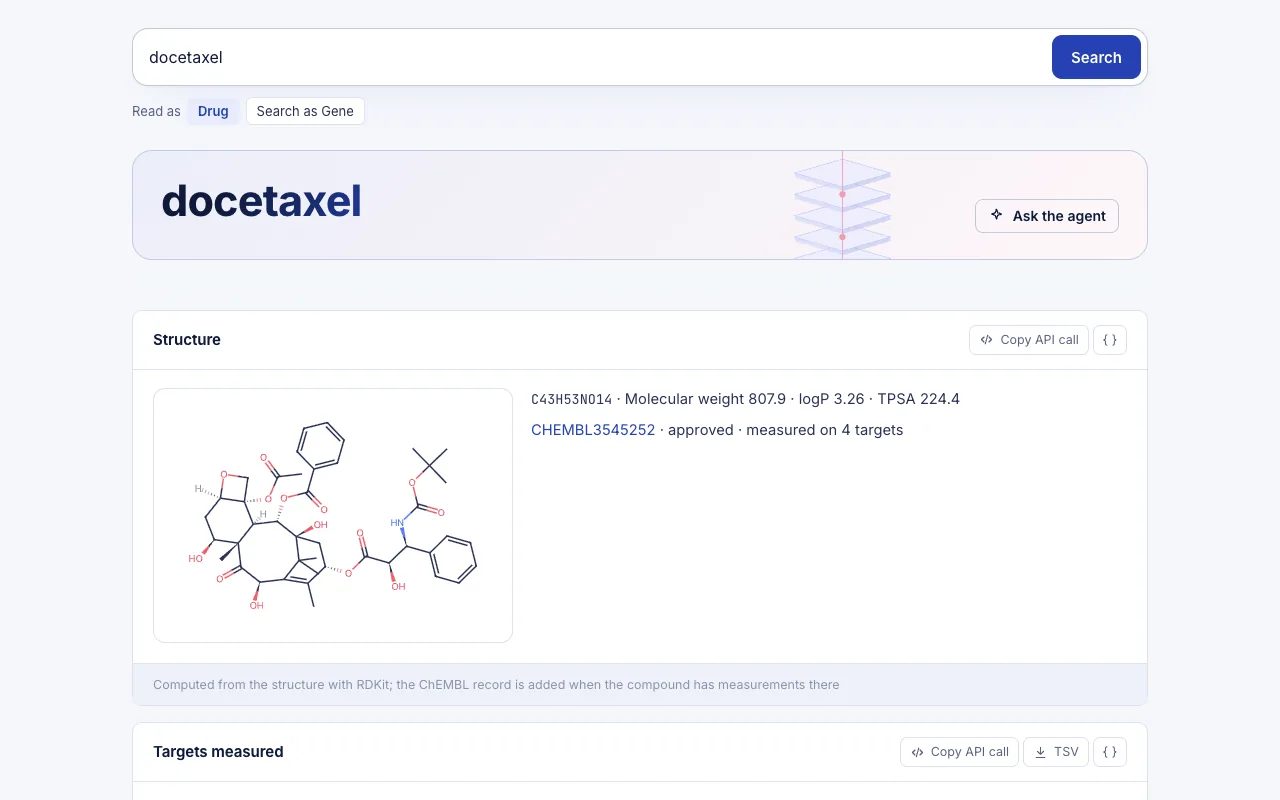
Docetaxel Non-Squamous Non-Small Cell Lung Cancer Trial
NCT07821684 is a phase 3 trial in non-squamous NSCLC; we pair it with docetaxel potency in ChEMBL, 1628 registered trials and EGFR dependency in DepMap.
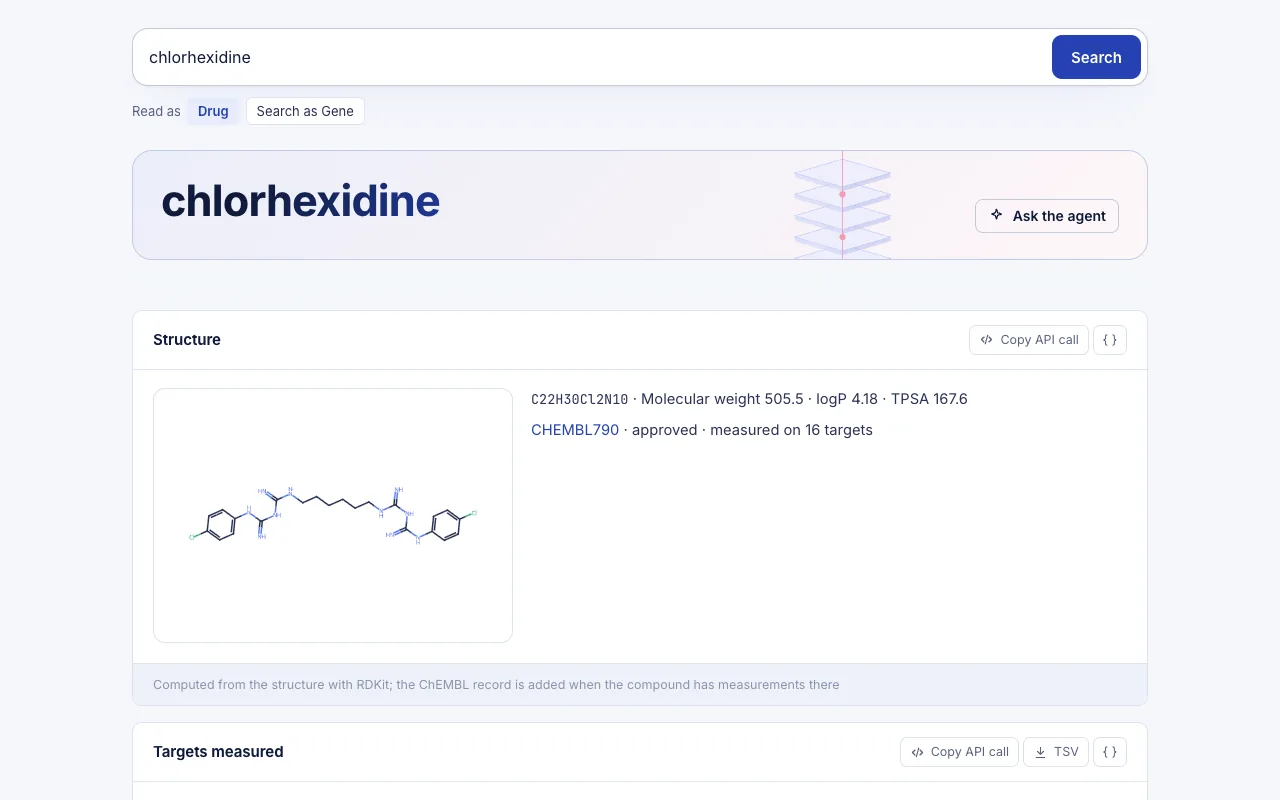
Chlorhexidine Plaque-Induced Gingivitis trial NCT07905456
NCT07905456 is a PHASE2 gingivitis trial starting 2026-12-01; we checked chlorhexidine in ChEMBL (104 targets) and ClinicalTrials.gov (101 studies).
Oxaliplatin Biliary Tract Cancer trial NCT07916844
NCT07916844 tests hepatic arterial infusion chemotherapy versus capecitabine in resected biliary tract cancer; ChEMBL and 1231 oxaliplatin studies.