

Chlorhexidine Plaque-Induced Gingivitis trial NCT07905456
NCT07905456 is a PHASE2 gingivitis trial starting 2026-12-01; we checked chlorhexidine in ChEMBL (104 targets) and ClinicalTrials.gov (101 studies).
Data as of November 12, 2026 · By the BioQ team
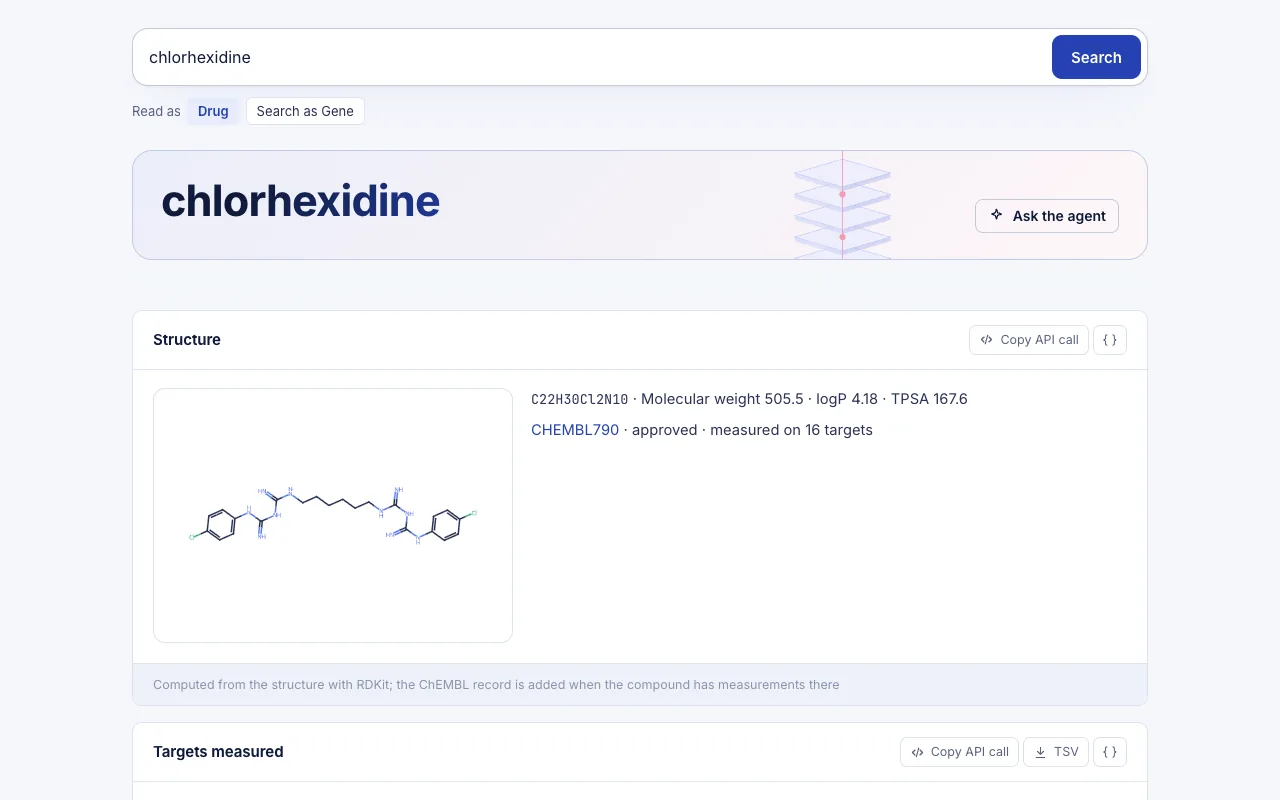
The PHASE2 trial NCT07905456, sponsored by the University of Sulaimani, is registered for Plaque-Induced Gingivitis with a planned start of 2026-12-01. For chlorhexidine, BioQ finds 104 ChEMBL targets (65 with exact measurements) and 101 registered studies, of which 5 are phase 1, 16 phase 2 and 9 phase 3. All figures are as of 2026-11-12.
What we asked: the chlorhexidine Plaque-Induced Gingivitis trial
NCT07905456 is a newly registered PHASE2 trial in Plaque-Induced Gingivitis. The registry title refers to a Thymus Vulgaris mouthwash in biofilm-induced gingivitis. The sponsor is the University of Sulaimani, and the start date is 2026-12-01. The record we worked from does not say what role chlorhexidine plays in the design. A mouthwash trial in this condition may use it as a reference product, but we cannot confirm that from the data we hold, and we do not claim it here.
What we can do is put the trial in context. Anyone reading a new gingivitis mouthwash trial will want to know what is already on record for chlorhexidine, an antiseptic commonly named in this setting. We asked three things:
- Which targets has chlorhexidine been measured against, and how strongly?
- How many chlorhexidine trials are registered, and in which phases?
- Which compound record do those results belong to?
The query was the single word chlorhexidine. Cancer-model dependency does not apply, because the trial is in an oral inflammatory condition and no cancer target is involved.
What BioQ returned
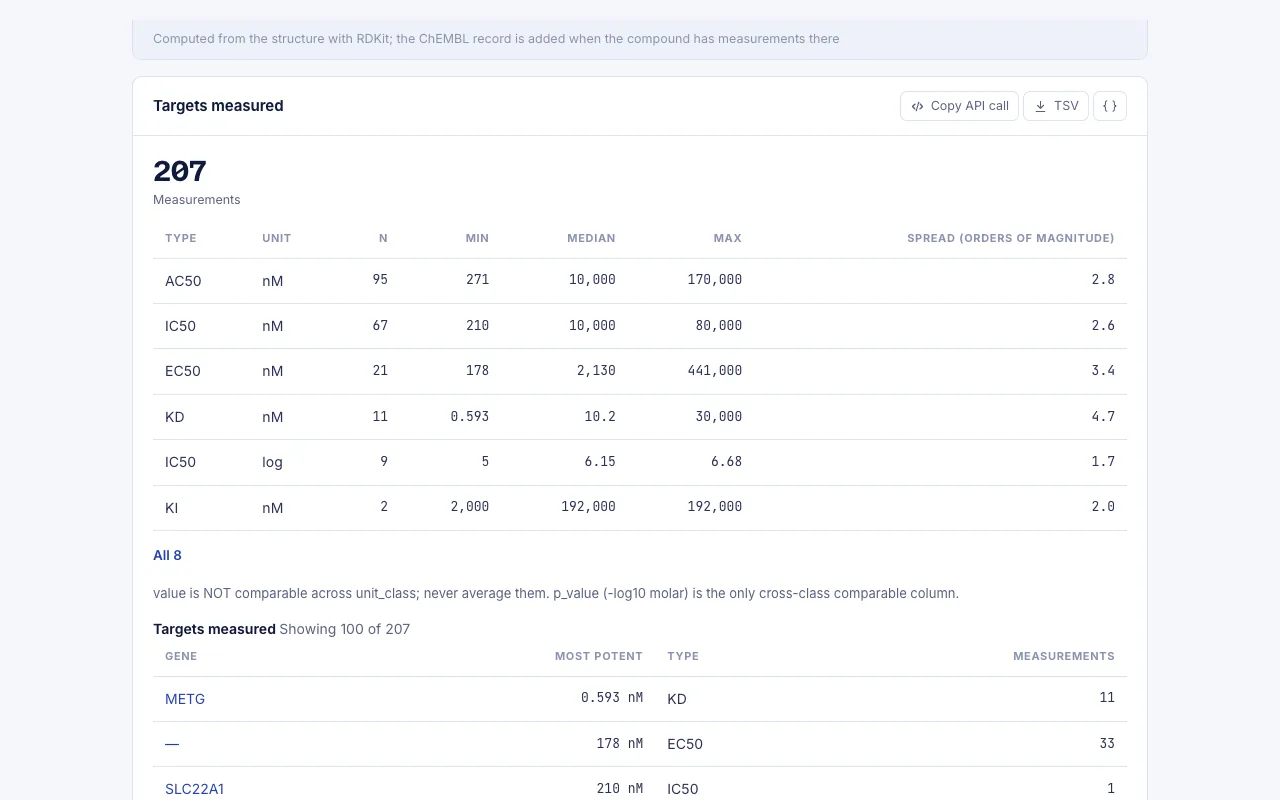
The compound is resolved to PubChem CID 9552079 (InChIKey GHXZTYHSJHQHIJ-UHFFFAOYSA-N), with 49 synonyms and the ChEMBL identifier CHEMBL790. The ChEMBL potency view lists 104 targets for CHEMBL790. Of these, 65 have at least one exact measurement. pChEMBL is the negative base-10 logarithm of the molar potency, so a higher value means a lower concentration for the same effect. The 8 strongest rows are below.
| ChEMBL target | Gene | Best pChEMBL | Type | Exact measurements |
|---|---|---|---|---|
| CHEMBL6066152 | METG | 9.23 | KD | 9 |
| CHEMBL6066151 | METG | 8.3 | KD | 3 |
| CHEMBL612545 | — | 6.75 | EC50 | 36 |
| CHEMBL5685 | SLC22A1 | 6.68 | IC50 | 1 |
| CHEMBL259 | MC4R | 6.57 | AC50 | 2 |
| CHEMBL612851 | — | 6.49 | EC50 | 11 |
| CHEMBL1743122 | SLC22A2 | 6.4 | IC50 | 1 |
| CHEMBL2073673 | SLC22A3 | 6.39 | IC50 | 1 |
The ClinicalTrials.gov snapshot matches 101 studies with chlorhexidine as an intervention. The phase counts cover all matched studies: 5 in phase 1, 16 in phase 2 and 9 in phase 3. The table is only a page of 6 studies.
| Trial | Phase | Status | Sponsor | Start | Enrollment |
|---|---|---|---|---|---|
| NCT07900022 | NA | COMPLETED | Yuzuncu Yil University | 2021-12 | 26 |
| NCT07001527 | PHASE3 | COMPLETED | Hospital Universitario Evangelico de Cur | 2022-06 | 516 |
| NCT07058727 | NA | RECRUITING | Cukurova University | 2025-05 | 75 |
| NCT01115049 | PHASE4 | COMPLETED | Federico II University | 2010-02 | 44 |
| NCT00841074 | PHASE1 | COMPLETED | University of Louisville | 2006-01 | 75 |
| NCT05952921 | NA | COMPLETED | Universidad El Bosque, Bogotá | 2019-07 | 32 |
The queries behind this page drew on 3 distinct resources (ChEMBL, ClinicalTrials.gov and PubChem). The engine took 0.36 seconds in total for 3 queries.
What it means and how to read it
Potency table. The two top rows are both mapped to the gene METG. They are KD values of 9.23 (9 exact measurements) and 8.3 (3 exact measurements). Binding constants are not functional effects, and a ChEMBL target record can come from a non-human or non-mammalian organism. Check the target entry before treating a gene symbol as a human protein.
The next rows are mostly EC50 and IC50 values in the 6.4 to 6.75 range. The row with 36 exact EC50 measurements (best pChEMBL 6.75) and the row with 11 (6.49) have no gene mapped, so they are not tied to a specific gene in this view. The remaining rows map to the transporters SLC22A1, SLC22A2 and SLC22A3 and to the receptor MC4R. Each of the three transporters has a single IC50 measurement, and MC4R has 2 exact measurements with an AC50 type. A single measurement is a weak basis for any conclusion.
Trial table. The 6 rows shown span phase 1, phase 3, phase 4 and non-phased (NA) studies, from different sponsors and start years. They show how varied the chlorhexidine registry is. They are not a ranking and not a list of gingivitis studies.
For the new trial. The useful reading is the contrast between the two sets of data. The measured-target data describe activity in biochemical and cell assays. A gingivitis trial in the mouth measures a clinical outcome. The ChEMBL values give no basis for predicting that outcome, and they say nothing about how a Thymus Vulgaris mouthwash would compare with chlorhexidine.
What the registry data do show is that chlorhexidine is a heavily studied intervention. The phase counts give a sense of how much prior work a new trial in this area sits beside.
How to reproduce it in BioQ
- Open BioQ and enter the single-word query below.
chlorhexidine- Read the compound identity first. Confirm that the ChEMBL identifier is CHEMBL790 and that the name resolved to the intended compound.
- Open the potency view. Sort by best pChEMBL, then compare the number of exact measurements for each target against its value. Open the target record before interpreting a gene symbol.
- Open the trials view and filter by condition or phase to find gingivitis or other oral studies. Then look up NCT07905456 by its identifier and compare its sponsor and start date with the registry entry.
- Note the data release shown with each block (ChEMBL, a ClinicalTrials.gov snapshot, PubChem). Re-run later, because registrations change.
Each block in the answer names its source, so you can check every value against the original database.
Limits: what the data do not show
- We do not know the intervention arms of NCT07905456 beyond its title. The record we used does not say whether chlorhexidine is a comparator, a control or a background treatment.
- We hold no enrollment, outcome measures or results for NCT07905456. The start date of 2026-12-01 is later than the data date of 2026-11-12, so the trial has not begun by that date.
- The potency table is a ranking of the best values, not of relevance. Target-based activity in ChEMBL does not establish a mechanism of action in gingivitis, and no mechanism claim is made here.
- Some potency rows lack a gene mapping. Measurements from different assay types (KD, EC50, IC50, AC50) are not directly comparable.
- The trial list shows 6 of 101 studies. Counts depend on how the registry codes the intervention name, so spelling variants or salt forms may be missed.
- Nothing here is medical advice, and the data do not support any statement about clinical benefit or safety.
Data and method
The numbers on this page were read from the BioQ engine on 2026-11-12 (3 queries, 0.4 s of engine time in total). The tables are generated by code from the engine's answers; the text only restates them.
/chembl_potency, /clinicaltrials, /compound
Sources
- Efficacy of Thymus Vulgaris Mouthwash in the Management of Biofilm-Induced Gingivitis (2026) — https://clinicaltrials.gov/study/NCT07905456
Run the same query yourself: chlorhexidine
For research use only. This page summarises public data and is not medical advice.
BioQ is an AI search engine and agent with one goal: making biology research 100X faster. Ask in the web app, over the REST API, or from Claude, ChatGPT or Cursor through MCP.
Queries used
Frequently asked questions
What is NCT07905456?
NCT07905456 is a PHASE2 trial in Plaque-Induced Gingivitis sponsored by the University of Sulaimani, with a planned start of 2026-12-01. Its title refers to a Thymus Vulgaris mouthwash.
How many chlorhexidine trials are registered on ClinicalTrials.gov?
BioQ matched 101 studies with chlorhexidine as an intervention as of 2026-11-12. Of these, 5 are phase 1, 16 are phase 2 and 9 are phase 3.
How many targets has chlorhexidine been measured against in ChEMBL?
ChEMBL lists 104 targets for chlorhexidine (CHEMBL790). 65 of them have exact measurements.
What is the strongest chlorhexidine potency in ChEMBL?
The highest best pChEMBL is 9.23, a KD value on a target mapped to METG with 9 exact measurements. The next row is also METG, with a KD value of 8.3 and 3 exact measurements.
Does the potency data explain how chlorhexidine acts in gingivitis?
No. The ChEMBL values come from assays on individual targets and do not establish a mechanism or a clinical outcome in Plaque-Induced Gingivitis.
Sources
- Trial Efficacy of Thymus Vulgaris Mouthwash in the Management of Biofilm-Induced Gingivitis (2026)
- Dataset ClinicalTrials.gov
- Dataset PubChem
Results come from public databases as of the date shown and may change. BioQ gives research information, not medical advice.
More from the blog
Tiratricol FDA approval: targets and potency in BioQ
Tiratricol FDA approval (Emcitate): ChEMBL shows 68 targets, THRB and THRA top by pChEMBL, and 3 registered trials on ClinicalTrials.gov, as of 2026-11-17.
Carboplatin Non-Small Cell Lung Cancer trial: NCT07877584
NCT07877584 is a phase 3 NSCLC trial of PD-1 blockade with or without chemotherapy; BioQ adds carboplatin ChEMBL potency and ClinicalTrials.gov context.
Semaglutide new study: what BioQ data show
A new FAERS paper on semaglutide and panic attacks, set against ChEMBL potency, ClinicalTrials.gov registrations and PubChem identity as of 2026-11-15.