

TNKS2 new study: what BioQ data show today
A Nature Chemical Biology paper on a TNKS2-selective inhibitor, set against DepMap, ChEMBL, Open Targets, Reactome and STRING data for TNKS2 as of 2026-11-13.
Data as of November 13, 2026 · By the BioQ team
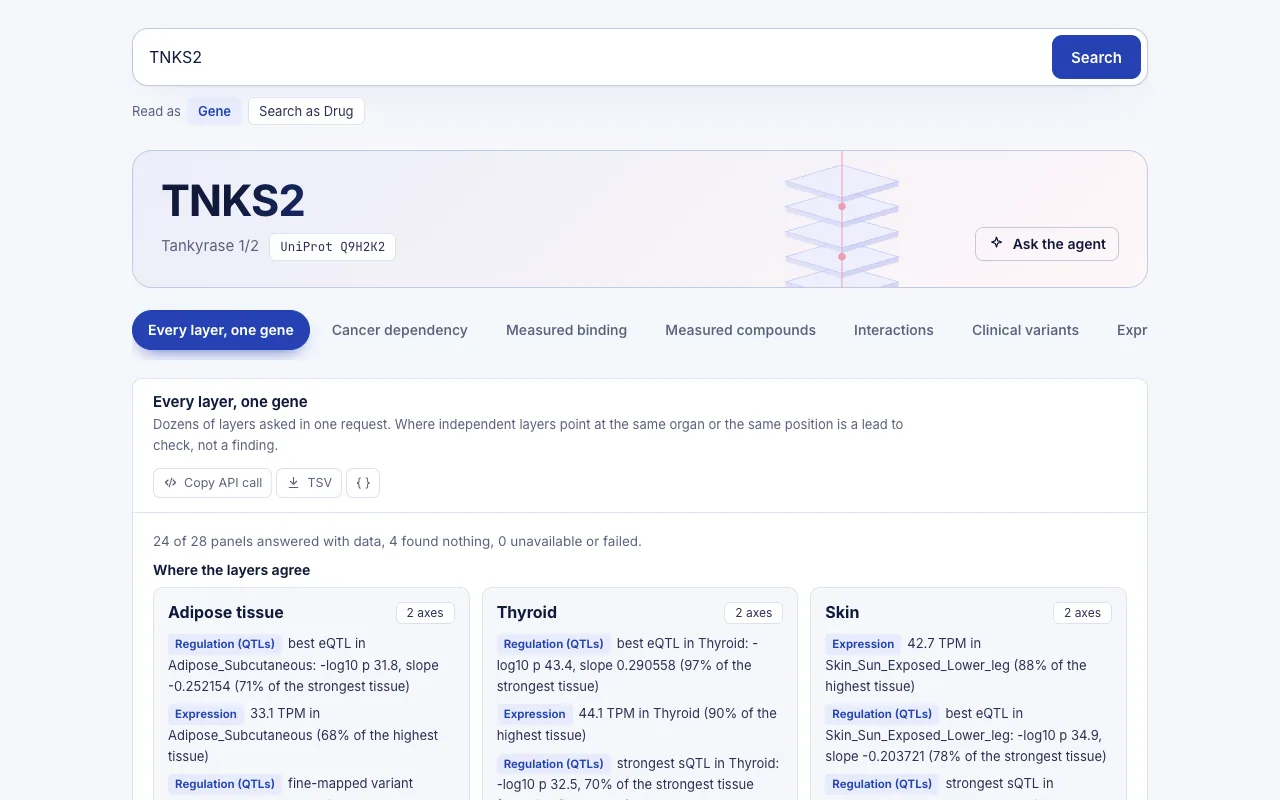
In DepMap, a TNKS2 knockout reduces viability in only 2 of 1178 cell lines (0.2 percent), and the gene is not common essential. A new Nature Chemical Biology study proposes a TNKS2-selective inhibitor for tumor-restricted WNT suppression. A pooled view like this one is therefore not the test of that idea. The data below are as of 2026-11-13.
What we asked about the new TNKS2 study
The paper's own results belong to the paper. We do not restate its abstract or judge its claims. Its central question is whether tankyrase activity in tumors that have lost TNKS1 depends on TNKS2, and whether that dependency can be targeted without suppressing WNT signaling in healthy tissue.
To place the paper in context, we asked BioQ what public data say about TNKS2 today:
- Is TNKS2 a broad dependency in cancer cell lines?
- Which drugs and compounds are already recorded against it, and with what potency?
- Which diseases and pathways does it link to?
- Which proteins does it interact with?
What BioQ returned
One query, TNKS2, drew on 7 distinct resources through 7 engine queries. The engine took 1.77 seconds in total. Each block below names its source.
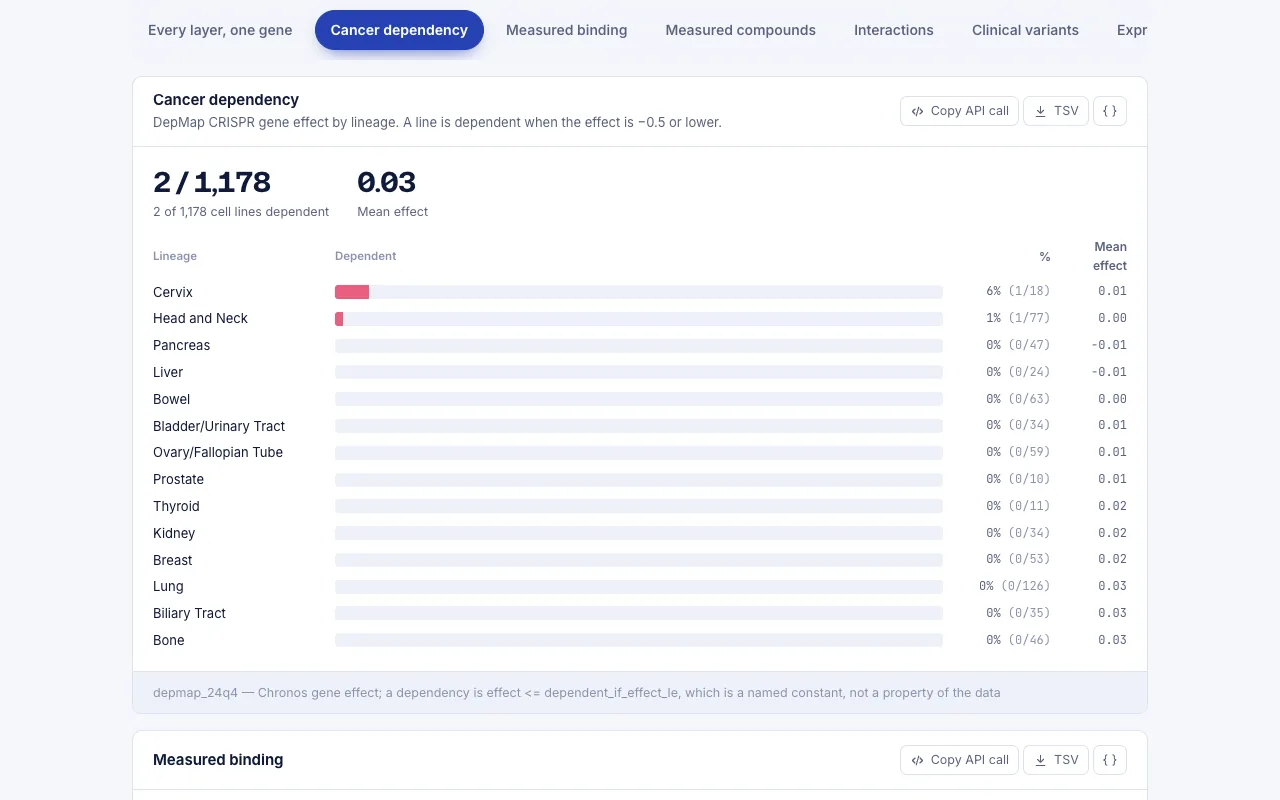
CRISPR dependency (DepMap Chronos). Across 1178 cell lines, 2 are dependent. The mean gene effect is 0.034, and a more negative Chronos value means a stronger loss of viability. The lineages with the most negative means are shown below.
| Lineage | Cell lines | Dependent | % dependent | Mean gene effect |
|---|---|---|---|---|
| Pancreas | 47 | 0 | 0 | -0.015 |
| Liver | 24 | 0 | 0 | -0.013 |
| Bowel | 63 | 0 | 0 | 0.001 |
| Head and Neck | 77 | 1 | 1.3 | 0.004 |
| Bladder/Urinary Tract | 34 | 0 | 0 | 0.006 |
| Ovary/Fallopian Tube | 59 | 0 | 0 | 0.011 |
| Prostate | 10 | 0 | 0 | 0.012 |
| Cervix | 18 | 1 | 5.6 | 0.015 |
Drugs and compounds (Open Targets, ChEMBL, Drug Repurposing Hub, ClinicalTrials.gov). BioQ lists 8 drugs for the gene. The table shows the highest exact pChEMBL value per compound where one exists. Higher values mean stronger potency.
| Drug | Max clinical stage | Mechanism | Best exact pChEMBL | Type | Trials by name |
|---|---|---|---|---|---|
| 2X-121 | PHASE_2 | Tankyrase 1/2 inhibitor | 7.3 | IC50 | 1 |
| 284028-89-3 | PHASE_1_2 | — | 8.68 | IC50 | 0 |
| C25H26N2O5 | UNKNOWN | — | 6.08 | IC50 | 0 |
| Endo-Iwr-1 | UNKNOWN | — | — | — | 0 |
| G007-Lk | UNKNOWN | — | — | — | 0 |
| Jw-74 | UNKNOWN | — | — | — | 0 |
| Nvp-Tnks656 | UNKNOWN | — | — | — | 0 |
| Wiki4 | UNKNOWN | — | — | — | 0 |
Pathways (Reactome). TNKS2 maps to 16 pathways. The most specific five are below.
| Pathway | Reactome ID | Genes in pathway |
|---|---|---|
| XAV939 stabilizes AXIN | R-HSA-5545619 | 2 |
| Signaling by WNT in cancer | R-HSA-4791275 | 34 |
| Degradation of AXIN | R-HSA-4641257 | 42 |
| Regulation of PTEN stability and activity | R-HSA-8948751 | 56 |
| PTEN Regulation | R-HSA-6807070 | 145 |
Other layers.
- STRING v12 lists 1230 interaction partners. The top scores are TERF1 at 998 and AXIN1 at 996, followed by SH3BP2 at 988, HIF1AN at 987, ARPIN at 978 and TNKS1BP1 at 971.
- Open Targets links TNKS2 to 208 diseases. The top six are blood and metabolic measurements, led by monocyte count at 0.477 and sex hormone-binding globulin measurement at 0.457. None of the six is a cancer.
- TCGA/GTEx Toil has 24 cancer types with both tumor and normal samples. The top rows differ from normal tissue only slightly, with log2 fold changes between -0.1 and 0.07.
- CIViC holds 1 record, a TNKS2::PDGFRA fusion with imatinib at evidence level C. It concerns a fusion partner and is not about tankyrase inhibition.
What it means and how to read it
The dependency is sparse in the pooled data. With 2 dependent lines out of 1178 and no common-essential flag, TNKS2 does not behave like a gene whose loss hurts most cell lines. That is compatible with a dependency that appears only in a specific genetic context. It does not show that such a context exists. The lineage table has small per-lineage counts: Head and Neck has 1 dependent line out of 77, and Cervix has 1 out of 18. Read the percentages with those denominators in mind.
The pathway and interaction data match the biology the paper addresses. Reactome places TNKS2 in "XAV939 stabilizes AXIN", "Signaling by WNT in cancer" and "Degradation of AXIN". STRING ranks AXIN1 among its top partners. These layers confirm the WNT link in curated and network resources. They say nothing about whether a selective inhibitor works.
The drug layer shows a crowded, partly non-selective field. The only compound with a stated mechanism is 2X-121, listed as a tankyrase 1/2 inhibitor at PHASE_2 with 1 trial found by name and a best exact pChEMBL of 7.3. The compound 284028-89-3 has the highest recorded value, 8.68, at PHASE_1_2. Several well-known tankyrase tool compounds, such as G007-Lk and NVP-TNKS656, appear with stage UNKNOWN and no exact pChEMBL value. These entries are recorded against the gene and do not show selectivity for TNKS2 over TNKS1. A selectivity claim needs paired TNKS1 and TNKS2 measurements, which this view does not give.
The disease associations point away from oncology. The top Open Targets associations are lipid, metabolic and blood-count traits. That is a reminder that the genetic evidence for TNKS2 is mostly not tumor evidence.
Why one query helps. Checking dependency, compounds, pathways, interactions, expression and variant evidence by hand means visiting each of these resources separately and reconciling gene names and releases. Here they sit on one page with their sources named.
How to reproduce it in BioQ
- Open BioQ and paste the query below into the search box.
- Read the DepMap panel first. Note the number of dependent lines and the lineage table.
- Open the drug panel and check the type and value of each potency entry before comparing compounds.
- Open the pathway and interaction panels to see the WNT and AXIN context.
- Note the data release shown on each block, because the numbers above are as of 2026-11-13.
TNKS2Limits: what the data do not show
- The paper's results are the paper's. BioQ has not reproduced or checked them, and this page does not judge whether the inhibitor works.
- The DepMap view is pooled across cell lines. It is not split by TNKS1 copy number or by loss of the chromosomal region that contains TNKS1, which is the context the paper is about. A conditional dependency can be invisible in a pooled summary.
- The dependency call uses a named threshold. It is a convention and not a property of the data.
- The drug table lists compounds recorded for the gene. It does not say whether any of them is TNKS2-selective, and the compound described in the paper is not identified here.
- Many compounds have no exact pChEMBL value, so the potency comparison is incomplete.
- TCGA normal sample counts are small for some cancer types, so fold changes there are weak evidence.
- Association scores, interaction scores and expression differences do not show causation or any therapeutic benefit.
- Nothing here is medical advice or guidance on treatment.
Data and method
The numbers on this page were read from the BioQ engine on 2026-11-13 (7 queries, 1.8 s of engine time in total). The tables are generated by code from the engine's answers; the text only restates them.
/civic, /depmap, /drugs, /interaction, /ot_association, /pathway, /tcga
Sources
- A selective TNKS2 inhibitor for tumor-restricted WNT suppression (2026) — doi:10.1038/s41589-026-02358-z
Run the same query yourself: TNKS2
For research use only. This page summarises public data and is not medical advice.
BioQ is an AI search engine and agent with one goal: making biology research 100X faster. Ask in the web app, over the REST API, or from Claude, ChatGPT or Cursor through MCP.
Queries used
Frequently asked questions
Is TNKS2 a common essential gene in DepMap?
No. In the DepMap Chronos data, 2 of 1178 cell lines are dependent on TNKS2 (0.2 percent), and the gene is not flagged as common essential. The mean gene effect is 0.034.
Which drugs are listed for TNKS2 in BioQ?
BioQ lists 8 drugs. 2X-121 is labelled a tankyrase 1/2 inhibitor at PHASE_2 with a best exact pChEMBL of 7.3, and 284028-89-3 has 8.68 at PHASE_1_2. The listing does not show selectivity for TNKS2 over TNKS1.
Which pathways and partners link TNKS2 to WNT signaling?
Reactome lists 16 pathways for TNKS2, including "Signaling by WNT in cancer" and "Degradation of AXIN". In STRING v12, AXIN1 scores 996 among 1230 partners.
Does Open Targets associate TNKS2 with cancer?
Among the top six of 208 associated diseases, none is a cancer. They are blood and metabolic measurements, led by monocyte count at 0.477.
Can this page confirm the paper's TNKS2 results?
No. The paper's results are the paper's. BioQ shows public data on TNKS2 as of 2026-11-13, and its DepMap view is not split by TNKS1 status.
Sources
- Paper A selective TNKS2 inhibitor for tumor-restricted WNT suppression (2026) DOI 10.1038/s41589-026-02358-z
- Dataset DepMap CRISPR Chronos gene effect (24Q4)
- Dataset Open Targets Platform; ChEMBL; Drug Repurposing Hub
- Dataset TCGA pan-cancer expression (UCSC Xena Toil recompute)
- Dataset CIViC: Clinical Interpretation of Variants in Cancer
- Dataset Reactome pathway knowledgebase
- Dataset STRING v12 protein-protein interactions
Results come from public databases as of the date shown and may change. BioQ gives research information, not medical advice.
More from the blog
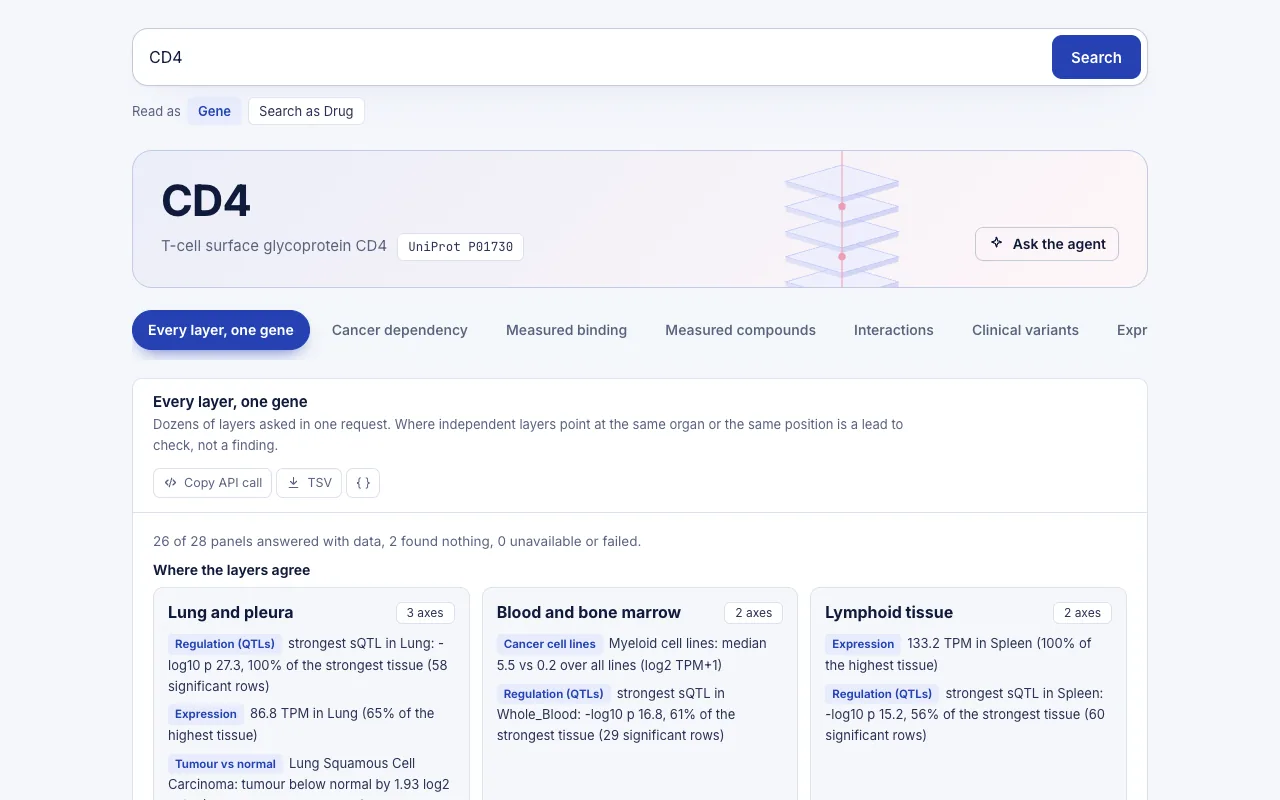
CD4 new study: CAR-NK cells and HIV rebound in context
A CD4-based CAR-NK paper on HIV rebound, placed in context with BioQ data on CD4: DepMap dependency, Open Targets diseases, drugs and Reactome pathways.
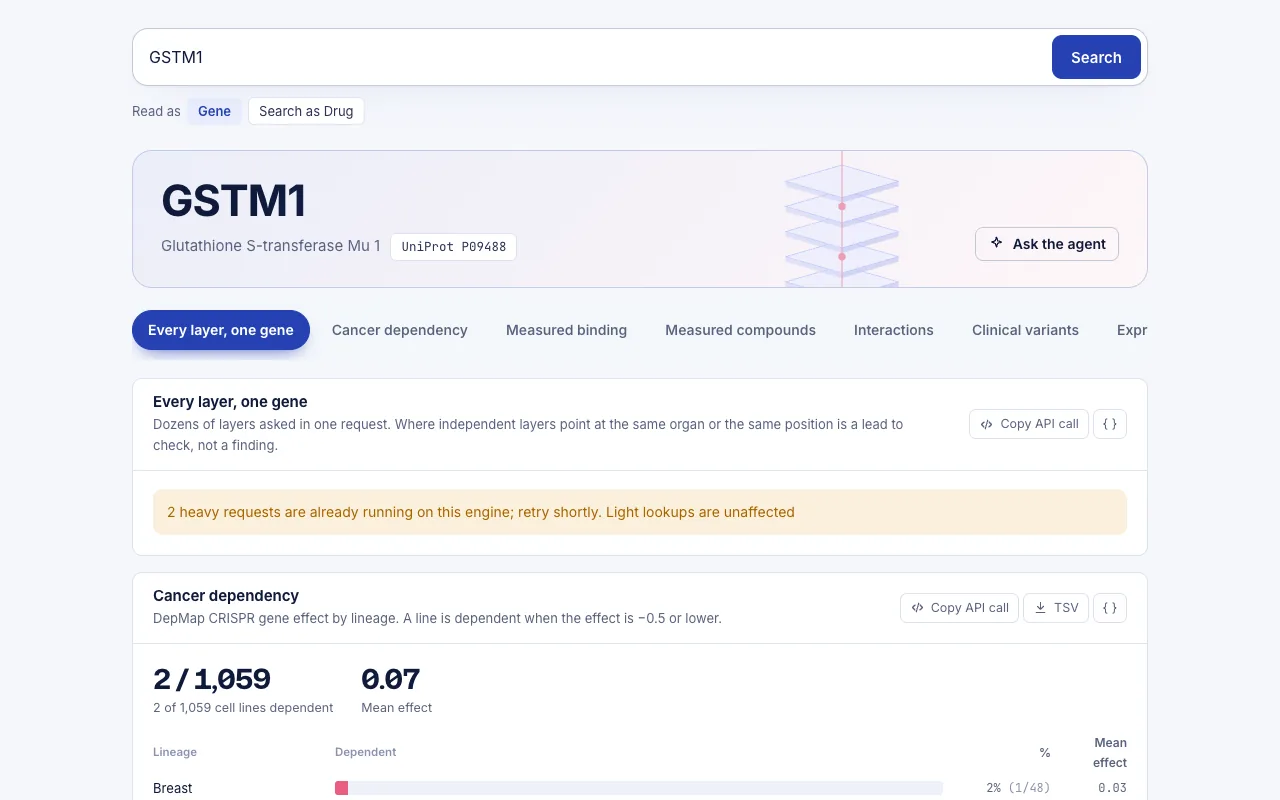
GSTM1 new study: cisplatin kidney injury in context
A 2026 paper links GSTM1 loss to worse cisplatin kidney injury; BioQ shows what DepMap, Open Targets, ChEMBL, Reactome and STRING say about GSTM1 today.
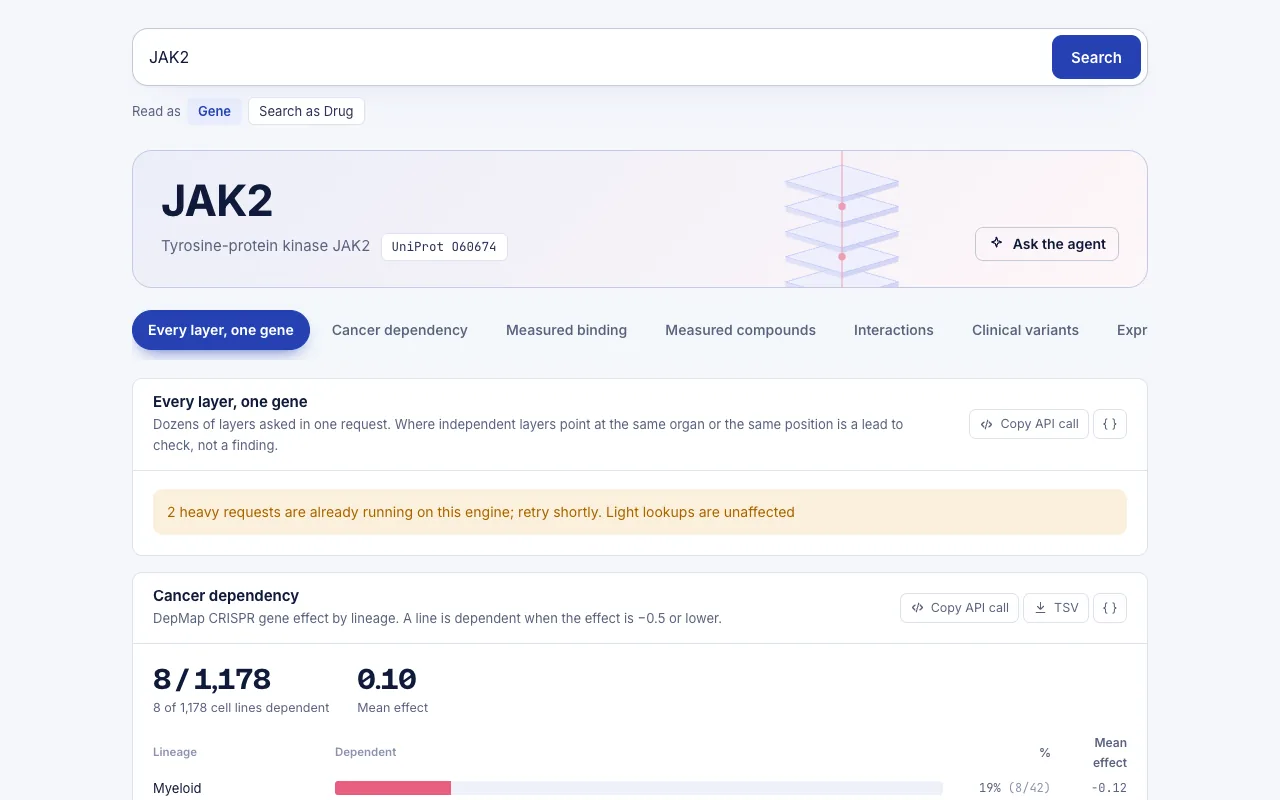
JAK2 vs TYK2: dependency and drugs side by side
JAK2 vs TYK2 in DepMap and drug databases: 8 of 1178 cell lines are dependent on JAK2, 11 on TYK2; 47 drugs are known for JAK2 and 20 for TYK2.