

TNKS new study: what BioQ data show today
A 2026 eLife paper on a TNKS PROTAC in colorectal cancer, placed in context with DepMap, ChEMBL, Open Targets, Reactome and STRING data as of 2026-11-12.
Data as of November 12, 2026 · By the BioQ team
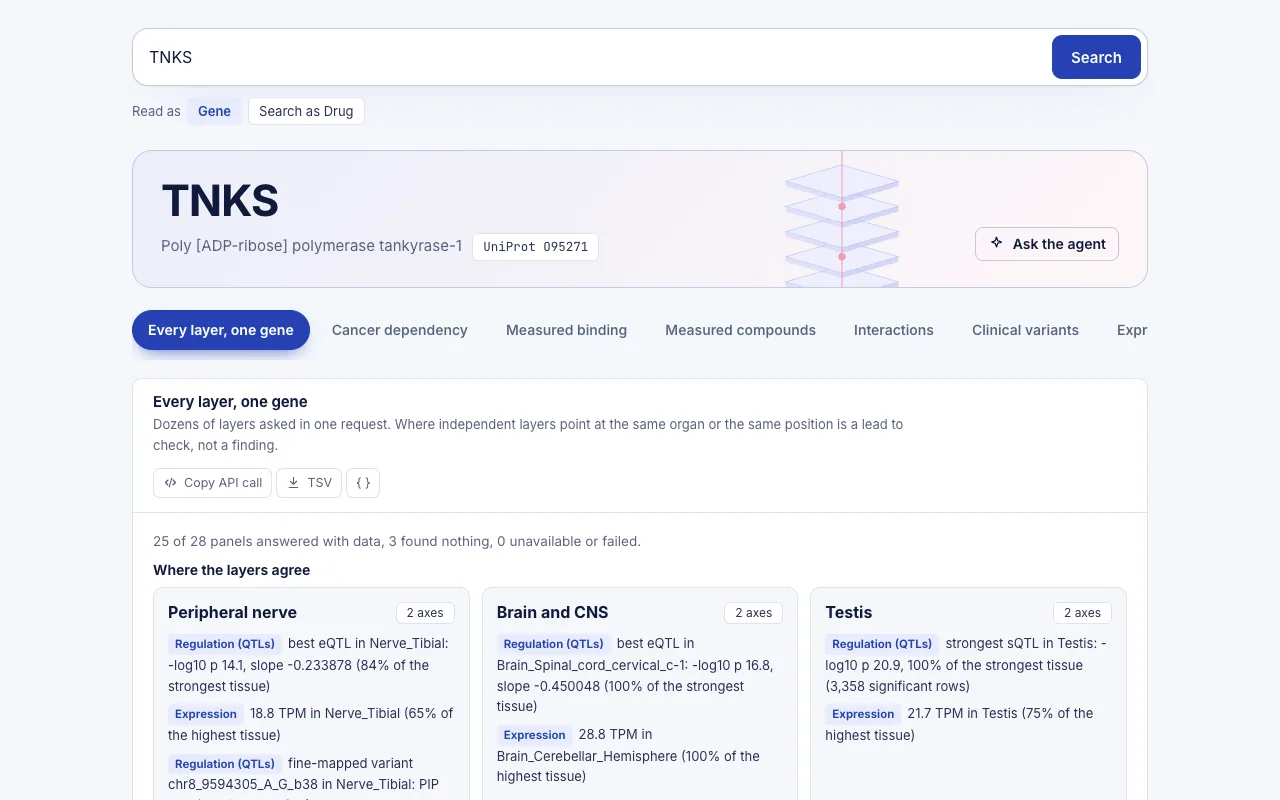
A 2026 eLife paper argues that degrading tankyrase (TNKS) with a PROTAC works differently from blocking its catalytic activity in colorectal cancer. As of 2026-11-12, BioQ's data show TNKS is not a common-essential gene: 15 of 1178 DepMap cell lines (1.3%) depend on it, with a mean Chronos gene effect of -0.07. The AXIN1 interaction and the Reactome WNT annotations are strongly supported.
What we asked
This post is a paper watch. The paper's results, mechanism and conclusions belong to its authors. BioQ did not reproduce them, and nothing below tests them. We only ask what public data layers say about TNKS today, so you can place the paper in context in one minute.
The paper touches a long-standing problem in WNT/β-catenin biology. Catalytic TNKS inhibitors stabilise AXIN, a core part of the β-catenin destruction complex, yet they have performed unevenly in colorectal cancer models. The authors propose that TNKS also acts as a scaffold, and that a degrader removes the protein where an inhibitor leaves it in place. They test this in cells with dysfunctional APC mutations.
Our questions were practical ones for anyone reading the paper:
- Is TNKS a broad dependency in CRISPR screens?
- Which TNKS-directed compounds are on record, and with what potency?
- Which diseases and pathways does TNKS connect to?
- Which proteins does it sit next to?
What BioQ returned for TNKS around the new study
One query, TNKS, ran 7 engine queries across 6 distinct resources. The measured engine time was 1.0 seconds in total. The tables below are the parts most relevant to the paper.
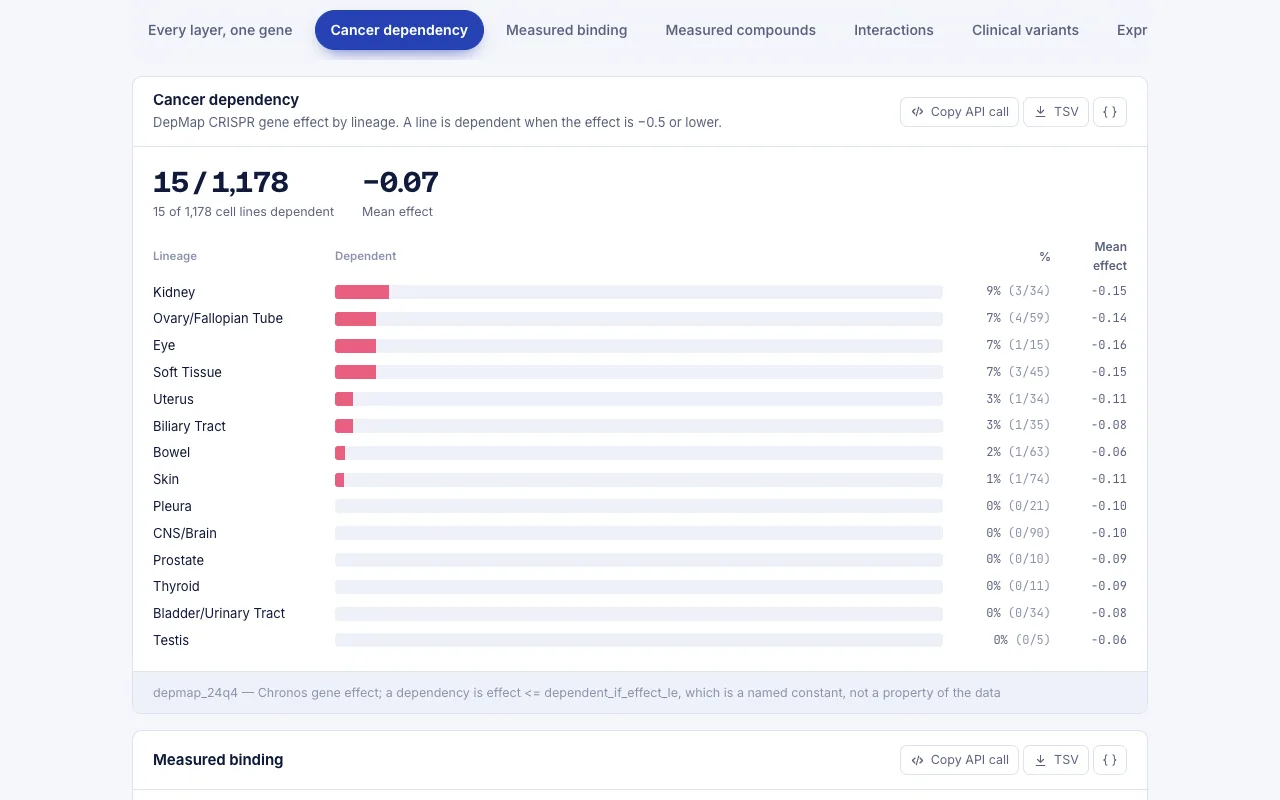
CRISPR dependency (DepMap Chronos, release depmap_24q4). Of 1178 cell lines, 15 count as dependent and 1.3% is the dependent share. The mean gene effect is -0.07, and TNKS is flagged as not common-essential. A more negative Chronos value means the knockout reduced viability more. The dependency cut-off is a named constant in the release, not a property of the biology.
| Lineage | Cell lines | Dependent | % dependent | Mean gene effect |
|---|---|---|---|---|
| Eye | 15 | 1 | 6.7 | -0.162 |
| Soft Tissue | 45 | 3 | 6.7 | -0.147 |
| Kidney | 34 | 3 | 8.8 | -0.145 |
| Ovary/Fallopian Tube | 59 | 4 | 6.8 | -0.143 |
| Uterus | 34 | 1 | 2.9 | -0.109 |
| Skin | 74 | 1 | 1.4 | -0.106 |
| Pleura | 21 | 0 | 0 | -0.104 |
| CNS/Brain | 90 | 0 | 0 | -0.1 |
Compounds on record (Open Targets, ChEMBL, Drug Repurposing Hub, ClinicalTrials.gov). Eight drugs are linked to TNKS. Only some have an exact potency value, given as pChEMBL (the negative log10 of the molar potency, so higher means stronger).
| Drug | Max clinical stage | Mechanism | Best exact pChEMBL | Type | Trials by name |
|---|---|---|---|---|---|
| 2X-121 | PHASE_2 | Tankyrase 1/2 inhibitor | 7.3 | IC50 | 1 |
| 284028-89-3 | PHASE_1_2 | — | 9 | IC50 | 0 |
| C25H26N2O5 | UNKNOWN | — | 5.91 | IC50 | 0 |
| Endo-Iwr-1 | UNKNOWN | — | — | — | 0 |
| Exo-Iwr-1 | UNKNOWN | — | — | — | 0 |
| G007-Lk | UNKNOWN | — | — | — | 0 |
| Jw-74 | UNKNOWN | — | — | — | 0 |
| Mn-64 | UNKNOWN | — | — | — | 0 |
Interaction partners (STRING v12). TNKS has 1215 partners in total. The top six by combined score are below, and AXIN1 is among them, which is the link the paper builds on.
| Partner | UniProt | STRING combined score |
|---|---|---|
| TERF1 | P54274 | 999 |
| AXIN1 | O15169 | 998 |
| RNF146 | Q9NTX7 | 992 |
| TNKS1BP1 | Q9C0C2 | 991 |
| TINF2 | Q9BSI4 | 983 |
| AXIN2 | Q9Y2T1 | 955 |
Three further results are worth noting without a table:
- Pathways: Reactome lists 16 pathways for TNKS. The most specific is "XAV939 stabilizes AXIN" (R-HSA-5545619, 2 genes). The list also includes "Signaling by WNT in cancer" (R-HSA-4791275, 34 genes) and "Degradation of AXIN" (R-HSA-4641257, 42 genes).
- Disease association: Open Targets lists 990 diseases for TNKS. The six highest-scoring entries are measurement traits, such as phospholipids:total lipids ratio (score 0.542, 73 evidence items) and cholesteryl ester measurement (0.508, 91 items). Blood pressure traits follow. Colorectal cancer is not among those six.
- Expression: TCGA and GTEx data cover 24 cancer types with both tumour and normal samples. The largest log2 fold among the top six is 0.13 (Pheochromocytoma & Paraganglioma, 177 tumours, 3 normals), and breast invasive carcinoma shows -0.06. These differences are small.
What it means and how to read it
The AXIN1 and AXIN2 rows in STRING (scores 998 and 955) and the Reactome entries on AXIN degradation fit the biology the paper discusses. They are annotations of the established TNKS–AXIN link, not evidence for the paper's scaffolding model.
The DepMap result needs careful reading. A low pan-cancer dependency rate (1.3%) says TNKS knockout rarely reduces viability across the whole panel. It does not say TNKS is irrelevant in APC-mutant colorectal cancer. The eight lineages shown are those with the most negative mean effect, and none of them is a colorectal lineage. The table therefore cannot place colorectal lines relative to the others. It also helps to remember that a CRISPR knockout removes the whole protein, so it combines both catalytic and scaffolding roles. That is closer to the idea of degradation than to catalytic inhibition, but the data here cannot separate the two.
The compound table shows how thin the potency record is. 2X-121 is listed as a tankyrase 1/2 inhibitor at PHASE_2 with an exact IC50-based pChEMBL of 7.3 and 1 trial found by name. The entry 284028-89-3 is at PHASE_1_2 with a pChEMBL of 9.0, and C25H26N2O5 has 5.91. G007-Lk, Jw-74, Mn-64, Endo-Iwr-1 and Exo-Iwr-1 appear with no exact value and an UNKNOWN stage. The table lists no degrader, which is consistent with a PROTAC being a new approach, though absence from these sources is not proof of absence elsewhere.
The Open Targets list leans toward lipid and blood pressure traits. Those associations typically come from genetic association evidence, so they say little about tumour biology.
How to reproduce it in BioQ
- Open BioQ and enter the gene symbol as the query, exactly as below.
- Run it and wait for the answer. Each block names its source and release.
- Read the DepMap block first, then the drugs, interaction and pathway blocks.
- Compare the lineage rows with the cell models used in the paper you are reading.
TNKS- Note the data date in the answer, since the underlying releases change.
Compared with the manual route, the six resources here would otherwise mean six separate searches and exports. BioQ returned them together in 1.0 seconds of engine time.
Limits: what the data do not show
- The paper's experiments, including AXIN puncta, destruction complex behaviour and PROTAC activity, are not in these data layers. Nothing here confirms or contradicts them.
- DepMap reports knockout effects in a cell line panel. It does not model a degrader, and the lineage table does not show colorectal lines.
- The 1.3% dependency share depends on the threshold chosen by the release.
- Exact pChEMBL values exist for only 3 of the 8 listed compounds. Stage labels such as UNKNOWN mean the sources do not record a stage, not that a compound is inactive.
- The query covers TNKS only. It does not report on related proteins or other WNT pathway components beyond the interaction partners shown.
- STRING scores reflect combined evidence of association, not proof of direct binding in any given tissue.
- Nothing here is guidance on treatment.
Data and method
The numbers on this page were read from the BioQ engine on 2026-11-12 (7 queries, 1.0 s of engine time in total). The tables are generated by code from the engine's answers; the text only restates them.
/depmap, /drugs, /interaction, /ot_association, /pathway, /tcga
Sources
- Targeting tankyrase scaffolding in the β-catenin destruction complex by PROTAC overcomes the limitation of catalytic inhibitors in colorectal cancer (2026) — doi:10.7554/elife.109052.4
Run the same query yourself: TNKS
For research use only. This page summarises public data and is not medical advice.
BioQ is an AI search engine and agent with one goal: making biology research 100X faster. Ask in the web app, over the REST API, or from Claude, ChatGPT or Cursor through MCP.
Queries used
Frequently asked questions
Is TNKS a common-essential gene in DepMap?
No. In the depmap_24q4 release, 15 of 1178 cell lines (1.3%) are dependent on TNKS, the mean Chronos gene effect is -0.07, and TNKS is not flagged as common-essential.
Which TNKS inhibitors does BioQ list, and with what potency?
BioQ lists 8 drugs. 2X-121 is at PHASE_2 with an exact pChEMBL of 7.3 (IC50), 284028-89-3 has 9.0 and C25H26N2O5 has 5.91. The rest, including G007-Lk, have no exact value on record.
Does TNKS interact with AXIN1 in STRING?
Yes. AXIN1 has a STRING combined score of 998 and AXIN2 has 955, out of 1215 partners in total. The top partner is TERF1 at 999.
Is colorectal cancer a top Open Targets disease for TNKS?
Not among the six shown. Open Targets lists 990 diseases for TNKS, and the highest-scoring entries are lipid and blood pressure measurement traits, led by phospholipids:total lipids ratio at 0.542.
Does BioQ confirm the paper's PROTAC results?
No. The paper's results belong to its authors. BioQ only shows what public data layers say about TNKS as of 2026-11-12, and it lists no TNKS degrader among the 8 compounds.
Sources
- Paper Targeting tankyrase scaffolding in the β-catenin destruction complex by PROTAC overcomes the limitation of catalytic inhibitors in colorectal cancer (2026) DOI 10.7554/elife.109052.4
- Dataset DepMap CRISPR Chronos gene effect (24Q4)
- Dataset Open Targets Platform; ChEMBL; Drug Repurposing Hub
- Dataset TCGA pan-cancer expression (UCSC Xena Toil recompute)
- Dataset Reactome pathway knowledgebase
- Dataset STRING v12 protein-protein interactions
Results come from public databases as of the date shown and may change. BioQ gives research information, not medical advice.
More from the blog
CD4 new study: CAR-NK cells and HIV rebound in context
A CD4-based CAR-NK paper on HIV rebound, placed in context with BioQ data on CD4: DepMap dependency, Open Targets diseases, drugs and Reactome pathways.
GSTM1 new study: cisplatin kidney injury in context
A 2026 paper links GSTM1 loss to worse cisplatin kidney injury; BioQ shows what DepMap, Open Targets, ChEMBL, Reactome and STRING say about GSTM1 today.
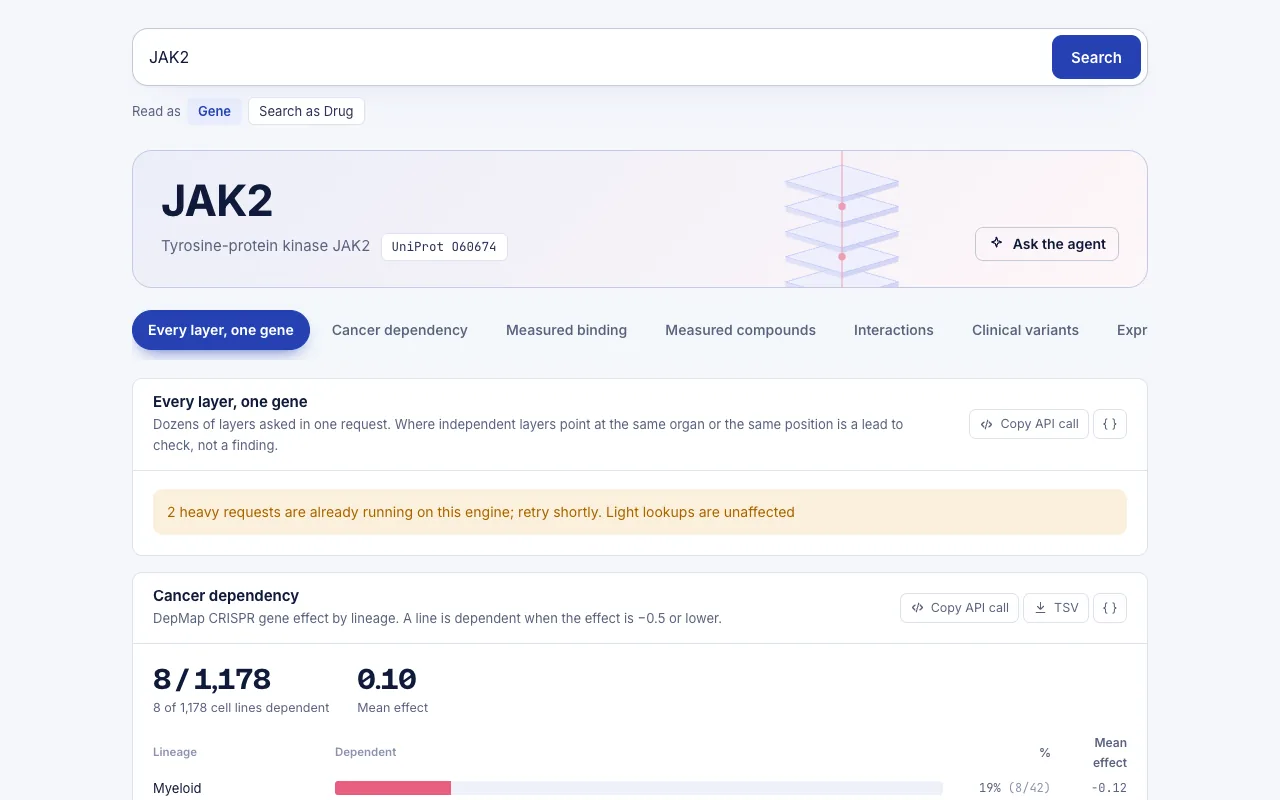
JAK2 vs TYK2: dependency and drugs side by side
JAK2 vs TYK2 in DepMap and drug databases: 8 of 1178 cell lines are dependent on JAK2, 11 on TYK2; 47 drugs are known for JAK2 and 20 for TYK2.