

Semaglutide Cannabis Use Disorder trial NCT07879612
NCT07879612 tests semaglutide in Cannabis Use Disorder; BioQ pulls GLP1R potency from ChEMBL and 349 semaglutide trials from ClinicalTrials.gov.
Data as of November 6, 2026 · By the BioQ team
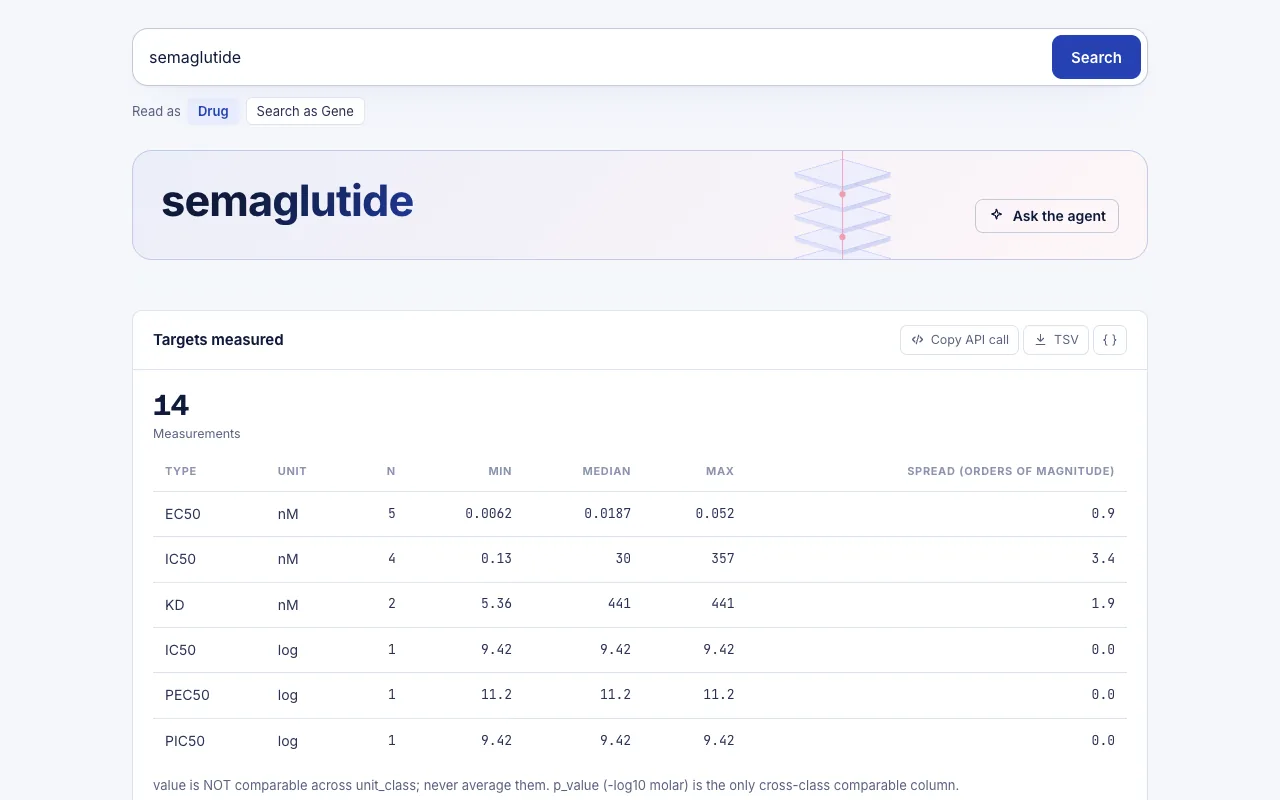
NCT07879612 is a PHASE2 semaglutide trial in Cannabis Use Disorder, sponsored by Massachusetts General Hospital. In ChEMBL, semaglutide has one measured target, GLP1R, with a best pChEMBL of 11.21 (EC50) from 11 exact measurements. ClinicalTrials.gov lists 349 semaglutide studies, 68 of them PHASE2. All data are as of 2026-11-06.
What we asked about the semaglutide trial in Cannabis Use Disorder
The registry entry is titled "Semaglutide for the Treatment of Cannabis Use Disorder". It is a PHASE2 study from Massachusetts General Hospital, and its listed conditions are Cannabis Use Disorder and Cue-reactivity. The start date is later than the snapshot date of this article, so there are no results to read yet.
A new registration raises three practical questions for a researcher:
- What is the intervention, and which molecular target has it been measured against?
- How strong is that measured activity, and how many independent measurements stand behind it?
- Where does this study sit among the other registered semaglutide trials?
We ran a single query, semaglutide, and let BioQ split it across the relevant data layers.
What BioQ returned
The potency block comes from ChEMBL. It resolves semaglutide to the ChEMBL compound CHEMBL2108724 and returns one target. The pChEMBL value is the negative log10 of the molar potency, so a higher number means a lower concentration for the effect.
| ChEMBL target | Gene | Best pChEMBL | Type | Exact measurements |
|---|---|---|---|---|
| CHEMBL1784 | GLP1R | 11.21 | EC50 | 11 |
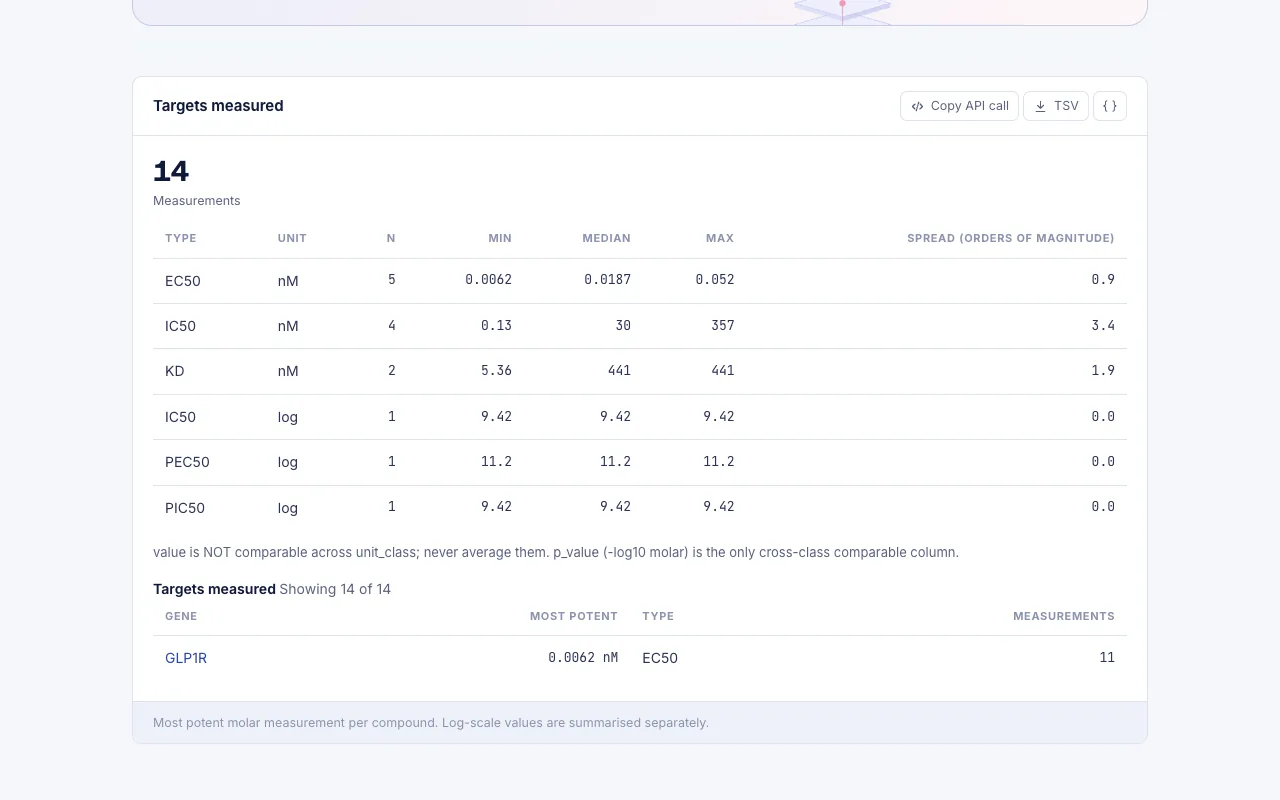
GLP1R (ChEMBL target CHEMBL1784) is the only target with data, and its 11 measurements are all exact values rather than censored ones. The best value, 11.21, is an EC50, which is a functional potency readout.
The trials block comes from ClinicalTrials.gov and searches by intervention. Across all matched studies the phase counts are 73 in PHASE1, 68 in PHASE2 and 108 in PHASE3. The table below is only one page of six rows from a total of 349 studies.
| Trial | Phase | Status | Sponsor | Start | Enrollment |
|---|---|---|---|---|---|
| NCT02243098 | PHASE1 | COMPLETED | Novo Nordisk A/S | 2014-09 | 31 |
| NCT01572753 | PHASE1 | COMPLETED | Novo Nordisk A/S | 2012-04 | 161 |
| NCT02249871 | PHASE1 | COMPLETED | Novo Nordisk A/S | 2014-09 | 54 |
| NCT07769047 | PHASE4 | NOT_YET_RECRUITING | Mayo Clinic | 2026-09 | 50 |
| NCT06639464 | PHASE2 | RECRUITING | Brigham and Women's Hospital | 2025-06 | 46 |
| NCT04261933 | — | COMPLETED | Novo Nordisk A/S | 2020-02 | 789 |
The compound block resolves semaglutide in PubChem to CID 56843331, with the InChIKey DLSWIYLPEUIQAV-CCUURXOWSA-N and 22 synonyms. The identifiers are useful for matching the drug across databases when trial records use different names.
What it means and how to read it
The ChEMBL data say that semaglutide has been measured with high potency at GLP1R, and that this is the only target in the database for it. That gives the trial a defined pharmacological starting point. A pChEMBL of 11.21 is a statement about receptor activity in the assays behind those 11 measurements. It does not say how the drug acts on substance use.
The trial table shows the breadth of the semaglutide record. The six rows on this page include completed PHASE1 studies from Novo Nordisk A/S, a PHASE4 study from Mayo Clinic with 50 planned participants that is not yet recruiting, and a recruiting PHASE2 study from Brigham and Women's Hospital with 46 participants. The page shows sponsor, phase, status and enrollment, but not the conditions studied. Do not infer from it that the other rows address substance use.
A PHASE2 study sits among 68 PHASE2 semaglutide studies in the snapshot. Each of those has its own question and design, so the count says how common the phase is, not how similar the studies are.
The angle on dependency in cancer models does not apply here. GLP1R was not queried against DepMap or other cancer datasets, since the trial concerns a behavioral and substance use condition.
How the query was answered:
- The three blocks draw on 3 distinct resources: ChEMBL, ClinicalTrials.gov and PubChem.
- The engine ran 3 queries in 0.27 seconds in total.
- Doing this by hand means opening each resource, resolving the drug name, and matching identifiers across them. BioQ does the resolution and returns each block with its source named.
How to reproduce it in BioQ
- Open BioQ and enter the drug name as the query, exactly as below.
- Read the target block first. Check the ChEMBL target, the best pChEMBL, the assay type and the number of exact measurements.
- Open the trial block and review the phase counts. Page through the studies and open the registry entry for any study of interest.
- Check the compound identity block if you need to map the drug to other databases.
semaglutide- To follow the new study, look for NCT07879612 in the trial list and compare its status and enrollment on later visits.
Limits: what the data do not show
- The trial has no reported results in this snapshot, so nothing here tells us whether semaglutide changes cannabis use or cue-reactivity.
- ChEMBL records potency in assays, mostly with cells or receptors. It cannot show effects in people, and it says nothing about the brain regions or circuits relevant to Cannabis Use Disorder.
- The single target, GLP1R, reflects what has been measured and deposited. It is not proof that no other targets exist.
- The trial table is a page of six rows from 349 studies. Its ordering is not a ranking, and the conditions of each study are not shown.
- Phase counts describe registrations, not evidence quality. Enrollment is a planned or reported figure and may change.
- Nothing here is medical, dosing or treatment advice.
Data and method
The numbers on this page were read from the BioQ engine on 2026-11-06 (3 queries, 0.3 s of engine time in total). The tables are generated by code from the engine's answers; the text only restates them.
/chembl_potency, /clinicaltrials, /compound
Sources
- Semaglutide for the Treatment of Cannabis Use Disorder (2027) — https://clinicaltrials.gov/study/NCT07879612
Run the same query yourself: semaglutide
For research use only. This page summarises public data and is not medical advice.
BioQ is an AI search engine and agent with one goal: making biology research 100X faster. Ask in the web app, over the REST API, or from Claude, ChatGPT or Cursor through MCP.
Queries used
Frequently asked questions
What is NCT07879612?
It is a PHASE2 trial titled "Semaglutide for the Treatment of Cannabis Use Disorder", sponsored by Massachusetts General Hospital. Its listed conditions are Cannabis Use Disorder and Cue-reactivity.
What is the measured target of semaglutide in ChEMBL?
ChEMBL lists one target for semaglutide, GLP1R (CHEMBL1784). The best pChEMBL is 11.21, an EC50 value, from 11 exact measurements.
How many semaglutide trials are registered on ClinicalTrials.gov?
The snapshot matches 349 studies with semaglutide as an intervention. Of these, 73 are PHASE1, 68 are PHASE2 and 108 are PHASE3.
Does the data show that semaglutide works for Cannabis Use Disorder?
No. The trial has no results in this snapshot, and the potency data describe receptor activity in assays, not clinical outcomes.
How long did the BioQ query take?
The engine ran 3 queries across 3 distinct resources in 0.27 seconds in total.
Sources
- Trial Semaglutide for the Treatment of Cannabis Use Disorder (2027)
- Dataset ClinicalTrials.gov
- Dataset PubChem
Results come from public databases as of the date shown and may change. BioQ gives research information, not medical advice.
More from the blog
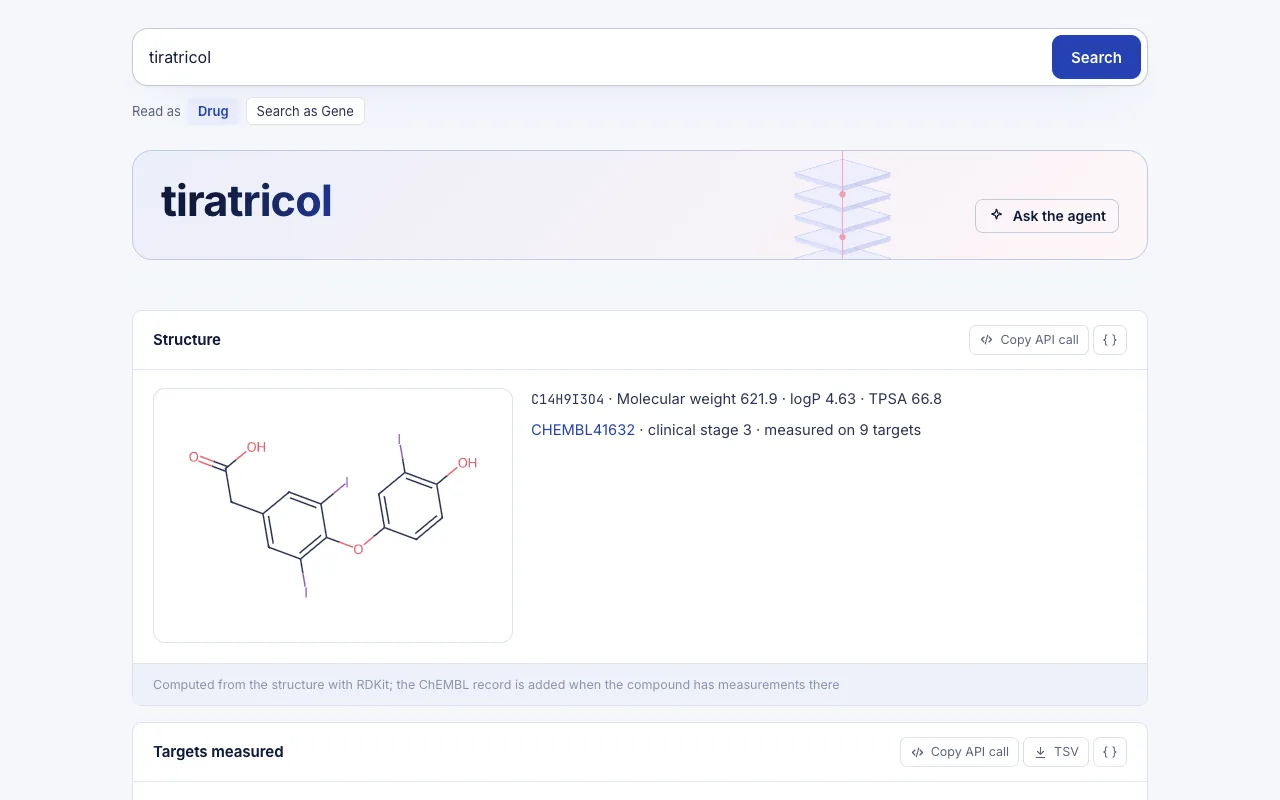
Tiratricol FDA approval: targets and potency in BioQ
Tiratricol FDA approval (Emcitate): ChEMBL shows 68 targets, THRB and THRA top by pChEMBL, and 3 registered trials on ClinicalTrials.gov, as of 2026-11-17.
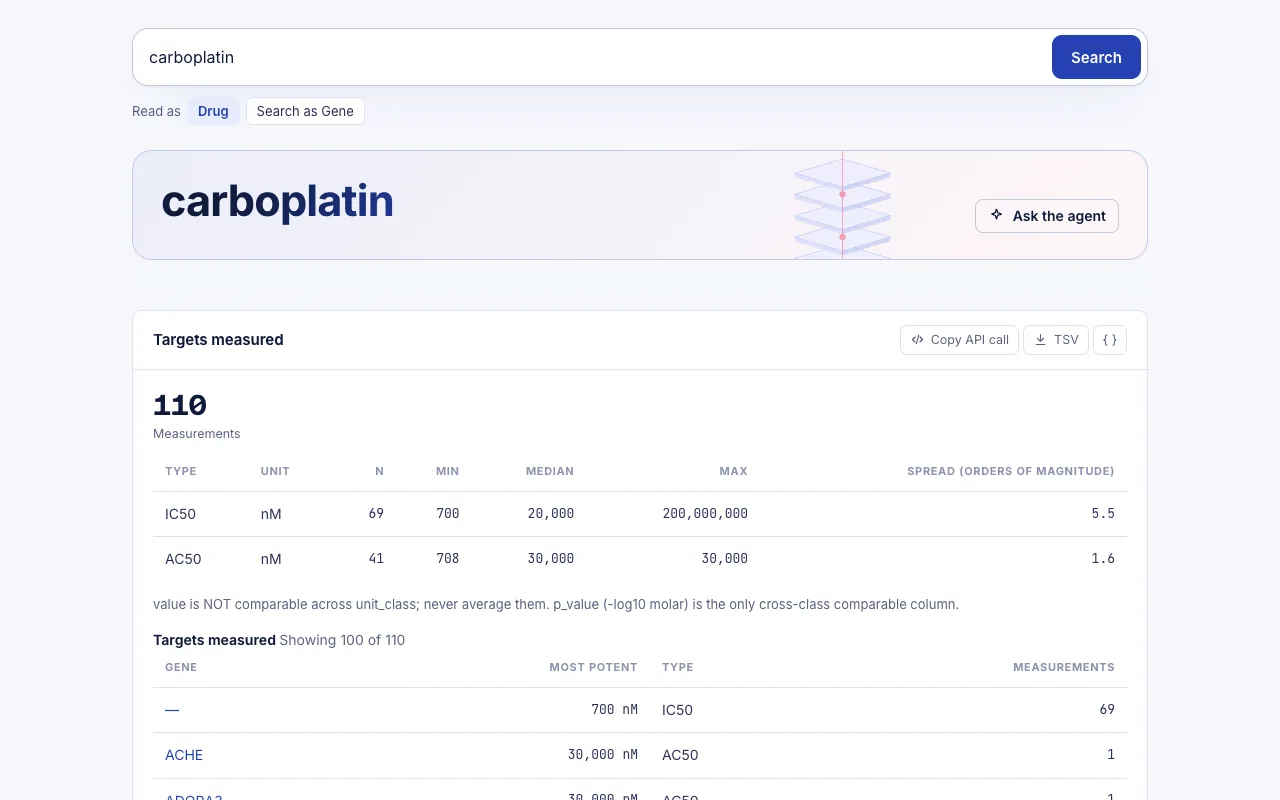
Carboplatin Non-Small Cell Lung Cancer trial: NCT07877584
NCT07877584 is a phase 3 NSCLC trial of PD-1 blockade with or without chemotherapy; BioQ adds carboplatin ChEMBL potency and ClinicalTrials.gov context.
Semaglutide new study: what BioQ data show
A new FAERS paper on semaglutide and panic attacks, set against ChEMBL potency, ClinicalTrials.gov registrations and PubChem identity as of 2026-11-15.