

Carboplatin Non-Small Cell Lung Cancer trial: NCT07877584
NCT07877584 is a phase 3 NSCLC trial of PD-1 blockade with or without chemotherapy; BioQ adds carboplatin ChEMBL potency and ClinicalTrials.gov context.
Data as of November 15, 2026 · By the BioQ team
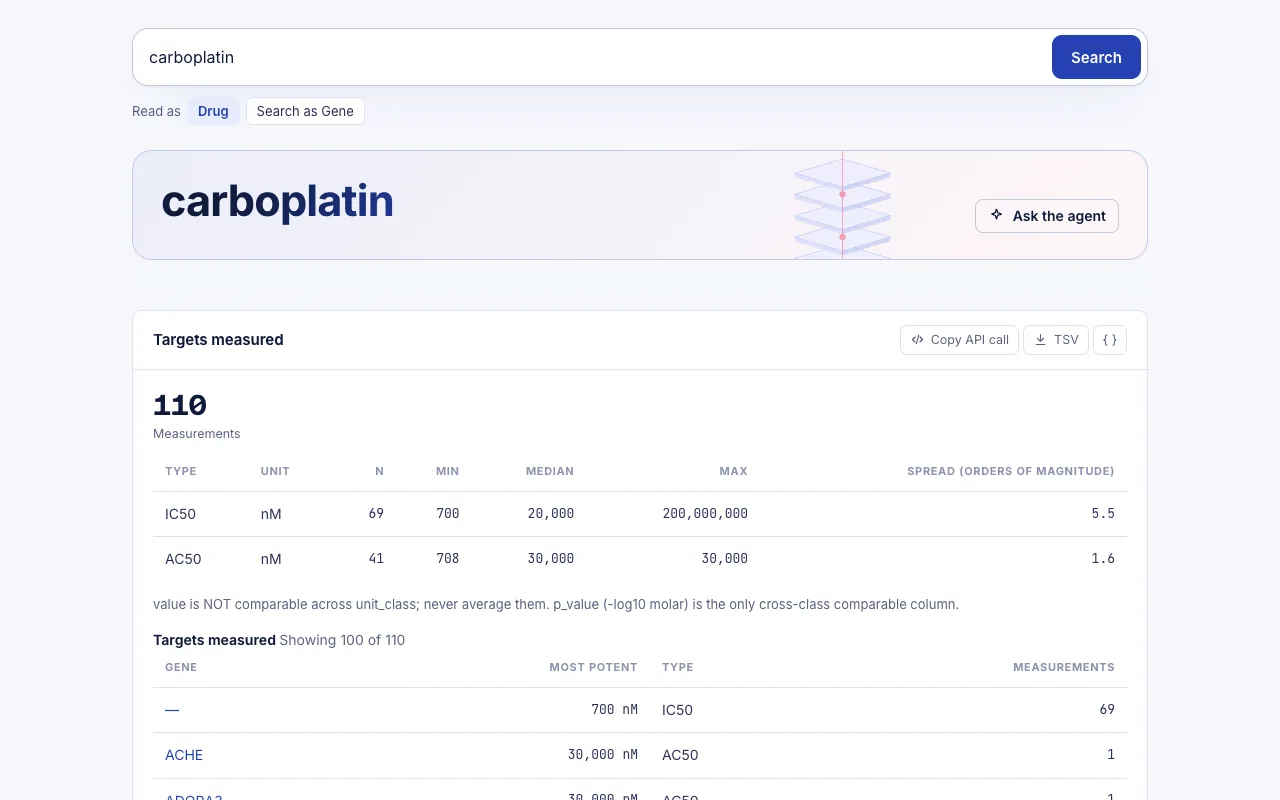
NCT07877584 is a new phase 3 trial in advanced Non-Small Cell Lung Cancer that compares PD-1 blockade alone with PD-1 blockade plus chemotherapy. For carboplatin, ChEMBL lists 52 targets, 23 of them with exact measurements, and ClinicalTrials.gov matches 2353 registered studies. The data are as of 2026-11-15.
What we asked
The trial, sponsored by the German Cancer Research Center, is registered as phase 3 with a start date after the data date above. Its title says it tests PD-1 blockade alone against PD-1 blockade combined with chemotherapy, as initial therapy in females with advanced NSCLC and high PD-L1 expression. Carboplatin is the chemotherapy drug this article follows.
Three questions guided the lookup:
- What is carboplatin as a compound, and which identifiers does it carry?
- What potency has been measured for it in ChEMBL, and against which targets?
- How many other carboplatin trials are registered, and in which phases?
We did not ask whether the combination works. A registration describes a plan, and no results exist yet.
Carboplatin in a Non-Small Cell Lung Cancer trial: what BioQ returned
One query, "carboplatin", ran 3 engine queries across 3 distinct resources (ChEMBL, ClinicalTrials.gov and PubChem). The measured engine time was 0.25 seconds in total.
Compound identity. PubChem gives CID 10339178 and the InChIKey OLESAACUTLOWQZ-UHFFFAOYSA-L, with 51 synonyms. The ChEMBL identifier is CHEMBL1351. This matters when you search by name, because synonym lists differ between databases.
Measured potency. ChEMBL holds 52 targets for carboplatin, and 23 of them have exact measurements. The table shows the 8 strongest by best pChEMBL (the negative log10 of the molar potency).
| ChEMBL target | Gene | Best pChEMBL | Type | Exact measurements |
|---|---|---|---|---|
| CHEMBL614187 | — | 6.16 | IC50 | 1 |
| CHEMBL386 | — | 5.74 | IC50 | 10 |
| CHEMBL3879801 | — | 5.62 | IC50 | 2 |
| CHEMBL614455 | — | 5.6 | IC50 | 6 |
| CHEMBL614206 | — | 5.56 | IC50 | 1 |
| CHEMBL383 | — | 5.54 | IC50 | 3 |
| CHEMBL612279 | — | 5.52 | IC50 | 1 |
| CHEMBL614004 | — | 5.28 | IC50 | 10 |
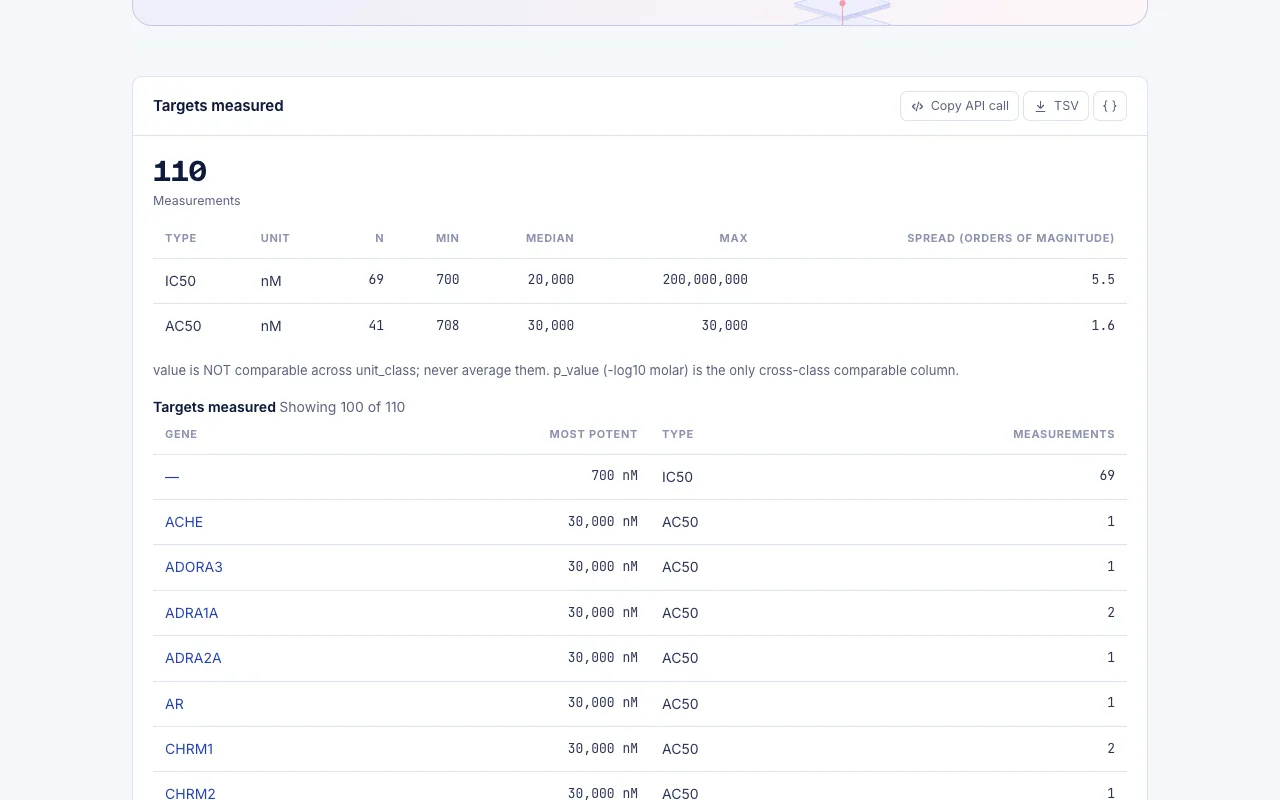
The Gene column is empty for all 8 rows. The best value is 6.16, an IC50 on CHEMBL614187 with a single exact measurement. CHEMBL386 has 10 exact measurements, with a best pChEMBL of 5.74. CHEMBL614004 also has 10 exact measurements, with a best of 5.28.
Other carboplatin trials. ClinicalTrials.gov matches 2353 studies with carboplatin as an intervention. By phase, 619 are phase 1, 1402 are phase 2 and 533 are phase 3. A study can carry more than one phase label, so do not add these counts up. The table is only a page of 6 studies and is not filtered to lung cancer.
| Trial | Phase | Status | Sponsor | Start | Enrollment |
|---|---|---|---|---|---|
| NCT07155174 | PHASE2 | RECRUITING | AbbVie | 2025-11 | 180 |
| NCT00301782 | PHASE2 | COMPLETED | Medical Research Council | 2005-06 | 88 |
| NCT03194373 | PHASE2 | COMPLETED | University of Michigan Rogel Cancer Cent | 2017-10 | 21 |
| NCT00568451 | PHASE2 | TERMINATED | Mayo Clinic | 2006-06 | 12 |
| NCT03800134 | PHASE3 | ACTIVE_NOT_RECRUITING | AstraZeneca | 2018-12 | 825 |
| NCT05751187 | PHASE2 | ACTIVE_NOT_RECRUITING | Shanghai Chest Hospital | 2023-06 | 54 |
The page includes a recruiting phase 2 study from AbbVie (NCT07155174, enrollment 180) and a phase 3 study from AstraZeneca (NCT03800134, active, not recruiting, enrollment 825).
What it means and how to read it
The potency rows describe carboplatin as a cytotoxic compound. The best pChEMBL values are modest, between 5.28 and 6.16 in the rows shown. All of these rows are IC50 values. Because no gene is assigned to any of them, they do not point to one protein target. Read them as assay-level readouts, and open the ChEMBL target record before you draw any conclusion about a specific protein.
For the trial itself, the useful reading is about design. PD-1 blockade is the common backbone of both arms, and chemotherapy is the variable. The question the registration poses is therefore whether adding chemotherapy changes outcomes in this subgroup. Carboplatin's measured potency does not answer that, because the comparison is clinical.
The count of 533 phase 3 studies shows carboplatin is a long-established comparator and backbone drug. That helps when you look for earlier trials with similar eligibility or endpoints, since you can compare how they defined the population and the outcomes.
BioQ's advantage here is practical. The manual route means opening ChEMBL for potency, ClinicalTrials.gov for registrations and PubChem for identifiers, then reconciling the names. In BioQ the same 3 layers returned in 0.25 seconds of engine time, each block labelled with its source and release.
How to reproduce it in BioQ
- Open BioQ and enter the compound name exactly as below.
carboplatin- Read the compound block and check the ChEMBL and PubChem identifiers against your own records.
- Open the targets view and sort by best pChEMBL. Note how many exact measurements back each value.
- Open the clinical trials block and filter by condition, for example Non-Small Cell Lung Cancer, and by phase, to isolate comparable studies.
- Search the trial identifier NCT07877584 to read the arms, eligibility and registered outcomes in full.
Limits: what the data do not show
- The facts here do not include the trial's arm-level drug list. They do not confirm the exact carboplatin regimen, the partner drug or the dosing, and we make no statement about them.
- No results exist for NCT07877584. The data say nothing about outcomes, adverse events or survival.
- The ChEMBL rows carry no gene assignment, so they say nothing on mechanism or on dependency of a particular target in cancer models. We did not run a dependency analysis for this article.
- Best pChEMBL is a single value per target. Rows with 1 exact measurement are weaker evidence than rows with 10.
- The trials table is a page of 6 out of 2353 studies and is not specific to lung cancer.
- Registry entries change. Check the record again before relying on the start date or the status.
Data and method
The numbers on this page were read from the BioQ engine on 2026-11-15 (3 queries, 0.2 s of engine time in total). The tables are generated by code from the engine's answers; the text only restates them.
/chembl_potency, /clinicaltrials, /compound
Sources
- PD-1 Blockade Alone Versus in Combination With Chemotherapy as First Line Therapy in Females With Advanced NSCLC & PD-L1 Expression ≥50% (2026) — https://clinicaltrials.gov/study/NCT07877584
Run the same query yourself: carboplatin
For research use only. This page summarises public data and is not medical advice.
BioQ is an AI search engine and agent with one goal: making biology research 100X faster. Ask in the web app, over the REST API, or from Claude, ChatGPT or Cursor through MCP.
Queries used
Frequently asked questions
What does trial NCT07877584 test?
It is a phase 3 trial in advanced Non-Small Cell Lung Cancer that compares PD-1 blockade alone with PD-1 blockade plus chemotherapy as initial therapy. It is sponsored by the German Cancer Research Center and has no results yet.
How many carboplatin trials are registered on ClinicalTrials.gov?
The snapshot matches 2353 studies with carboplatin as an intervention: 619 labelled phase 1, 1402 phase 2 and 533 phase 3. A study can carry more than one phase label.
What is the measured potency of carboplatin in ChEMBL?
ChEMBL lists 52 targets for carboplatin (CHEMBL1351), and 23 have exact measurements. The best pChEMBL among the top 8 rows is 6.16, an IC50 on CHEMBL614187 with 1 exact measurement.
Does BioQ show which gene carboplatin acts on?
Not in this result. The Gene column is empty for all 8 strongest ChEMBL rows, so the data do not assign a single protein target.
Sources
Results come from public databases as of the date shown and may change. BioQ gives research information, not medical advice.
More from the blog
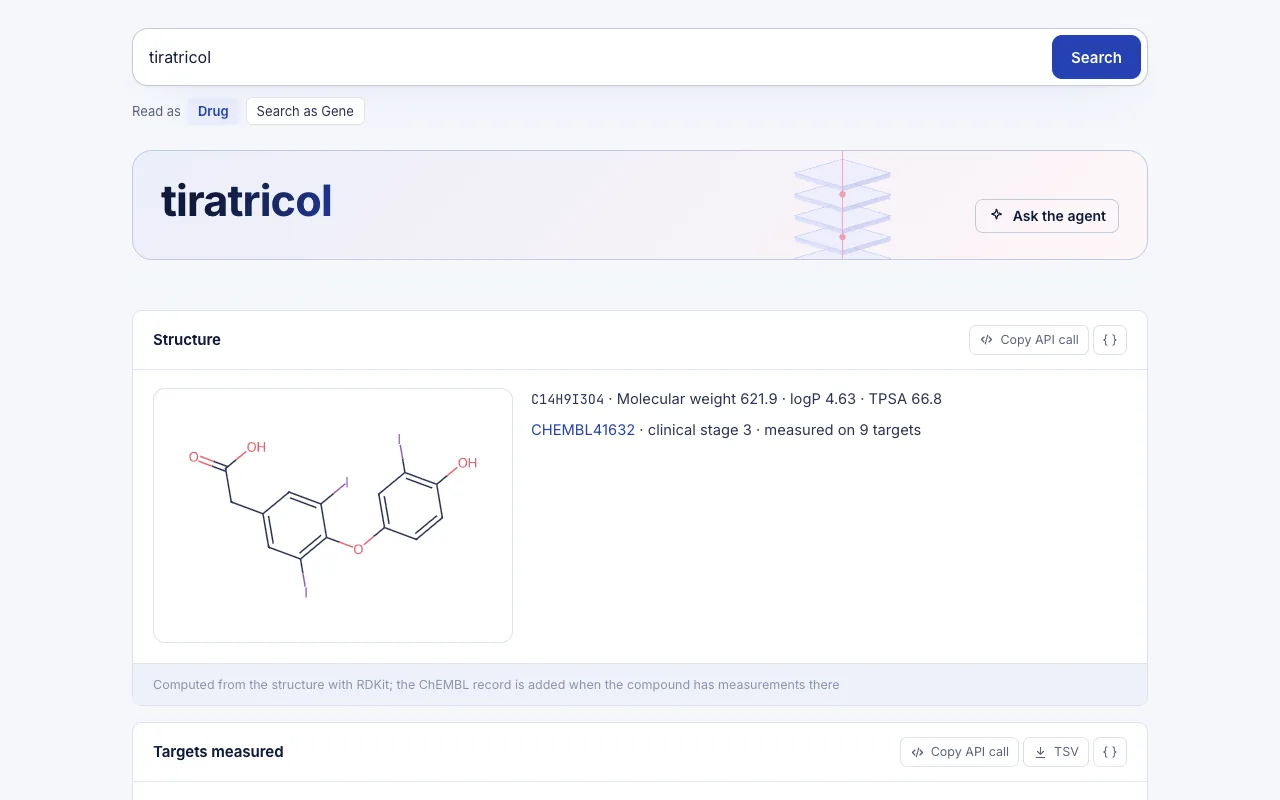
Tiratricol FDA approval: targets and potency in BioQ
Tiratricol FDA approval (Emcitate): ChEMBL shows 68 targets, THRB and THRA top by pChEMBL, and 3 registered trials on ClinicalTrials.gov, as of 2026-11-17.
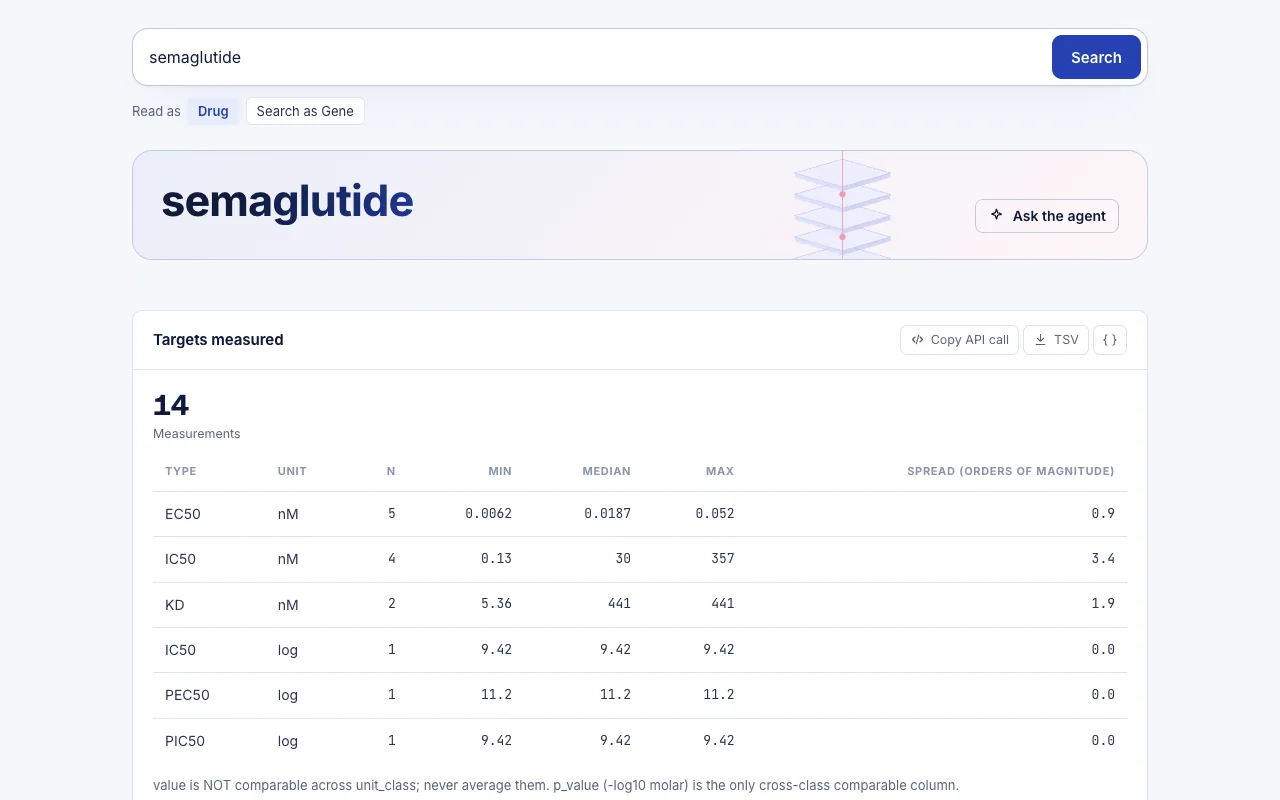
Semaglutide new study: what BioQ data show
A new FAERS paper on semaglutide and panic attacks, set against ChEMBL potency, ClinicalTrials.gov registrations and PubChem identity as of 2026-11-15.
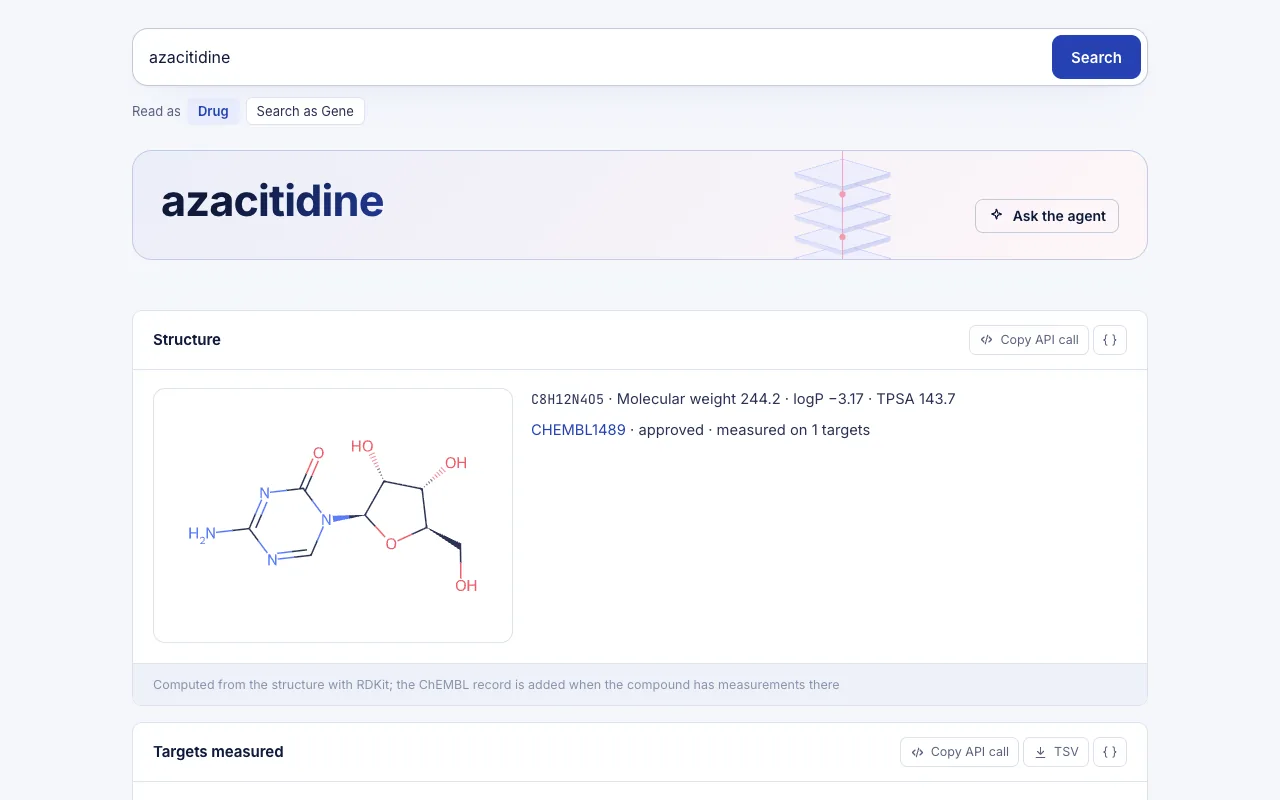
Azacitidine Ropeginterferon trial NCT07646821
Phase 1b/2 trial NCT07646821 adds ropeginterferon alfa-2b to azacitidine in TP53-mutated MDS/AML; ChEMBL, ClinicalTrials.gov and DepMap data as of 2026-11-15.