

PRMT5 new study: what BioQ data show today
A 2026 Nature Communications paper ties PRMT5 to histone supply; DepMap, ChEMBL, Open Targets, TCGA, Reactome and STRING data show where PRMT5 stands today.
Data as of November 6, 2026 · By the BioQ team
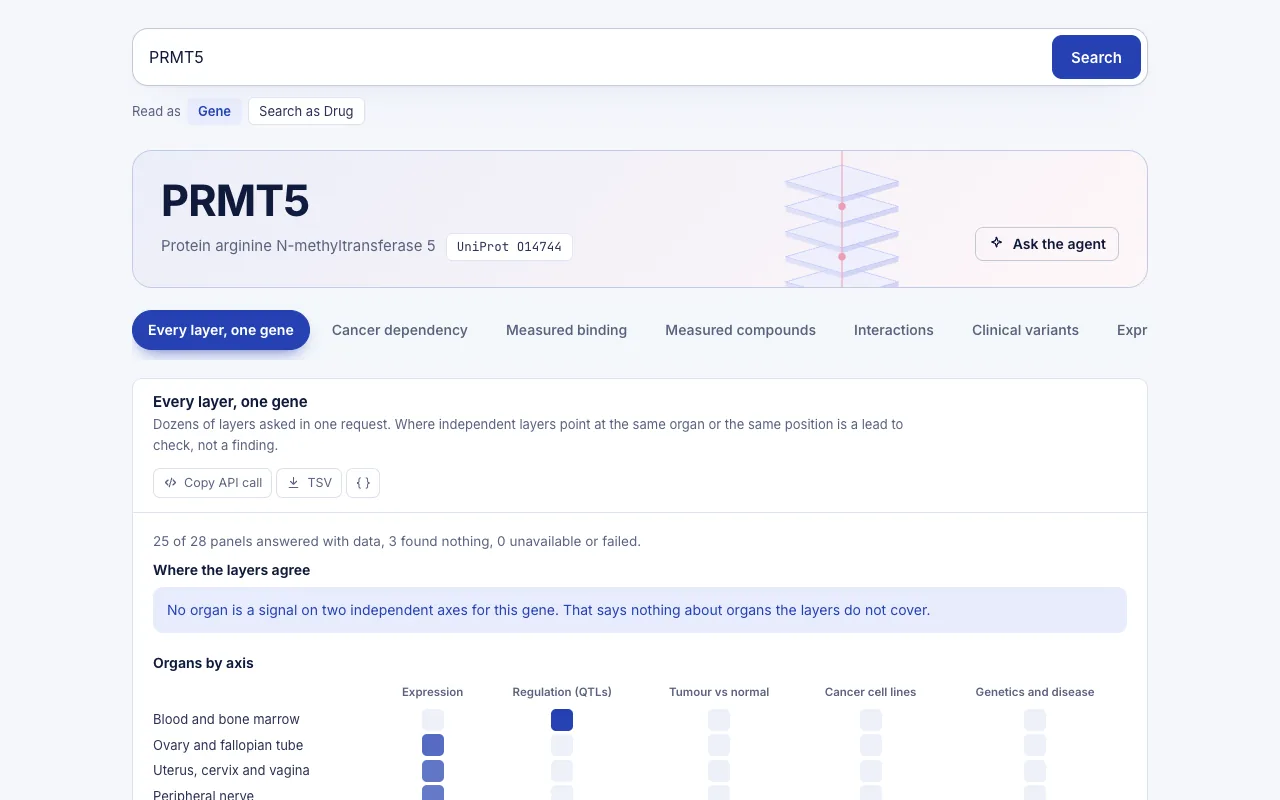
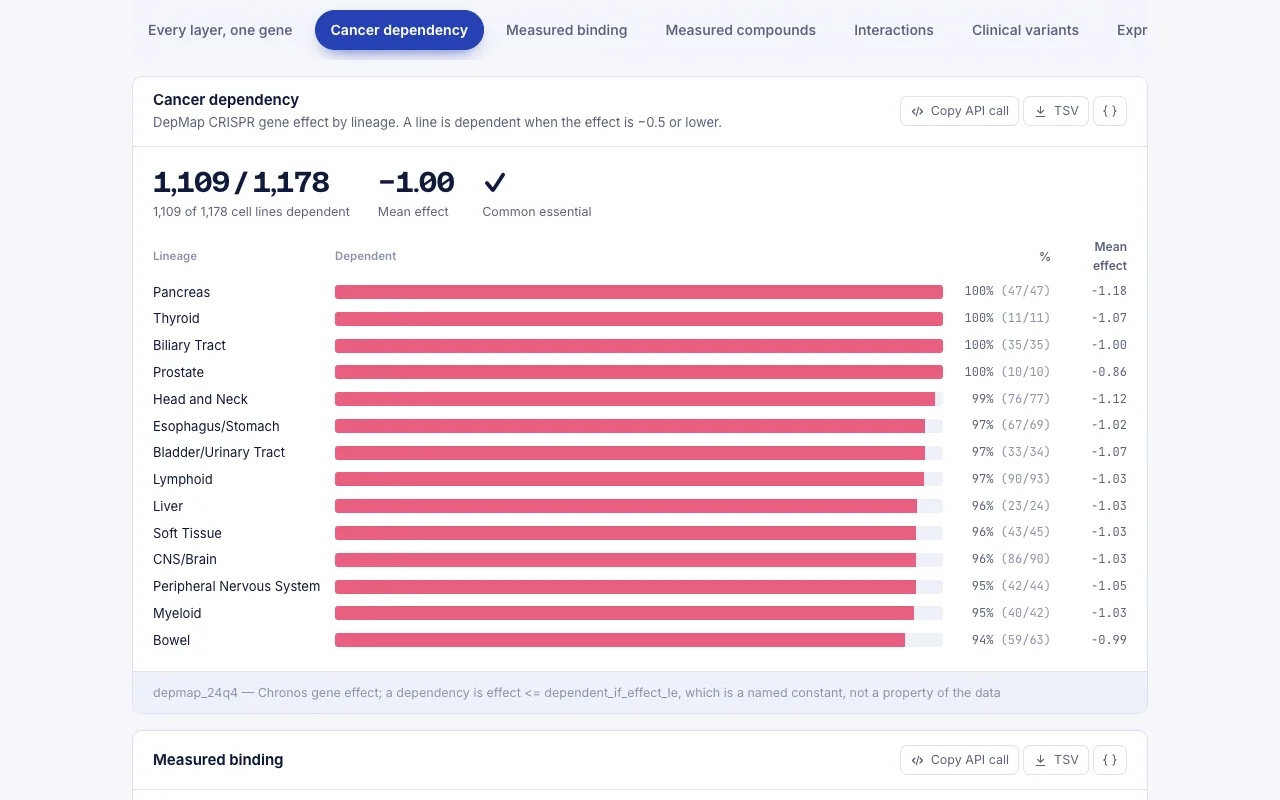
The PRMT5 new study in Nature Communications (2026) examines how PRMT5 supports histone production; its results belong to the authors, not to BioQ. As of 2026-11-06, BioQ's data place PRMT5 as a common-essential gene in DepMap: 1109 of 1178 cell lines (94.1%) are dependent, with a mean Chronos gene effect of -1.004.
What the PRMT5 new study asks
The paper (DOI 10.1038/s41467-026-78671-x) asks what controls the supply of histone proteins in proliferating cells. It looks at PRMT5, a type II arginine methyltransferase, and at whether its activity is needed to keep histone transcription and histone protein synthesis going during S phase. It also looks at histone H4 as a methylation substrate and at histone locus bodies. We do not restate its findings here. They come from the authors' own nascent transcription, proteomics and imaging experiments, and BioQ has not reproduced any of them.
What BioQ can do is show the public data around the gene the paper names, so you can place the work in context. We ran one query, PRMT5, and read the blocks that bear on the paper's themes: essentiality, pharmacology, disease association, pathway membership and protein partners.
What BioQ returned for PRMT5
Dependency. In the DepMap CRISPR screen (release depmap_24q4, Chronos gene effect), PRMT5 is flagged common essential. The 1109 dependent lines out of 1178 are counted against a named threshold in the release, not a property of the data itself. A more negative gene effect means the knockout reduced viability more. The top lineages by mean gene effect:
| Lineage | Cell lines | Dependent | % dependent | Mean gene effect |
|---|---|---|---|---|
| Pancreas | 47 | 47 | 100 | -1.178 |
| Head and Neck | 77 | 76 | 98.7 | -1.124 |
| Thyroid | 11 | 11 | 100 | -1.074 |
| Bladder/Urinary Tract | 34 | 33 | 97.1 | -1.072 |
| Peripheral Nervous System | 44 | 42 | 95.5 | -1.049 |
| Liver | 24 | 23 | 95.8 | -1.033 |
| Lymphoid | 93 | 90 | 96.8 | -1.033 |
| Soft Tissue | 45 | 43 | 95.6 | -1.032 |
Drugs. BioQ lists 3 drugs for PRMT5 across Open Targets, ChEMBL, the Drug Repurposing Hub and ClinicalTrials.gov:
| Drug | Max clinical stage | Mechanism | Best exact pChEMBL | Type | Trials by name |
|---|---|---|---|---|---|
| Pemrametostat | PHASE_2 | Protein arginine N-methyltransferase 5 inhibitor | 8.7 | EC50 | 0 |
| 3Xv | UNKNOWN | — | 8.22 | IC50 | 0 |
| Hlcl-61 | UNKNOWN | — | — | — | 0 |
Interaction partners. STRING v12 lists 1794 partners for PRMT5. The top six by combined score:
| Partner | UniProt | STRING combined score |
|---|---|---|
| WDR77 | Q9BQA1 | 999 |
| CLNS1A | P54105 | 999 |
| H4C6 | P62805 | 997 |
| SNRPD3 | P62318 | 996 |
| RIOK1 | Q9BRS2 | 996 |
| PRMT1 | Q99873 | 993 |
Disease association. Open Targets links PRMT5 to 453 diseases. The highest score, 0.208, is for neurodegenerative disease, but that rests on only 3 evidence items. Breast cancer scores 0.14 with 187 evidence items, and the broad term neoplasm scores 0.119 with 668. Hepatocellular carcinoma (0.117, 120 items), colorectal carcinoma (0.116, 78 items) and lung carcinoma (0.116, 139 items) follow.
Tumour versus normal expression. TCGA and GTEx (Toil recompute) have both tumour and normal samples for 24 cancer types. The differences for PRMT5 are small on the log2 scale. Cholangiocarcinoma shows a log2 fold of 0.12 (36 tumours, 9 normals), and lung squamous cell carcinoma and lung adenocarcinoma each show 0.1. Pheochromocytoma and paraganglioma go the other way at -0.11, but with only 3 normal samples.
Pathways. Reactome assigns PRMT5 to 12 pathways. The most specific include "RMTs methylate histone arginines" (R-HSA-3214858, 48 genes), "snRNP Assembly" (R-HSA-191859, 54 genes) and "Regulation of TP53 Activity through Methylation" (R-HSA-6804760, 19 genes).
What it means and how to read it
The paper calls PRMT5 cell essential. The DepMap block is consistent with that at the level of cell-line viability: the effect is broad rather than lineage-restricted. Pancreas shows 47 of 47 lines dependent (mean -1.178), and head and neck shows 76 of 77. The lineages in the table are the top eight by mean effect, so a dependency is not limited to them. Because the essentiality is so widespread, lineage ranking here says little about which tumour types might be more sensitive.
The partner list is the part that most directly meets the paper's subject. WDR77 and CLNS1A both score 999, which fits the known PRMT5 complex partners. H4C6, a gene encoding histone H4, scores 997. That agrees with H4 being a PRMT5 interactor, but a STRING score aggregates several kinds of evidence and does not tell you which residue is methylated or what follows from it. The arginine 3 question is the paper's, and it is tested there experimentally.
On pharmacology, the one named drug with a stage is Pemrametostat, listed as a PRMT5 inhibitor at PHASE_2. Its potency figure is 8.7 pChEMBL, but the type is EC50, not IC50. If you need an exact IC50 only, 3Xv is the entry with one, at 8.22. Hlcl-61 has no potency value. All three show 0 trials matched by name, so this block does not map the clinical landscape.
The Open Targets pattern is a reminder to read scores with their evidence counts. A top score from 3 items is a different kind of signal than 187 items for breast cancer.
Why run it this way: the facts above draw on 6 distinct resources and took 7 engine queries, which BioQ answered in 0.87 seconds of engine time. Collecting the same views by hand means separate visits to each database, each with its own gene identifiers and release. Every block names its source and release so you can check it.
How to reproduce it in BioQ
- Open BioQ and enter the gene symbol as the query, exactly as below.
PRMT5- Read the DepMap block first. Note the number of dependent lines and the lineage table, and check the release label.
- Open the drugs block and compare the potency type (EC50 or IC50) before comparing values.
- Check the interaction block for H4C6 and the complex partners, then the Reactome pathways.
- Compare the Open Targets scores with their evidence counts before drawing conclusions.
Then open the paper itself to see what was measured and how.
Limits: what the data do not show
- DepMap measures viability after CRISPR knockout in cell lines. It does not show histone mRNA levels, S phase behaviour or genome integrity, which are the paper's readouts.
- A Chronos effect does not distinguish loss of PRMT5 protein from loss of its catalytic activity. The paper's inhibitor and knockdown comparison addresses that, and this data cannot.
- STRING scores indicate association, not methylation or its direction. Nothing here confirms H4 arginine 3 as a substrate.
- The potency values come from mixed assay types and cannot be compared one to one. The trial count of 0 is by drug name only.
- Open Targets scores combine evidence of many types and say nothing about causality. TCGA values are bulk mRNA, not enzyme activity.
- None of this is medical advice, and nothing here tests the paper's claims.
Data and method
The numbers on this page were read from the BioQ engine on 2026-11-06 (7 queries, 0.9 s of engine time in total). The tables are generated by code from the engine's answers; the text only restates them.
/depmap, /drugs, /interaction, /ot_association, /pathway, /tcga
Sources
- PRMT5 activity sustains histone production to maintain genome integrity (2026) — doi:10.1038/s41467-026-78671-x
Run the same query yourself: PRMT5
For research use only. This page summarises public data and is not medical advice.
BioQ is an AI search engine and agent with one goal: making biology research 100X faster. Ask in the web app, over the REST API, or from Claude, ChatGPT or Cursor through MCP.
Queries used
Frequently asked questions
Is PRMT5 a common essential gene in DepMap?
Yes. In depmap_24q4, PRMT5 is flagged common essential. 1109 of 1178 cell lines (94.1%) are dependent, with a mean Chronos gene effect of -1.004.
Which lineages show the strongest PRMT5 dependency?
By mean gene effect, Pancreas is first in the table at -1.178 with 47 of 47 lines dependent. Head and Neck follows at -1.124 (76 of 77 lines), then Thyroid at -1.074 (11 of 11).
Which PRMT5 inhibitors does BioQ list?
BioQ lists 3 drugs. Pemrametostat is a PRMT5 inhibitor at PHASE_2 with a pChEMBL of 8.7 (EC50). 3Xv has an IC50-based value of 8.22, and Hlcl-61 has no potency value.
Does PRMT5 interact with histone H4 in STRING?
H4C6 appears among 1794 PRMT5 partners with a combined score of 997. This shows association only and does not identify the methylated residue.
What is the strongest PRMT5 disease association in Open Targets?
Neurodegenerative disease scores highest at 0.208, but with 3 evidence items. Breast cancer scores 0.14 with 187 evidence items, among 453 associated diseases in total.
Sources
- Paper PRMT5 activity sustains histone production to maintain genome integrity (2026) DOI 10.1038/s41467-026-78671-x
- Dataset DepMap CRISPR Chronos gene effect (24Q4)
- Dataset Open Targets Platform; ChEMBL; Drug Repurposing Hub
- Dataset TCGA pan-cancer expression (UCSC Xena Toil recompute)
- Dataset Reactome pathway knowledgebase
- Dataset STRING v12 protein-protein interactions
Results come from public databases as of the date shown and may change. BioQ gives research information, not medical advice.
More from the blog
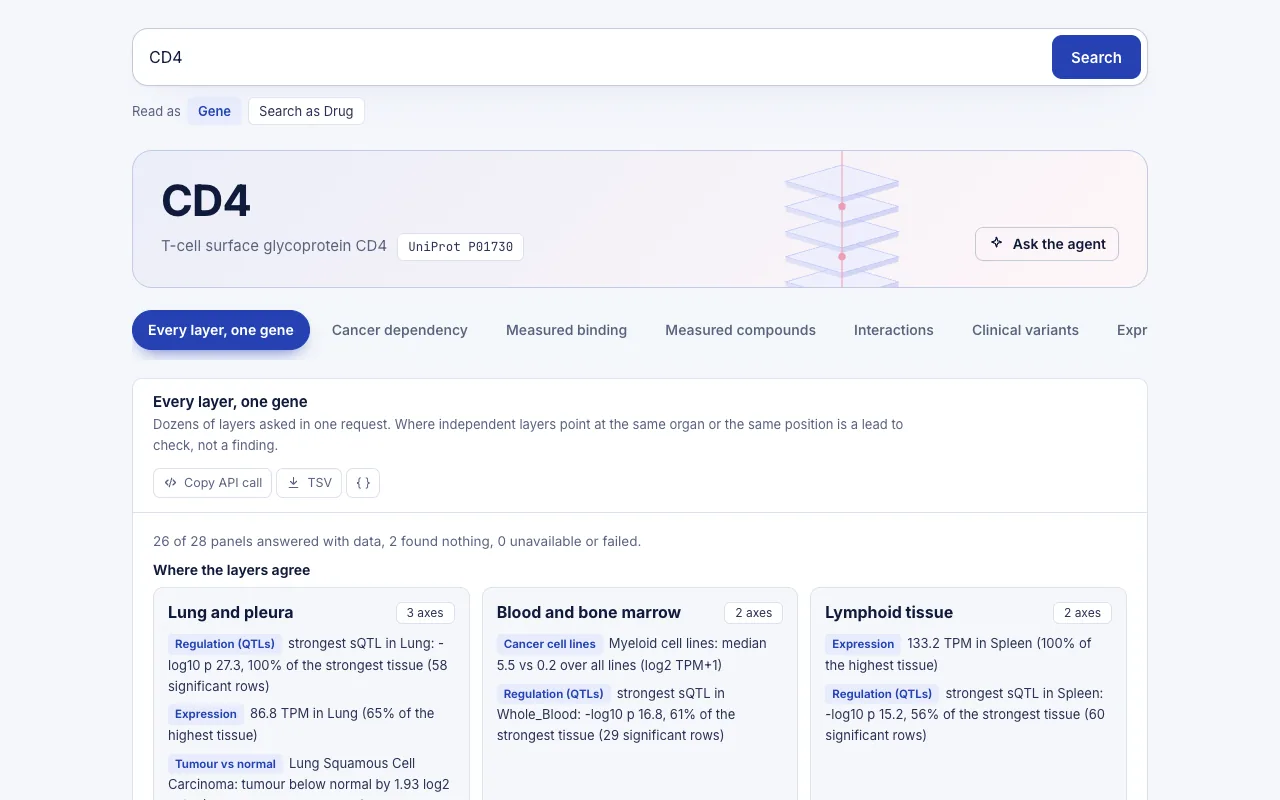
CD4 new study: CAR-NK cells and HIV rebound in context
A CD4-based CAR-NK paper on HIV rebound, placed in context with BioQ data on CD4: DepMap dependency, Open Targets diseases, drugs and Reactome pathways.
GSTM1 new study: cisplatin kidney injury in context
A 2026 paper links GSTM1 loss to worse cisplatin kidney injury; BioQ shows what DepMap, Open Targets, ChEMBL, Reactome and STRING say about GSTM1 today.
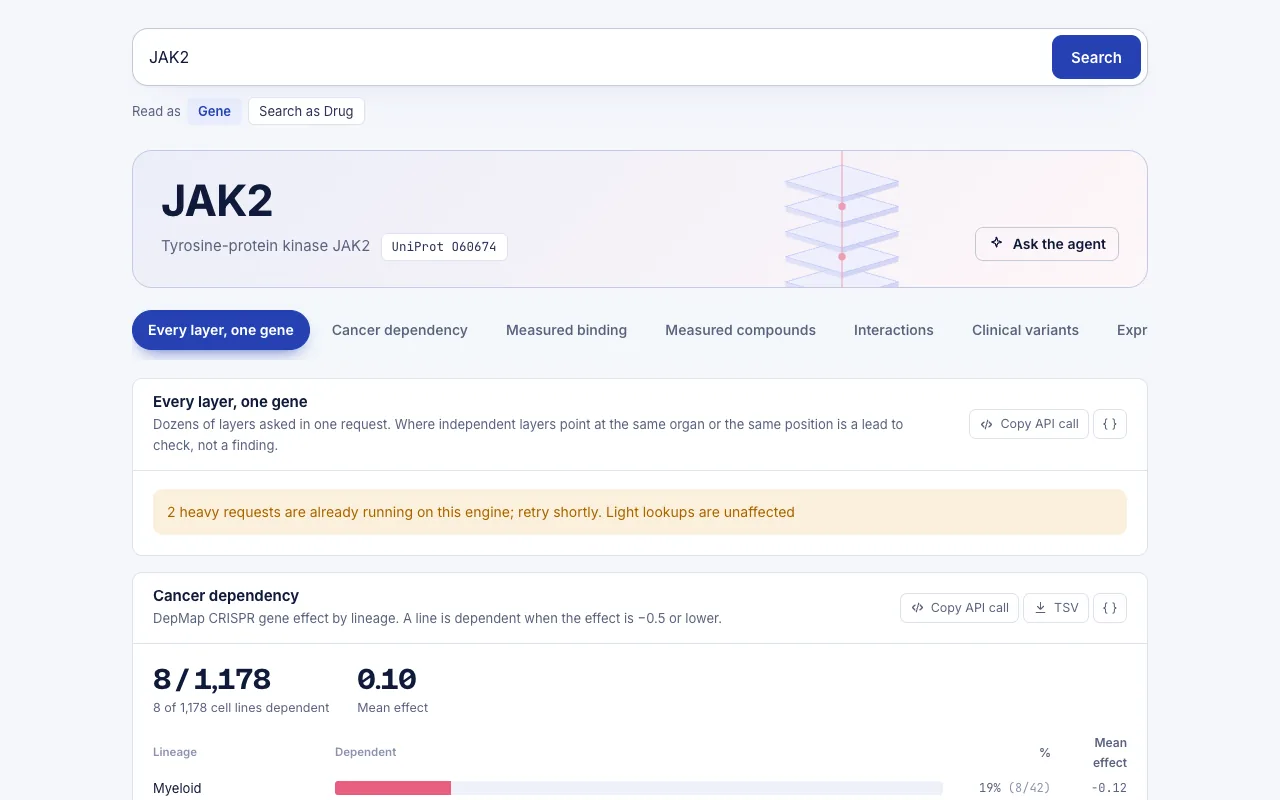
JAK2 vs TYK2: dependency and drugs side by side
JAK2 vs TYK2 in DepMap and drug databases: 8 of 1178 cell lines are dependent on JAK2, 11 on TYK2; 47 drugs are known for JAK2 and 20 for TYK2.