

MYC new study: HCC microbiome paper and MYC data
A paper watch on Bacteroidetes and HCC immunotherapy resistance, with what DepMap, Open Targets, TCGA, CIViC and STRING show about MYC as of 2026-11-14.
Data as of November 14, 2026 · By the BioQ team
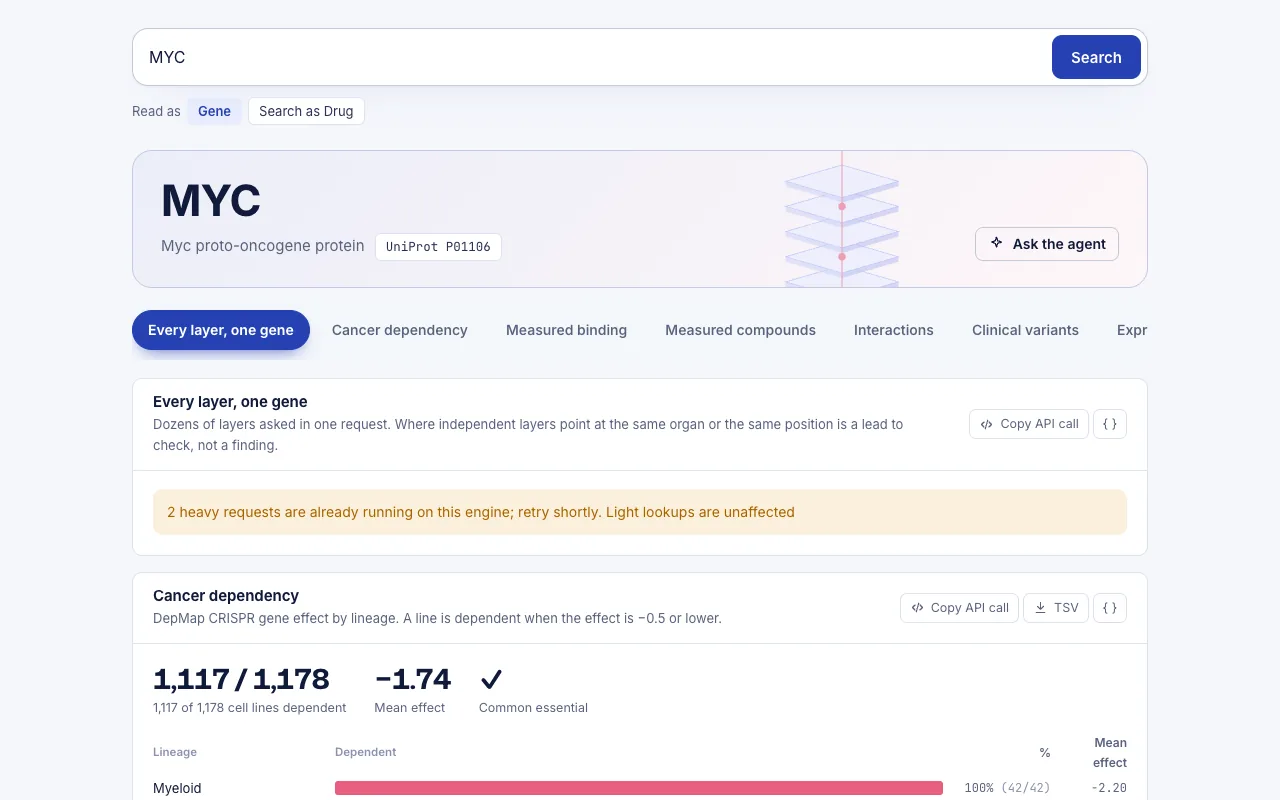
A recent Hepatology Communications paper links Bacteroidetes in the gut to hepatocellular carcinoma progression and resistance to immune checkpoint blockade, using a mouse model driven by MYC and CTNNB1. As of 2026-11-14, BioQ shows MYC as a common-essential gene: 1117 of 1178 DepMap cell lines (94.8%) depend on it, with a mean Chronos gene effect of -1.743.
What we asked about MYC after the new study
The paper (DOI 10.1097/hc9.0000000000001086) asks how gut bacteria shape liver tumour growth and the response to checkpoint blockade. It combines stool sequencing from treated patients, antibiotic-induced dysbiosis in mice, colonization with Parabacteroides distasonis, and fecal transplants. Its results belong to the paper. This post does not restate them and BioQ did not generate them.
MYC enters the study as a component of the tumour model. The mouse tumours are induced by MYC-lucOS together with CTNNB1. So the question for this page is narrow: what do public data layers say today about MYC itself, so you can place that model in context? We did not test the microbiome claims.
What BioQ returned
We ran the single query MYC. The engine used 7 queries across 7 distinct resources in 0.61 engine seconds in total. Reaching the same layers by hand means visiting each resource separately, with its own gene identifiers and export format.
Dependency: DepMap Chronos gene effect
DepMap (release depmap_24q4) classes MYC as common essential. A more negative Chronos gene effect means the knockout reduced viability more. The table shows the lineages with the strongest mean effect.
| Lineage | Cell lines | Dependent | % dependent | Mean gene effect |
|---|---|---|---|---|
| Myeloid | 42 | 42 | 100 | -2.196 |
| Pancreas | 47 | 47 | 100 | -2.155 |
| Lymphoid | 93 | 93 | 100 | -2.088 |
| Biliary Tract | 35 | 35 | 100 | -2.047 |
| Prostate | 10 | 10 | 100 | -1.996 |
| Bladder/Urinary Tract | 34 | 32 | 94.1 | -1.957 |
| Esophagus/Stomach | 69 | 69 | 100 | -1.954 |
| Head and Neck | 77 | 76 | 98.7 | -1.908 |
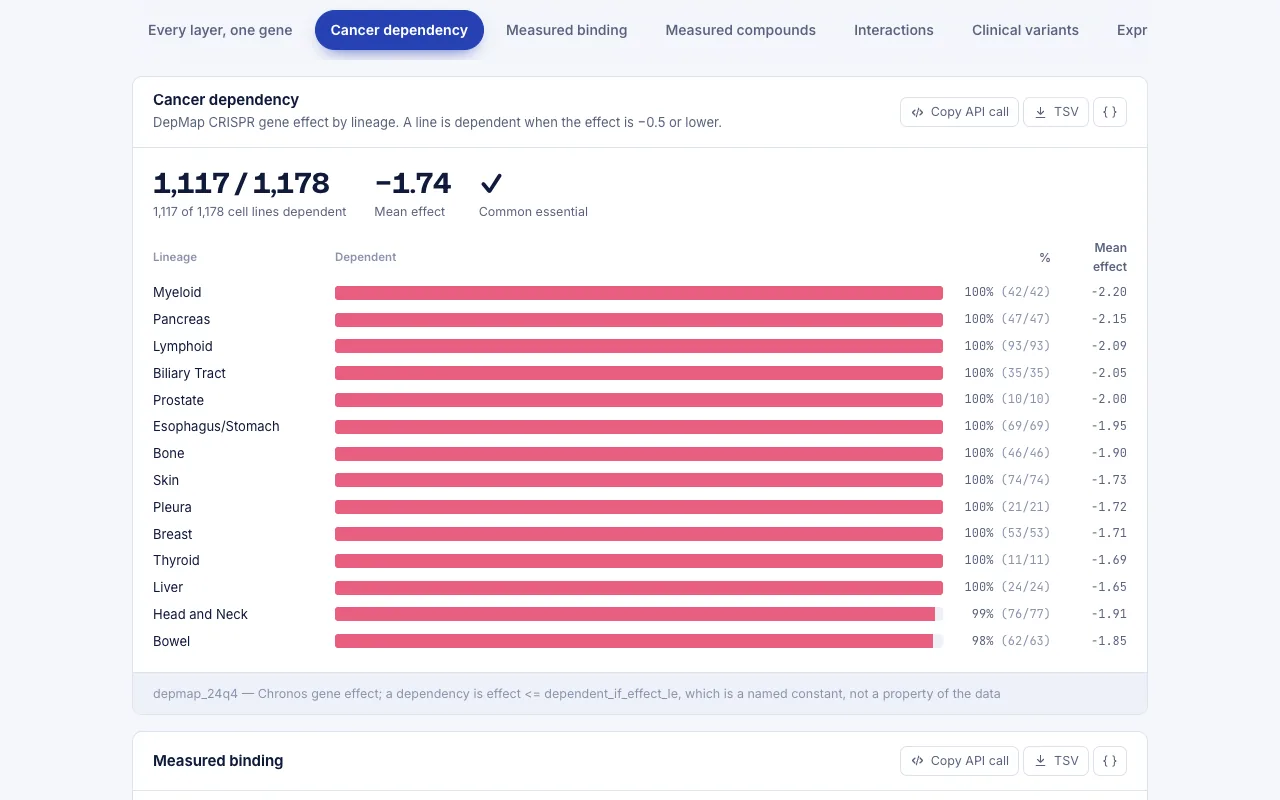
The lineages shown are the top of the ranking. A liver lineage is not among them, so this table cannot tell you how liver lines compare. Biliary Tract is the nearest bile-duct and liver-adjacent entry in the list: 35 of 35 lines depend on MYC, with a mean of -2.047.
Disease association: Open Targets
Open Targets links MYC to 2193 diseases. The top of the list is led by Burkitt lymphoma, which fits the IGH::MYC rearrangement biology. The scores run from 0 to 1.
| Disease | Association score | Evidence items |
|---|---|---|
| Burkitt lymphoma | 0.631 | 2170 |
| neurodegenerative disease | 0.544 | 39 |
| breast carcinoma | 0.528 | 3561 |
| erythrocyte volume | 0.518 | 25 |
| body height | 0.517 | 58 |
| urinary bladder carcinoma | 0.511 | 396 |
Hepatocellular carcinoma is not in the rows shown. Several top entries, such as erythrocyte volume and body height, are genetic-association traits and not cancers, so the score mixes very different kinds of evidence.
Clinical evidence: CIViC
CIViC holds 7 records for MYC, of which BioQ shows 5. Evidence levels run from A to E, with A the strongest.
| Molecular profile | Disease | Therapies | Evidence level | Significance |
|---|---|---|---|---|
| MYC Overexpression | Lung Small Cell Carcinoma | Cisplatin, Olaparib, Prexasertib | D | Sensitivity/Response |
| MYC Overexpression | Multiple Myeloma | JQ-1 | D | Sensitivity/Response |
| FGFR1 Amplification AND MYC Overexpression | Lung Squamous Cell Carcinoma | Pazopanib | C | Sensitivity/Response |
| IGH::MYC Fusion | B-lymphoblastic Leukemia With MYC Rearrangement | — | B | Positive |
| IGH::MYC Fusion | B-lymphoblastic Leukemia With MYC Rearrangement | — | C | Positive |
The entries are in lung, myeloma and B-lymphoblastic leukemia settings. None concerns liver cancer, and the levels shown are B, C and D.
Other layers
- Pathways (Reactome): MYC sits in 77 pathways. Among the most specific ones shown is "Binding of TCF/LEF:CTNNB1 to target gene promoters", which connects to the CTNNB1 half of the paper's model. "RUNX3 regulates WNT signaling" is also listed.
- Interactions (STRING v12): 7147 partners. The ones shown are EP300, BIN1, MAX, TRRAP, ZBTB17 and BRCA1, each with a combined score of 999.
- Expression (TCGA/GTEx Toil): 24 cancer types have both tumour and normal samples. Among the rows BioQ shows, Glioblastoma Multiforme has the largest log2 fold (0.33) and Pheochromocytoma & Paraganglioma the lowest (-0.33). Liver is not in that view.
- Drugs: BioQ lists 1 drug for MYC, Tws-119. Its maximum clinical stage is UNKNOWN, there is no mechanism text, no exact pChEMBL value and 0 trials by name. That is a thin picture for MYC inhibitors. It does not show that no one is working on the target, only that this record is sparse.
What it means and how to read it
The paper's mouse model uses MYC as an oncogenic driver, and the data above are consistent with MYC being a central, broadly required gene. Because nearly every cell line depends on it, a DepMap dependency does not distinguish a liver tumour from any other tissue. It cannot say whether MYC activity changes how tumours respond to microbiota or to checkpoint blockade.
The pathway link to TCF/LEF:CTNNB1 binding is worth noting for context. It shows that MYC and CTNNB1 are annotated in related transcriptional programmes. It does not show that the pairing in the mouse model reflects what happens in patients.
The sparse drug record has a practical meaning. If you came to this paper looking for a pharmacological handle on MYC, a ChEMBL exact IC50 is not there in this result. You would need to look at direct and indirect routes separately and check each source.
How to reproduce it in BioQ
- Open BioQ and enter the gene symbol as the query:
MYC- Run it and wait for the answer, which draws on the layers listed above.
- Read the DepMap panel first, then the Open Targets, CIViC and Reactome panels. Each names its source and release.
- Narrow to a lineage or disease of your own by adding it to the query.
Limits: what the data do not show
- The paper's microbiome findings, patient cohort and mouse experiments are not tested or checked here. Read them in the paper.
- DepMap measures knockout effects in cell lines in culture. It has no gut microbes, no immune cells and no checkpoint blockade, so it says nothing about immunotherapy response.
- A dependency is defined by a named threshold on the Chronos gene effect, not by a property of the data itself.
- The tables show only the top rows. Liver lineages and hepatocellular carcinoma do not appear in them, so absence from a table is not evidence of absence.
- Open Targets scores combine many evidence types, and a high score does not mean a disease is driven by MYC.
- CIViC and the drug record contain nothing specific to liver cancer here, and none of it is guidance for treatment.
- The data are as of 2026-11-14 and will change as the sources update.
Data and method
The numbers on this page were read from the BioQ engine on 2026-11-14 (7 queries, 0.6 s of engine time in total). The tables are generated by code from the engine's answers; the text only restates them.
/civic, /depmap, /drugs, /interaction, /ot_association, /pathway, /tcga
Sources
- Bacteroidetes promote hepatocellular carcinoma progression and resistance to immunotherapy (2026) — doi:10.1097/hc9.0000000000001086
Run the same query yourself: MYC
For research use only. This page summarises public data and is not medical advice.
BioQ is an AI search engine and agent with one goal: making biology research 100X faster. Ask in the web app, over the REST API, or from Claude, ChatGPT or Cursor through MCP.
Queries used
Frequently asked questions
Is MYC a dependency in cancer cell lines?
In DepMap (depmap_24q4), MYC is flagged common essential. 1117 of 1178 cell lines (94.8%) are dependent, with a mean Chronos gene effect of -1.743.
Which diseases does Open Targets associate most strongly with MYC?
Open Targets lists 2193 diseases for MYC. Burkitt lymphoma leads with a score of 0.631 and 2170 evidence items, followed by neurodegenerative disease at 0.544 and breast carcinoma at 0.528.
Are there MYC inhibitors with exact potency data in ChEMBL?
BioQ lists 1 drug for MYC, Tws-119, with maximum clinical stage UNKNOWN, no exact pChEMBL value and 0 trials by name. The record does not support potency comparisons.
Does BioQ confirm the Bacteroidetes findings in the HCC paper?
No. The paper's results are the paper's own. BioQ only shows what public data layers hold about MYC, one of the genes in the paper's mouse model, as of 2026-11-14.
How long does a BioQ query for MYC take?
The MYC query ran 7 engine queries across 7 distinct resources in 0.61 engine seconds in total.
Sources
- Paper Bacteroidetes promote hepatocellular carcinoma progression and resistance to immunotherapy (2026) DOI 10.1097/hc9.0000000000001086
- Dataset DepMap CRISPR Chronos gene effect (24Q4)
- Dataset Open Targets Platform; ChEMBL; Drug Repurposing Hub
- Dataset TCGA pan-cancer expression (UCSC Xena Toil recompute)
- Dataset CIViC: Clinical Interpretation of Variants in Cancer
- Dataset Reactome pathway knowledgebase
- Dataset STRING v12 protein-protein interactions
Results come from public databases as of the date shown and may change. BioQ gives research information, not medical advice.
More from the blog
CD4 new study: CAR-NK cells and HIV rebound in context
A CD4-based CAR-NK paper on HIV rebound, placed in context with BioQ data on CD4: DepMap dependency, Open Targets diseases, drugs and Reactome pathways.
GSTM1 new study: cisplatin kidney injury in context
A 2026 paper links GSTM1 loss to worse cisplatin kidney injury; BioQ shows what DepMap, Open Targets, ChEMBL, Reactome and STRING say about GSTM1 today.
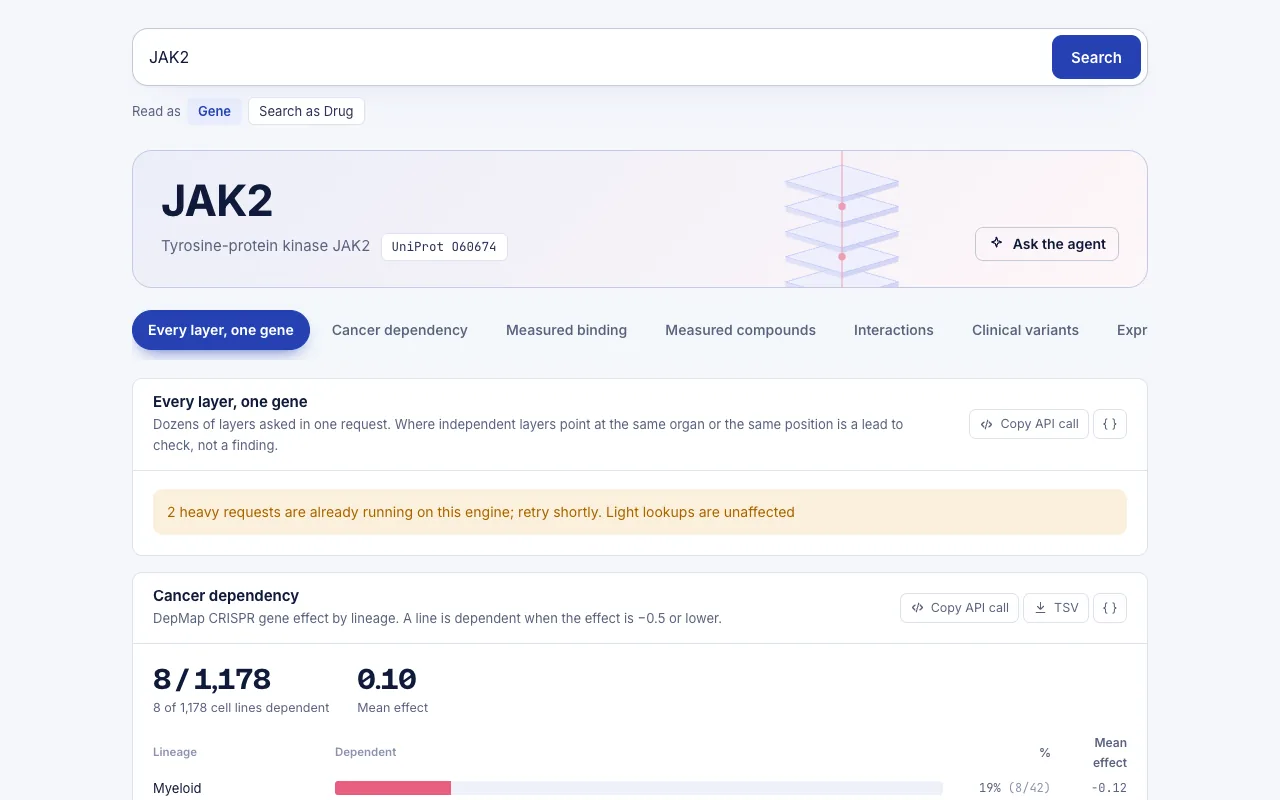
JAK2 vs TYK2: dependency and drugs side by side
JAK2 vs TYK2 in DepMap and drug databases: 8 of 1178 cell lines are dependent on JAK2, 11 on TYK2; 47 drugs are known for JAK2 and 20 for TYK2.