

MAPT new study: what BioQ shows about MAPT today
A new npj Dementia paper on MAPT V337M organoids, placed in context with DepMap, Open Targets, ChEMBL, STRING and Reactome data as of 2026-11-10.
Data as of November 10, 2026 · By the BioQ team
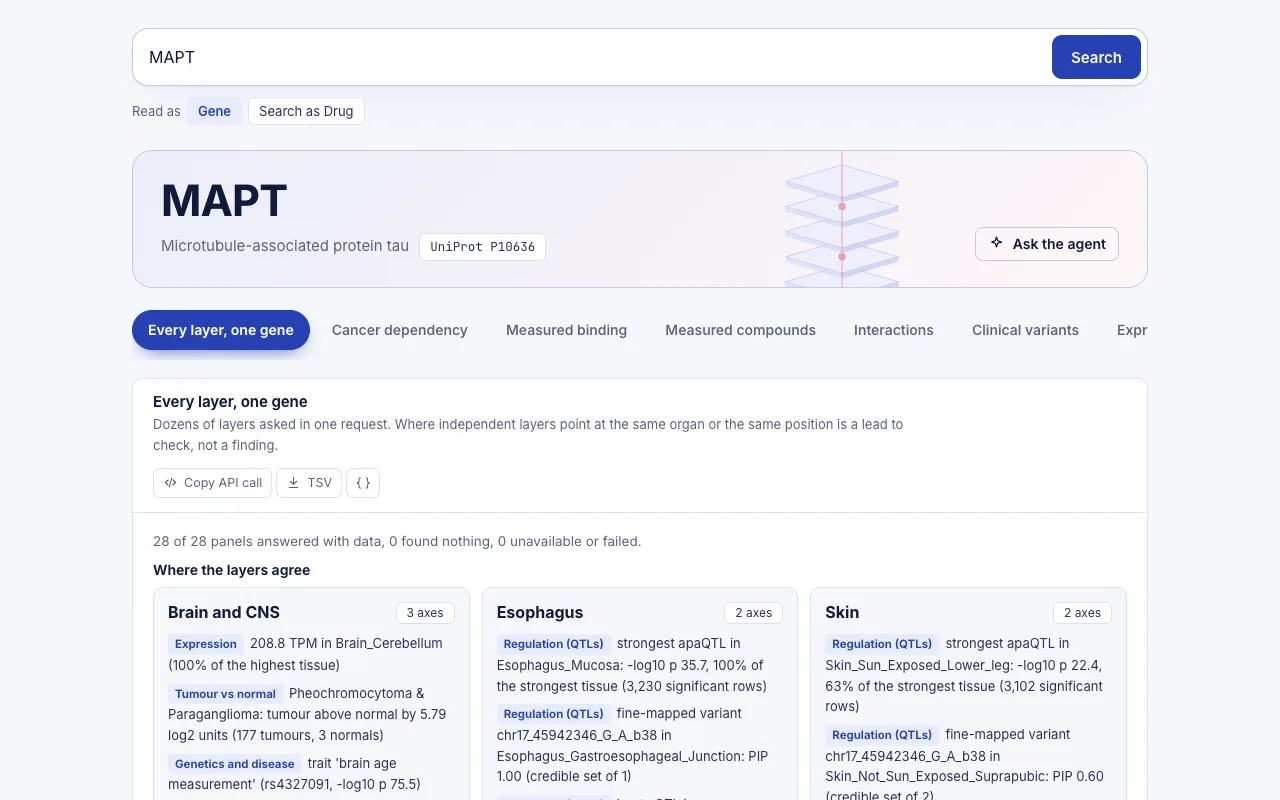
For a reader of the new MAPT study, the public data give a clear background. In Open Targets, MAPT links most strongly to frontotemporal dementia (association score 0.789), and 9 drugs are on record, mostly phase 2 anti-tau antibodies. In DepMap, none of 1178 cancer cell lines depends on MAPT. All figures are as of 2026-11-10; the paper's own results belong to the paper.
What we asked: where the new MAPT study sits
The paper (npj Dementia, 2026, DOI 10.1038/s44400-026-00147-y) has two parts. One is a manufacturing and quality-control platform for cortical organoids grown from human pluripotent stem cells. The other is a biological finding in neurons carrying the MAPT V337M mutation, which is relevant to frontotemporal dementia with tau pathology. The authors report that excitatory neurons show early changes in the phosphatase regulators PPP2CA and ANP32A and in the prefoldin subunit PFDN6. These changes appear before tau hyperphosphorylation and oligomerization. Those results are theirs; BioQ did not re-analyse the organoid data.
Our question was narrower: what do public data layers say about MAPT itself today? That gives the paper some context. We ran the single query MAPT and read the returned blocks on disease association, drugs, dependency, interaction partners and pathways. The facts cover MAPT only. We did not query PPP2CA, ANP32A or PFDN6, so nothing below speaks to those genes.
What BioQ returned
The query drew on 6 distinct resources through 7 engine queries, which took 2.25 seconds of engine time in total. The first table shows the diseases most associated with MAPT in Open Targets, out of 3226 associated diseases.
| Disease | Association score | Evidence items |
|---|---|---|
| frontotemporal dementia | 0.789 | 4379 |
| Pick disease | 0.76 | 2828 |
| supranuclear palsy, progressive, 1 | 0.737 | 2931 |
| progressive supranuclear palsy-parkinsonism syndrome | 0.716 | 38 |
| atypical progressive supranuclear palsy syndrome | 0.716 | 28 |
| late-onset Parkinson disease | 0.641 | 43 |
Frontotemporal dementia leads, followed by Pick disease and progressive supranuclear palsy. The evidence counts differ widely between rows. Frontotemporal dementia has 4379 evidence items, while atypical progressive supranuclear palsy syndrome has 28.
The second table lists drugs on record for MAPT, 8 of the 9 found.
| Drug | Max clinical stage | Mechanism | Best exact pChEMBL | Type | Trials by name |
|---|---|---|---|---|---|
| Docetaxel | APPROVAL | — | — | — | 1628 |
| Paclitaxel | APPROVAL | — | — | — | 2177 |
| Bepranemab | PHASE_2 | Microtubule-associated protein tau inhibitor | — | — | 2 |
| Gosuranemab | PHASE_2 | Microtubule-associated protein tau inhibitor | — | — | 0 |
| Posdinemab | PHASE_2 | Microtubule-associated protein tau inhibitor | — | — | 0 |
| Semorinemab | PHASE_2 | Microtubule-associated protein tau inhibitor | — | — | 2 |
| Tilavonemab | PHASE_2 | Microtubule-associated protein tau inhibitor | — | — | 1 |
| Zagotenemab | PHASE_2 | Microtubule-associated protein tau inhibitor | — | — | 1 |
Docetaxel and Paclitaxel are listed as approved. The other six rows are phase 2 agents annotated as microtubule-associated protein tau inhibitors, and the names Bepranemab, Gosuranemab, Posdinemab, Semorinemab, Tilavonemab and Zagotenemab suggest antibodies. The "Trials by name" column counts trials that mention the drug name. It is not a count of tau-specific trials, which is why the taxanes show 1628 and 2177. The exact pChEMBL column is empty for all eight rows, so there is no exact IC50-type potency value for MAPT in ChEMBL in this result.
The third table is the DepMap view.
| Lineage | Cell lines | Dependent | % dependent | Mean gene effect |
|---|---|---|---|---|
| Testis | 5 | 0 | 0 | -0.059 |
| Cervix | 18 | 0 | 0 | 0.021 |
| Head and Neck | 77 | 0 | 0 | 0.023 |
| Uterus | 34 | 0 | 0 | 0.026 |
| Liver | 24 | 0 | 0 | 0.037 |
| Kidney | 34 | 0 | 0 | 0.046 |
| Lung | 126 | 0 | 0 | 0.049 |
| Esophagus/Stomach | 69 | 0 | 0 | 0.051 |
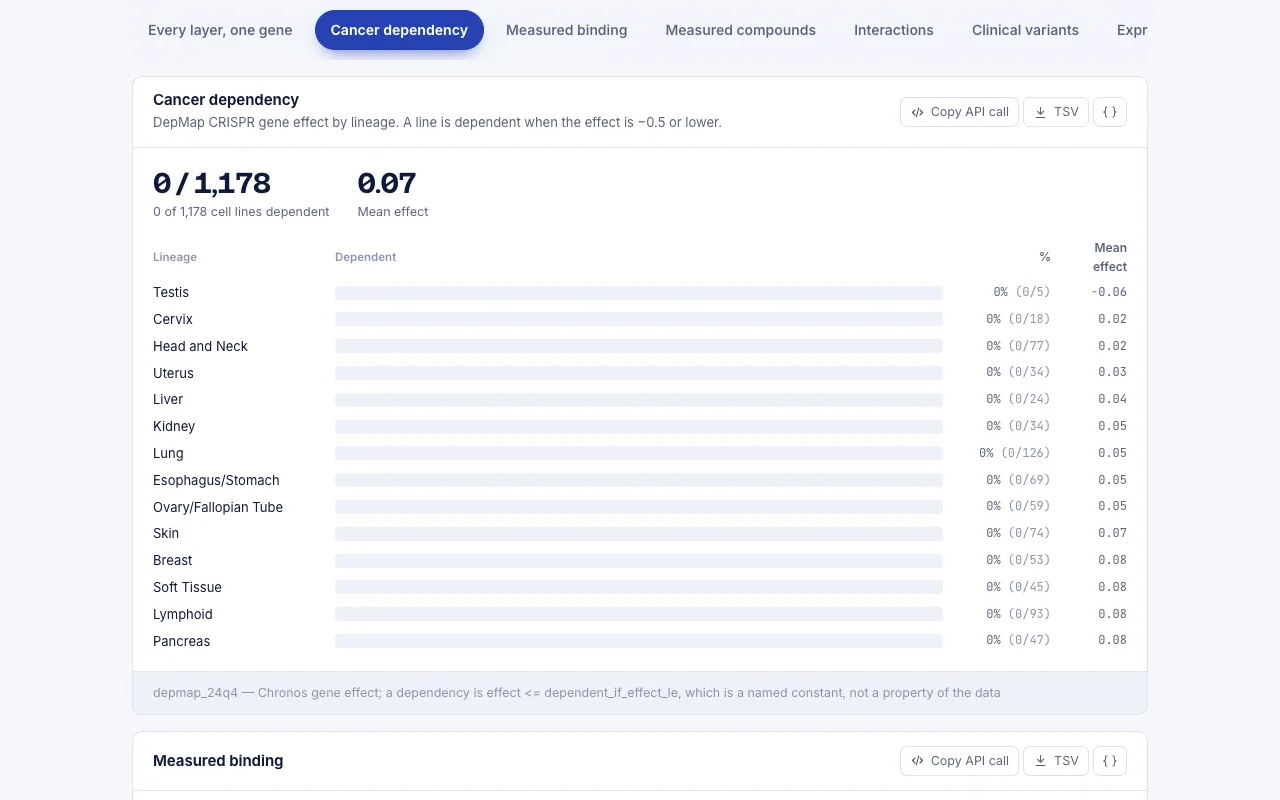
Across 1178 cell lines, 0 are dependent, the mean Chronos gene effect is 0.068, and MAPT is not flagged as common essential. The lineage with the most negative mean among those shown is Testis at -0.059, but it has only 5 lines and no dependent ones.
Three other blocks give context without tables:
- Interaction partners (STRING v12). There are 2794 partners. The top scores are GSK3B and CDK5 at 999, then APP and TUBA1B at 995, and TUBB2B and FYN at 994.
- Reactome. The result lists 16 pathways. The most specific is "Caspase-mediated cleavage of cytoskeletal proteins", with 12 genes.
- TCGA/GTEx. MAPT can be compared between tumour and normal tissue in 24 cancer types. For example, Pheochromocytoma & Paraganglioma shows a log2 fold of 0.87 (177 tumours, 3 normals).
What it means and how to read it
The Open Targets ranking shows that the paper works in the part of MAPT biology with the densest evidence: frontotemporal dementia and related tauopathies. A model that uses a MAPT mutation for frontotemporal dementia therefore addresses the disease area most strongly tied to this gene in the platform.
The drug table shows that most clinical activity targeting tau sits in phase 2 antibodies, which act on tau protein itself. The paper looks upstream of that, at regulators of phosphorylation and protein folding. These are different levels of the biology, and nothing in the table links the paper's three genes to any of these drugs.
The DepMap result is easy to misread. Zero dependent lines does not mean MAPT is unimportant in neurons. These are cancer cell lines, which mostly do not rely on tau, so the result mainly says that knocking out MAPT is unlikely to be a general cancer vulnerability. The label "dependent" also comes from a named Chronos threshold, not from the data themselves.
The STRING partners GSK3B and CDK5 are kinases, so the interaction layer reflects known phosphorylation biology around tau. The paper's phosphatase finding fits the same theme from the opposite side, but that is our reading as a reader, not a result from either source.
How to reproduce it in BioQ
- Open BioQ and enter the gene symbol as the whole query.
- Run it exactly as written:
MAPT- Read the Open Targets block for disease associations and the drug block for clinical stage and the exact pChEMBL column.
- Open the DepMap block to check the lineage table and the Chronos gene effect.
- Check the STRING and Reactome blocks, and note that each answer names its source resource and release.
Doing this by hand means visiting separate databases and reconciling gene identifiers and release versions. Here the 6 resources were queried together in 2.25 seconds of engine time.
Limits: what the data do not show
- BioQ's data say nothing about the paper's organoid results. They do not confirm or contradict the changes in PPP2CA, ANP32A or PFDN6, because those genes were not queried.
- Open Targets scores measure the amount and type of evidence, not how strongly a gene causes a disease.
- The trial counts are matched by drug name and include trials unrelated to tau, so they cannot be read as activity against MAPT.
- Empty exact pChEMBL values mean no exact potency measurement was found in this result, not that none exists anywhere.
- DepMap covers cancer cell lines in release depmap_24q4. It does not model post-mitotic neurons or the V337M mutation.
- The TCGA comparison has very few normal samples in some cancer types, such as 3 in the example above, so its fold changes are weak evidence.
- Nothing here is medical advice or a statement about treatment.
Data and method
The numbers on this page were read from the BioQ engine on 2026-11-10 (7 queries, 2.2 s of engine time in total). The tables are generated by code from the engine's answers; the text only restates them.
/depmap, /drugs, /interaction, /ot_association, /pathway, /tcga
Sources
- Integrated manufacturing platform for cortical organoids reveals early phosphatase and prefoldin dysregulation in MAPT V337M neurons (2026) — doi:10.1038/s44400-026-00147-y
Run the same query yourself: MAPT
For research use only. This page summarises public data and is not medical advice.
BioQ is an AI search engine and agent with one goal: making biology research 100X faster. Ask in the web app, over the REST API, or from Claude, ChatGPT or Cursor through MCP.
Queries used
Frequently asked questions
Which diseases are most associated with MAPT in Open Targets?
Frontotemporal dementia has the highest association score at 0.789, followed by Pick disease at 0.76 and progressive supranuclear palsy, 1 at 0.737. In total, 3226 diseases are associated with MAPT, as of 2026-11-10.
Is MAPT a dependency in DepMap?
No. Across 1178 cell lines, 0 are dependent on MAPT in the Chronos data (release depmap_24q4), the mean gene effect is 0.068, and MAPT is not flagged as common essential. These are cancer cell lines, not neurons.
Are there MAPT inhibitors with exact IC50 data in ChEMBL?
BioQ lists 9 drugs for MAPT, but the exact pChEMBL column is empty for all 8 shown rows. Six of them are phase 2 agents annotated as microtubule-associated protein tau inhibitors.
Does BioQ confirm the PPP2CA, ANP32A and PFDN6 findings in the MAPT V337M paper?
No. The query covered MAPT only, and the paper's organoid results are the paper's own. BioQ provides background on MAPT from public resources, drawing on 6 distinct resources here.
Which proteins interact most strongly with MAPT in STRING?
GSK3B and CDK5 both score 999, followed by APP and TUBA1B at 995. STRING v12 lists 2794 partners for MAPT in total.
Sources
- Paper Integrated manufacturing platform for cortical organoids reveals early phosphatase and prefoldin dysregulation in MAPT V337M neurons (2026) DOI 10.1038/s44400-026-00147-y
- Dataset DepMap CRISPR Chronos gene effect (24Q4)
- Dataset Open Targets Platform; ChEMBL; Drug Repurposing Hub
- Dataset TCGA pan-cancer expression (UCSC Xena Toil recompute)
- Dataset Reactome pathway knowledgebase
- Dataset STRING v12 protein-protein interactions
Results come from public databases as of the date shown and may change. BioQ gives research information, not medical advice.
More from the blog
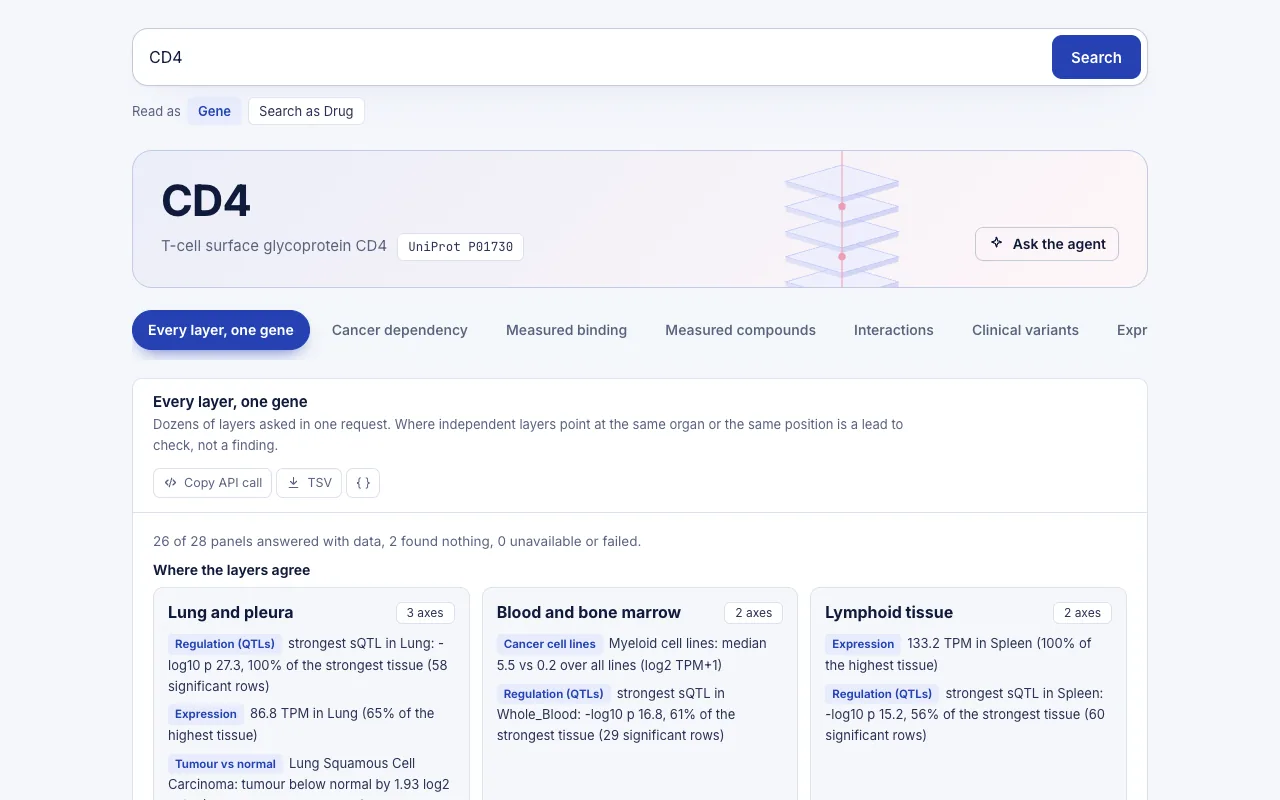
CD4 new study: CAR-NK cells and HIV rebound in context
A CD4-based CAR-NK paper on HIV rebound, placed in context with BioQ data on CD4: DepMap dependency, Open Targets diseases, drugs and Reactome pathways.
GSTM1 new study: cisplatin kidney injury in context
A 2026 paper links GSTM1 loss to worse cisplatin kidney injury; BioQ shows what DepMap, Open Targets, ChEMBL, Reactome and STRING say about GSTM1 today.
JAK2 vs TYK2: dependency and drugs side by side
JAK2 vs TYK2 in DepMap and drug databases: 8 of 1178 cell lines are dependent on JAK2, 11 on TYK2; 47 drugs are known for JAK2 and 20 for TYK2.