

LRRK2 new study: ClC-7 and PIKfyve in context
A new JCB paper links PIKfyve inhibition to LRRK2 via ClC-7; here is what DepMap, Open Targets, ChEMBL, STRING and TCGA show for LRRK2 as of 2026-11-06.
Data as of November 6, 2026 · By the BioQ team
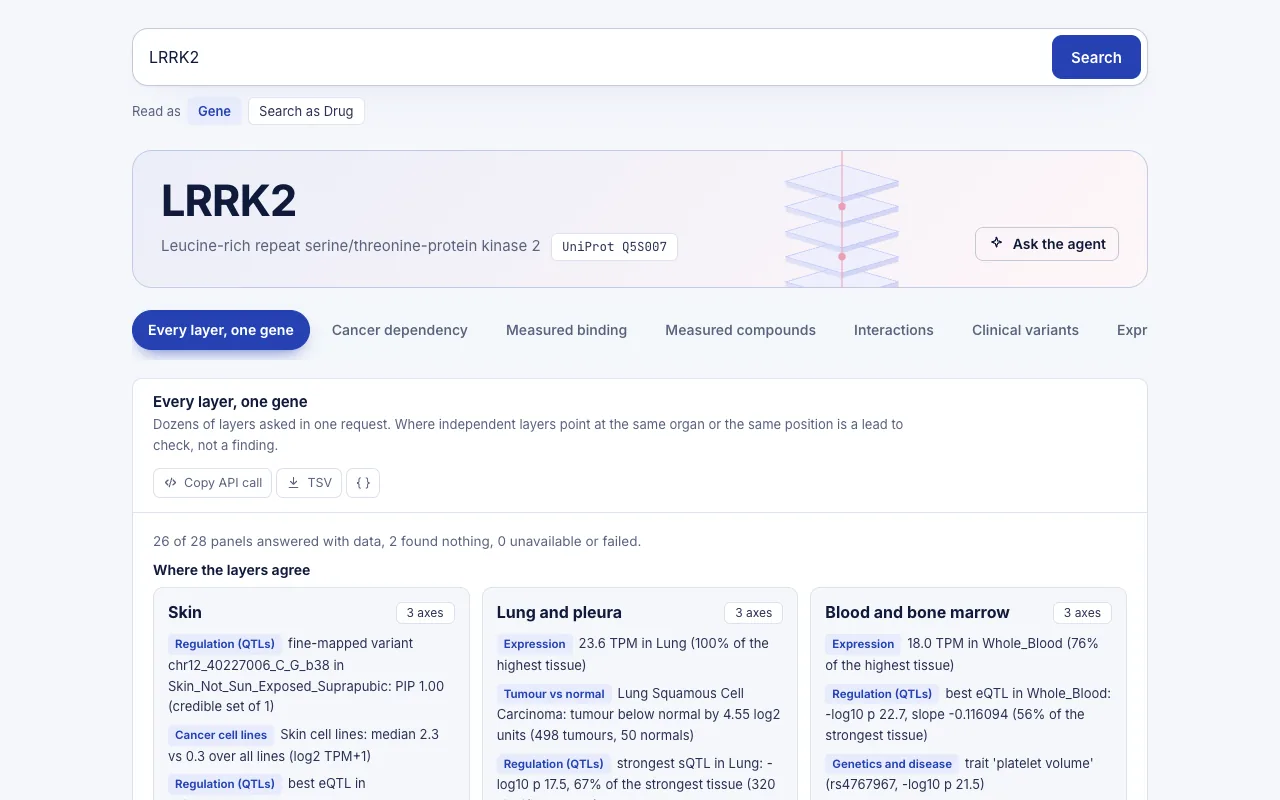
A new LRRK2 study in the Journal of Cell Biology connects PIKfyve inhibition to LRRK2 signalling through ClC-7. The paper's results are the authors' own; BioQ's data, as of 2026-11-06, only add context. LRRK2 is not common essential in DepMap (6 of 1178 cell lines are dependent), and its top Open Targets link is late-onset Parkinson disease, with a score of 0.838.
What we asked: where the new LRRK2 study sits
In the paper, the authors treat cells with a PIKfyve inhibitor. PIKfyve is a lipid kinase found on lysosomes. They report that this brings LRRK2 to the lysosome and increases its signalling, and that the lysosomal ion exchanger ClC-7 is needed for the effect. They also describe a change in how several Rab GTPases collect on lysosomes, with Rab12 named as a notable contributor. A separate set of lysosomal stresses, tied to CASM and GABARAP, is handled as a different route. We do not restate or evaluate those experiments, and BioQ did not reproduce them.
The question we put to BioQ is narrower. Before reading a lysosome-biology paper on LRRK2, what do public data layers already say about the gene? We looked at dependency, known drugs, disease association, tumour expression, pathway membership and interaction partners.
What BioQ returned
The query LRRK2 ran 7 engine queries across 6 distinct resources in 0.83 seconds of engine time. Each block below names its source.
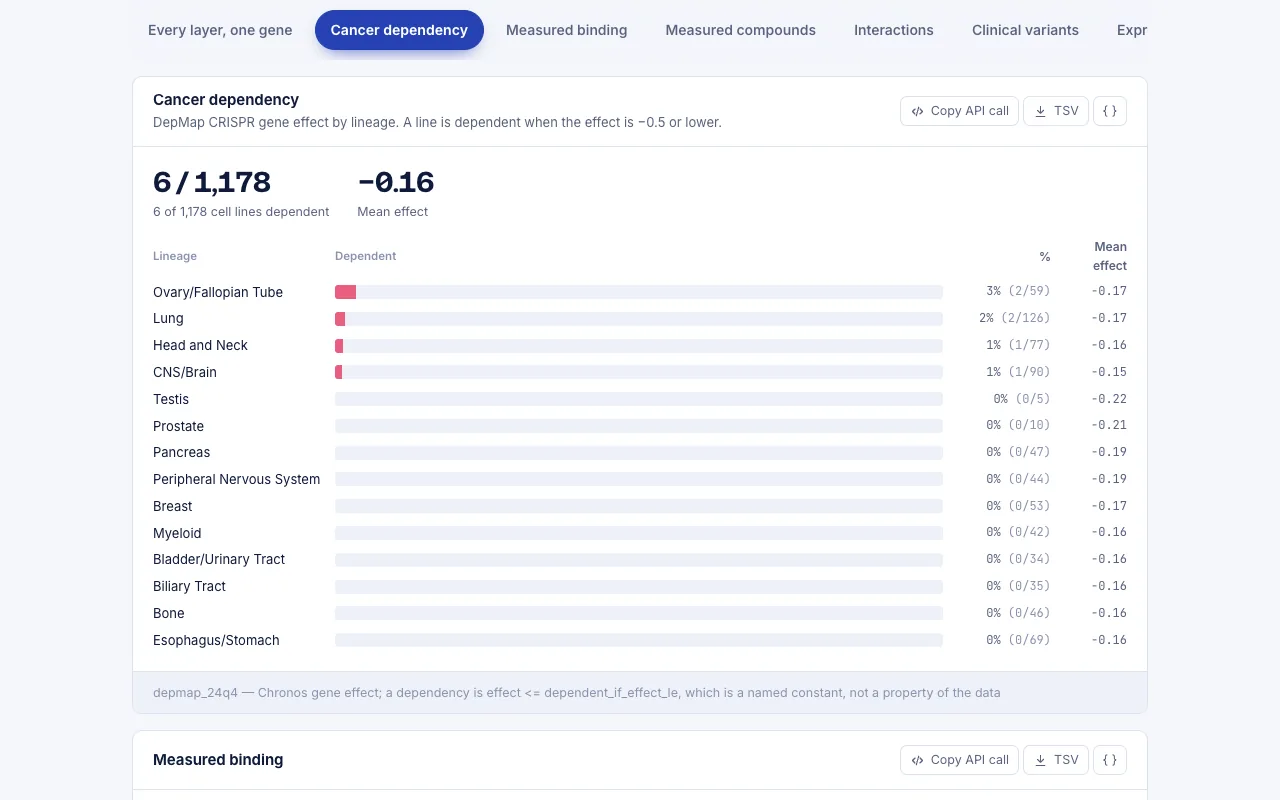
Dependency (DepMap Chronos, release depmap_24q4). Of 1178 cell lines, 6 count as dependent, which is 0.5 percent, and the mean gene effect is -0.155. The gene is not flagged as common essential. The lineages with the most negative means are Testis (-0.218, 5 lines), Prostate (-0.213, 10 lines) and Pancreas (-0.194, 47 lines), and none of them has a dependent line. Two lung lines (of 126) and two ovary/fallopian tube lines (of 59) are dependent. A line counts as dependent when its effect falls below a named threshold, which is a convention and not a biological boundary.
Drugs. BioQ lists 5 compounds for LRRK2. None has a recorded clinical stage, and no trials were found by name.
| Drug | Max clinical stage | Mechanism | Best exact pChEMBL | Type | Trials by name |
|---|---|---|---|---|---|
| Lrrk2-In-1 | UNKNOWN | — | 8.51 | IC50 | 0 |
| Urmc-099 | UNKNOWN | — | 7.96 | IC50 | 0 |
| Czc-54252 | UNKNOWN | — | — | — | 0 |
| Gsk2578215A | UNKNOWN | — | — | — | 0 |
| Pf-06447475 | UNKNOWN | — | — | — | 0 |
Exact IC50-based potency is available for two of them: Lrrk2-In-1 at a pChEMBL of 8.51 and Urmc-099 at 7.96. A higher pChEMBL means stronger potency. The other three have no exact value in this layer.
Disease association (Open Targets). LRRK2 is linked to 916 diseases. The top of the list is Parkinson disease in its different forms, followed by blood and metabolic measurements.
| Disease | Association score | Evidence items |
|---|---|---|
| late-onset Parkinson disease | 0.838 | 1026 |
| Parkinson disease | 0.763 | 6771 |
| young-onset Parkinson disease | 0.59 | 10 |
| platelet volume | 0.531 | 23 |
| low density lipoprotein cholesterol measurement | 0.487 | 11 |
| serum gamma-glutamyl transferase measurement | 0.485 | 14 |
Interaction partners (STRING v12). BioQ returns 3025 partners. RAB29 leads with a score of 995.
| Partner | UniProt | STRING combined score |
|---|---|---|
| RAB29 | O14966 | 995 |
| PARK7 | Q99497 | 988 |
| PRKN | O60260 | 986 |
| SNCA | P37840 | 986 |
| GAK | O14976 | 981 |
| SFN | P31947 | 975 |
Expression and pathways. TCGA/GTEx Toil data cover 24 cancer types with both tumour and normal samples. In Lung Squamous Cell Carcinoma the log2 fold is -0.58 (498 tumours, 50 normals), and in Thyroid Carcinoma it is 0.45 (504 tumours, 59 normals). Reactome returns 4 pathways for LRRK2. The most specific is "PTK6 promotes HIF1A stabilization" (R-HSA-8857538, 7 genes).
What it means and how to read it
Three points help place the paper.
The disease signal comes first. The Open Targets scores for late-onset Parkinson disease (0.838, 1026 evidence items) and Parkinson disease (0.763, 6771 evidence items) fit the field the paper works in, where raised LRRK2 kinase activity is a recognised concern. The association layer says the gene is tied to the disease. It says nothing about the lysosomal mechanism the paper proposes.
The interaction layer is next. The paper deals with Rab GTPases, and RAB29 is the top STRING partner here. STRING scores combine several kinds of evidence, so a high score does not show that a partner acts in the lysosomal pathway the paper describes. Rab12 is not among the six partners shown above, and we make no claim about where it ranks.
Last, the dependency data. A mean Chronos effect of -0.155, with 6 dependent lines out of 1178, suggests that knocking out LRRK2 rarely reduces viability in cultured cancer lines. For readers interested in LRRK2 at the lysosome, this is background about proliferation assays. It does not speak to neuronal or lysosomal function.
The drug layer is thin. Two IC50-based potencies and no clinical stages mean this block should not be read as a map of LRRK2 pharmacology. The paper's use of PIKfyve inhibition is a separate matter, because we ran the query on LRRK2 only.
The BioQ route saves effort mainly because the layers sit in one place. A manual pass over DepMap, Open Targets, ChEMBL, STRING, Reactome and TCGA/GTEx means separate sites with different identifiers and formats. Here the 6 resources came back together, in 0.83 seconds of engine time.
How to reproduce it in BioQ
- Open BioQ and paste the query below into the search box.
- Read the dependency block and check the release label (depmap_24q4) and the dependency threshold that BioQ names.
- Open the drugs block and look at the potency type and the exact pChEMBL values.
- Check the disease association and interaction blocks, then compare the sources they name with the paper's reference list.
LRRK2- To place the paper's other genes in context, repeat the search for PIKfyve, ClC-7 or a Rab gene and compare the same blocks.
Limits: what the data do not show
- The paper's experiments and conclusions belong to its authors. Nothing in BioQ confirms or contradicts them.
- DepMap measures knockout effects on viability in cancer cell lines. It says nothing about lysosomal recruitment, Rab accumulation or kinase signalling.
- The drug block lists compounds with unknown clinical stage and no trials by name. It is not a statement about treatment, and nothing here is medical advice.
- Open Targets scores rank the strength of evidence for an association. They do not show mechanism or direction of effect.
- STRING scores combine several evidence types and do not describe a specific cellular compartment.
- The Reactome entries for LRRK2 are broad signalling pathways and do not cover the lysosomal biology the paper addresses.
- TCGA/GTEx compares bulk tumour and normal tissue, so it does not resolve cell types.
- Data are as of 2026-11-06, and any layer may change after that date.
Data and method
The numbers on this page were read from the BioQ engine on 2026-11-06 (7 queries, 0.8 s of engine time in total). The tables are generated by code from the engine's answers; the text only restates them.
/depmap, /drugs, /interaction, /ot_association, /pathway, /tcga
Sources
- ClC-7 links PIKfyve inhibition to Rab-dependent LRRK2 activity at lysosomes (2026) — doi:10.1083/jcb.202511137
Run the same query yourself: LRRK2
For research use only. This page summarises public data and is not medical advice.
BioQ is an AI search engine and agent with one goal: making biology research 100X faster. Ask in the web app, over the REST API, or from Claude, ChatGPT or Cursor through MCP.
Queries used
Frequently asked questions
Is LRRK2 a DepMap dependency?
Not broadly. In depmap_24q4, 6 of 1178 cell lines are dependent (0.5 percent), the mean Chronos gene effect is -0.155, and LRRK2 is not flagged as common essential.
Which diseases does Open Targets associate with LRRK2?
Open Targets links LRRK2 to 916 diseases. The top entries are late-onset Parkinson disease (score 0.838), Parkinson disease (0.763) and young-onset Parkinson disease (0.59).
Which LRRK2 inhibitors have exact IC50 data in ChEMBL?
Of 5 listed compounds, Lrrk2-In-1 has an exact IC50-based pChEMBL of 8.51 and Urmc-099 has 7.96. The other three have no exact value in this layer, and none has a recorded clinical stage.
What is the strongest STRING partner of LRRK2?
RAB29 is the top partner with a combined score of 995. It is followed by PARK7 (988), then PRKN and SNCA (986 each), out of 3025 partners.
Sources
- Paper ClC-7 links PIKfyve inhibition to Rab-dependent LRRK2 activity at lysosomes (2026) DOI 10.1083/jcb.202511137
- Dataset DepMap CRISPR Chronos gene effect (24Q4)
- Dataset Open Targets Platform; ChEMBL; Drug Repurposing Hub
- Dataset TCGA pan-cancer expression (UCSC Xena Toil recompute)
- Dataset Reactome pathway knowledgebase
- Dataset STRING v12 protein-protein interactions
Results come from public databases as of the date shown and may change. BioQ gives research information, not medical advice.
More from the blog
CD4 new study: CAR-NK cells and HIV rebound in context
A CD4-based CAR-NK paper on HIV rebound, placed in context with BioQ data on CD4: DepMap dependency, Open Targets diseases, drugs and Reactome pathways.
GSTM1 new study: cisplatin kidney injury in context
A 2026 paper links GSTM1 loss to worse cisplatin kidney injury; BioQ shows what DepMap, Open Targets, ChEMBL, Reactome and STRING say about GSTM1 today.
JAK2 vs TYK2: dependency and drugs side by side
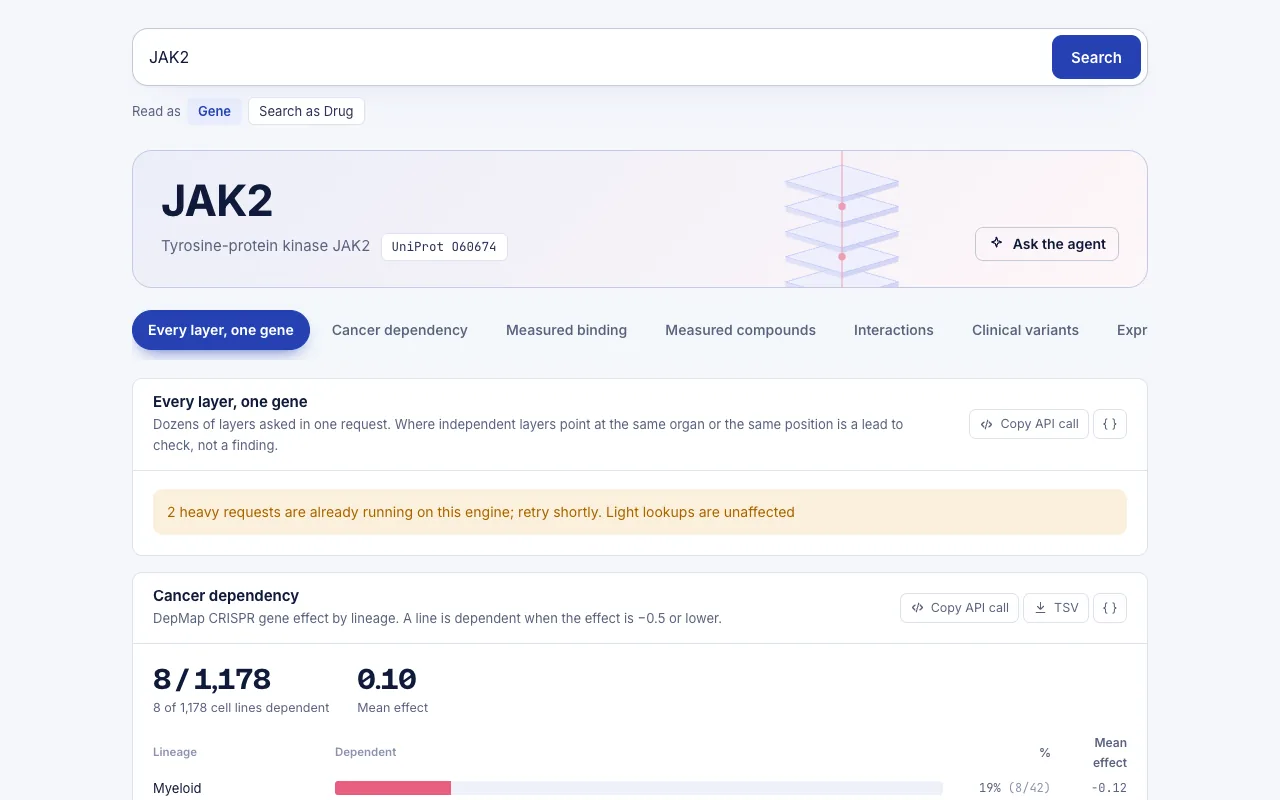
JAK2 vs TYK2 in DepMap and drug databases: 8 of 1178 cell lines are dependent on JAK2, 11 on TYK2; 47 drugs are known for JAK2 and 20 for TYK2.