

Lemborexant Postoperative Sleep Disturbance Trial
NCT07811401 tests lemborexant in postoperative sleep disturbance; BioQ adds ChEMBL potency and 22 ClinicalTrials.gov studies, data as of 2026-11-06.
Data as of November 6, 2026 · By the BioQ team
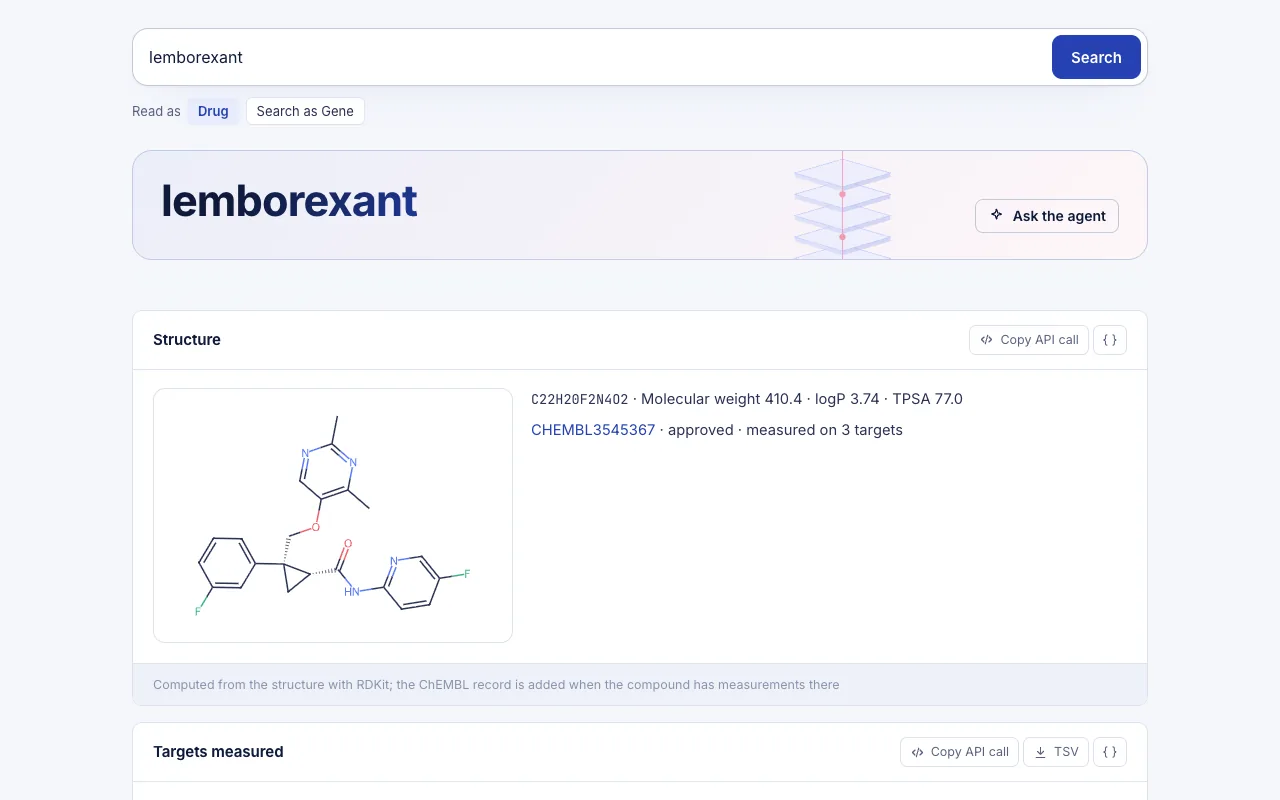
The new Phase 2 lemborexant trial in postoperative sleep disturbance (NCT07811401) enrolls patients undergoing thoracoscopic surgery. For lemborexant, ChEMBL lists 9 targets, and the strongest are the orexin receptors HCRTR2 (best pChEMBL 9.36) and HCRTR1 (8.6). ClinicalTrials.gov lists 22 studies of the drug. All data are as of 2026-11-06.
What we asked
The trial is sponsored by Beijing Tiantan Hospital and is registered as Phase 2. It studies lemborexant for perioperative sleep quality in patients undergoing thoracoscopic surgery. The listed conditions are Postoperative Sleep Disturbance and Thoracoscopic Surgery. Its registered start date is in October, shortly before the date of our data.
A trial watch is only useful with context, so we asked BioQ three things about the intervention:
- What is the compound, and which identifiers does it carry?
- Which targets has it been measured against, and how potently?
- Which other trials of lemborexant are registered, and at which phases?
Dependency of the target in cancer models (DepMap) is not relevant to this indication, so we did not ask for it.
What BioQ returned
BioQ resolved lemborexant to PubChem CID 56944144 and ChEMBL ID CHEMBL3545367. The InChIKey is MUGXRYIUWFITCP-PGRDOPGGSA-N, and PubChem lists 14 synonyms. This matters when you search registries by name, because synonyms can hide trials from a simple string match.
ChEMBL records 9 targets for the compound. Only 3 of them have exact measurements, meaning a defined value rather than a bound such as "greater than". The table shows the top 8.
| ChEMBL target | Gene | Best pChEMBL | Type | Exact measurements |
|---|---|---|---|---|
| CHEMBL4792 | HCRTR2 | 9.36 | KI | 3 |
| CHEMBL5113 | HCRTR1 | 8.6 | KI | 3 |
| CHEMBL240 | KCNH2 | 5.21 | IC50 | 1 |
| CHEMBL2364675 | CYP3A4, CYP3A5, CYP3A43, CYP3A7 | — | — | 0 |
| CHEMBL289 | CYP2D6 | — | — | 0 |
| CHEMBL3356 | CYP1A2 | — | — | 0 |
| CHEMBL3397 | CYP2C9 | — | — | 0 |
| CHEMBL3622 | CYP2C19 | — | — | 0 |
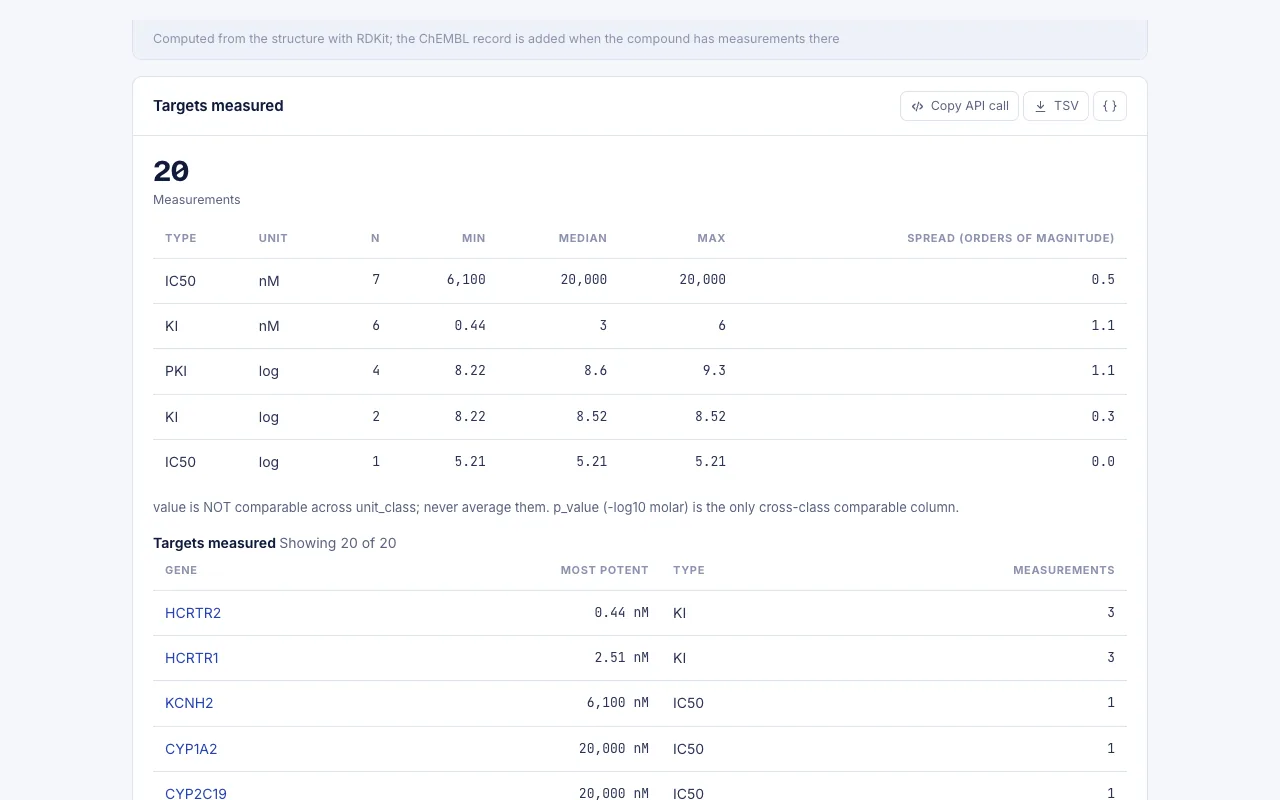
The two orexin receptors lead the list, both with Ki values and 3 exact measurements each. KCNH2 follows with a best pChEMBL of 5.21, an IC50 from a single exact measurement. The CYP rows (CYP3A family, CYP2D6, CYP1A2, CYP2C9, CYP2C19) have no exact potency value in this release.
On the clinical side, the ClinicalTrials.gov snapshot matches 22 studies with lemborexant as an intervention. By phase there are 7 Phase 1, 4 Phase 2 and 5 Phase 3 studies. The table below is one page of 6 of them.
| Trial | Phase | Status | Sponsor | Start | Enrollment |
|---|---|---|---|---|---|
| NCT04555733 | PHASE1 | COMPLETED | Eisai Co., Ltd. | 2020-10 | 26 |
| NCT07480096 | PHASE2 | COMPLETED | Universitas Indonesia | 2024-10 | 82 |
| NCT04890561 | PHASE1 | COMPLETED | Eisai Inc. | 2021-05 | 8 |
| NCT02783729 | PHASE3 | COMPLETED | Eisai Inc. | 2016-05 | 1006 |
| NCT04549168 | PHASE3 | COMPLETED | Eisai Co., Ltd. | 2020-11 | 194 |
| NCT04573556 | — | COMPLETED | Eisai Co., Ltd. | 2020-10 | 550 |
What it means and how to read it
pChEMBL is the negative log10 of the molar potency, so a higher value means a lower concentration is needed. The Ki of the two orexin receptors is a binding measure. In this data set, the biochemical profile of lemborexant is concentrated on HCRTR2 and HCRTR1, and the best value for HCRTR2 (9.36) is higher than for HCRTR1 (8.6). That is consistent with a trial built around sleep. The potency table does not state the functional direction of the binding, so for the mechanism of action you should read the compound's ChEMBL annotation and the primary literature.
The KCNH2 value of 5.21 is far below the orexin values. It rests on one exact measurement, so it is a flag to note rather than a conclusion. The CYP rows show that the compound has been tested against, or annotated for, drug-metabolising enzymes. ChEMBL holds no exact potency for them here.
The registry context shows that lemborexant already has a body of earlier trials. The visible page includes Eisai studies, such as NCT02783729 (Phase 3, 1006 participants) and NCT04549168 (Phase 3, 194 participants). It also includes a completed Phase 2 study from Universitas Indonesia, NCT07480096, with 82 participants. Together they show who has run the drug in earlier phases. They do not tell you whether those studies addressed surgical patients. Open the records and check the conditions before you compare designs.
How to reproduce it in BioQ
- Open BioQ and enter the single-word query below.
- Read the compound block and confirm the ChEMBL ID CHEMBL3545367.
- Open the targets view and sort by best pChEMBL. Check the count of exact measurements next to each value.
- Open the clinical trials view and filter by phase, or search the NCT number from this post to see the Phase 2 record.
- Follow the source label on each row back to ChEMBL, PubChem or ClinicalTrials.gov.
lemborexantThe three lookups drew on 3 distinct resources and took 0.24 engine seconds in total across 3 engine queries. Doing the same by hand means matching identifiers between PubChem and ChEMBL, pulling measurements by target, and paging through the registry. BioQ does that in one query and keeps the source on every row.
Limits: what the data do not show
- The facts here do not include the trial's enrollment, arms, dose, comparator or outcome measures. They say nothing about whether lemborexant helps after thoracoscopic surgery, and no result has been reported.
- The recruitment status of NCT07811401 is not in our facts.
- ChEMBL potency comes from assays in vitro. A Ki at an orexin receptor does not predict a clinical effect in surgical patients.
- Only 3 of 9 targets have exact measurements, and the KCNH2 value comes from a single exact measurement.
- The trial table is one page of 6 studies out of 22. The phase counts cover all matched studies, but the table does not.
- Nothing here is medical advice or a view on how the drug should be used.
Data and method
The numbers on this page were read from the BioQ engine on 2026-11-06 (3 queries, 0.2 s of engine time in total). The tables are generated by code from the engine's answers; the text only restates them.
/chembl_potency, /clinicaltrials, /compound
Sources
- Lemborexant on Perioperative Sleep Quality in Patients Undergoing Thoracoscopic Surgery (2026) — https://clinicaltrials.gov/study/NCT07811401
Run the same query yourself: lemborexant
For research use only. This page summarises public data and is not medical advice.
BioQ is an AI search engine and agent with one goal: making biology research 100X faster. Ask in the web app, over the REST API, or from Claude, ChatGPT or Cursor through MCP.
Queries used
Frequently asked questions
What does NCT07811401 test?
It is a Phase 2 trial sponsored by Beijing Tiantan Hospital. It tests lemborexant for perioperative sleep quality in patients undergoing thoracoscopic surgery. The listed conditions are Postoperative Sleep Disturbance and Thoracoscopic Surgery.
What are the targets of lemborexant in ChEMBL?
ChEMBL lists 9 targets, 3 of them with exact measurements. The strongest are HCRTR2 (best pChEMBL 9.36, Ki) and HCRTR1 (8.6, Ki), followed by KCNH2 at 5.21 (IC50).
How many clinical trials of lemborexant are registered?
The ClinicalTrials.gov snapshot matches 22 studies as of 2026-11-06. Of these, 7 are Phase 1, 4 are Phase 2 and 5 are Phase 3.
What is the ChEMBL ID of lemborexant?
It is CHEMBL3545367. PubChem lists it as CID 56944144 with 14 synonyms.
Sources
- Trial Lemborexant on Perioperative Sleep Quality in Patients Undergoing Thoracoscopic Surgery (2026)
- Dataset ClinicalTrials.gov
- Dataset PubChem
Results come from public databases as of the date shown and may change. BioQ gives research information, not medical advice.
More from the blog
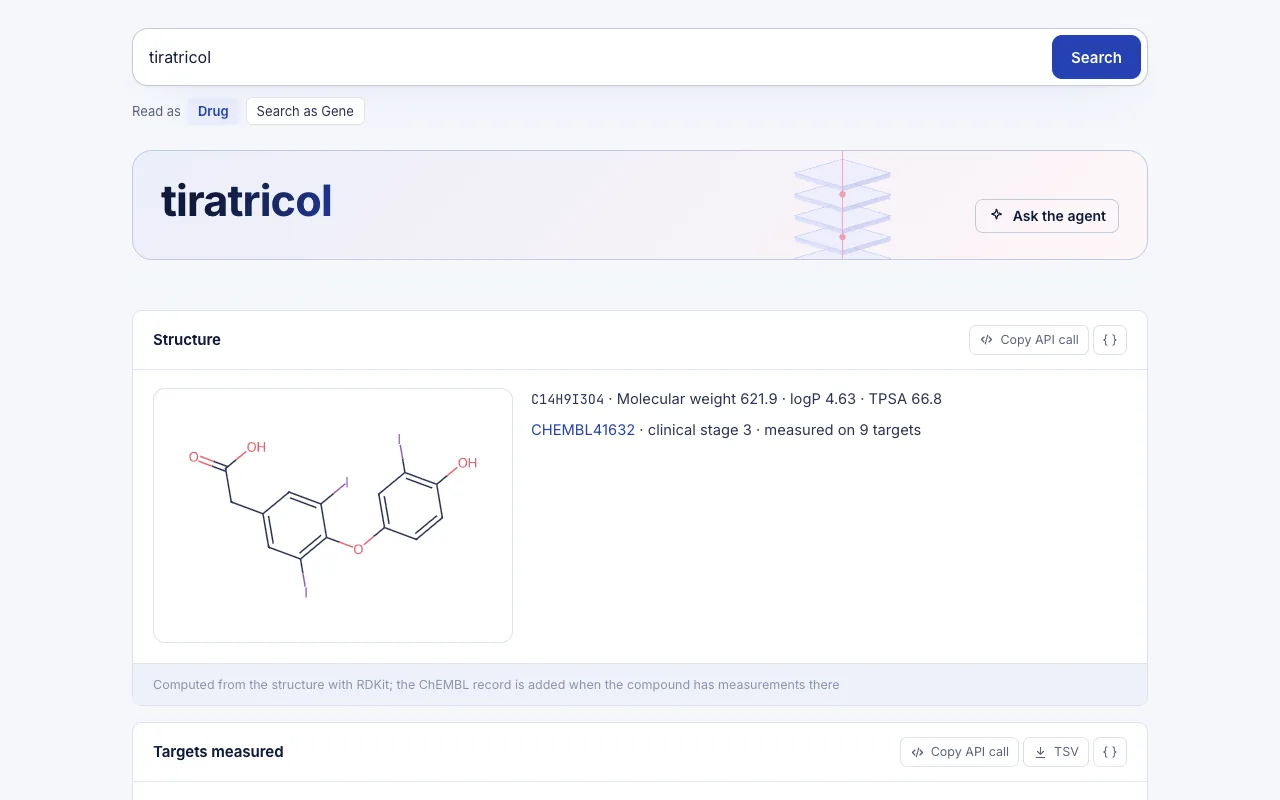
Tiratricol FDA approval: targets and potency in BioQ
Tiratricol FDA approval (Emcitate): ChEMBL shows 68 targets, THRB and THRA top by pChEMBL, and 3 registered trials on ClinicalTrials.gov, as of 2026-11-17.
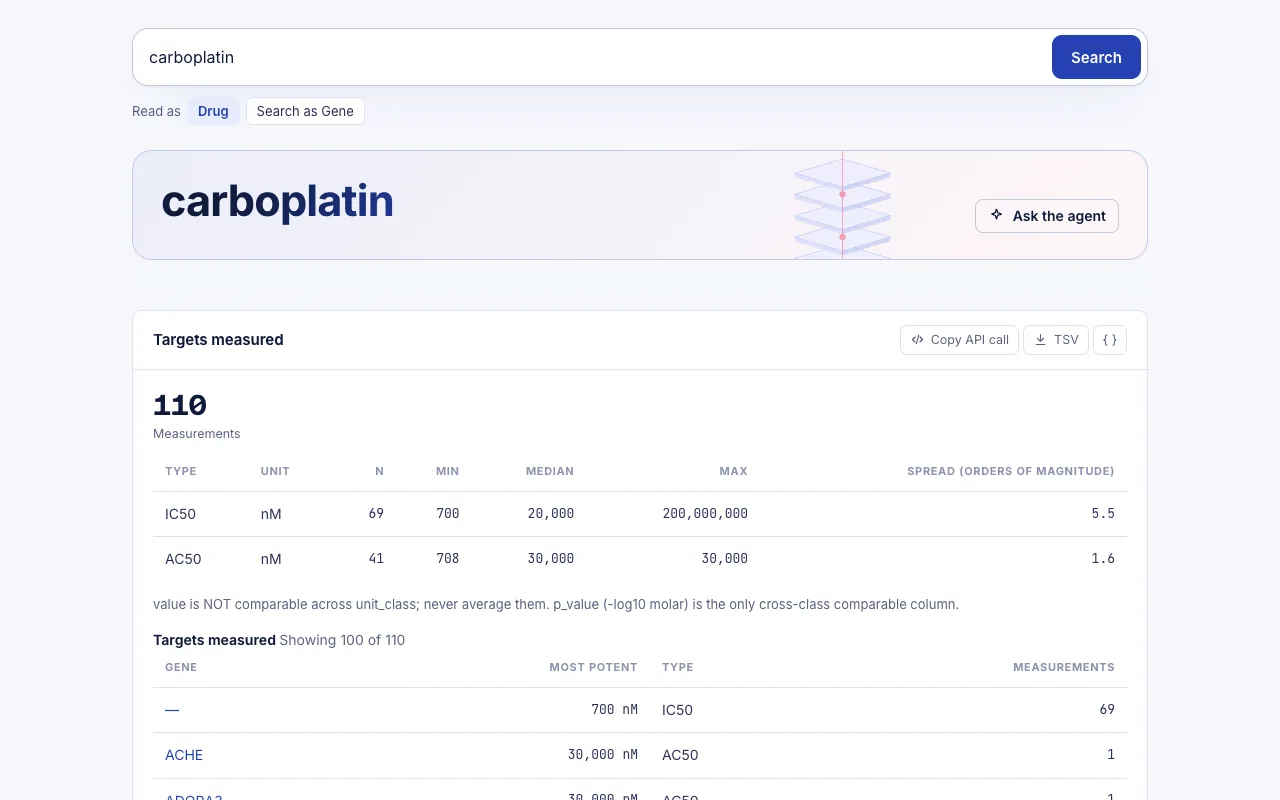
Carboplatin Non-Small Cell Lung Cancer trial: NCT07877584
NCT07877584 is a phase 3 NSCLC trial of PD-1 blockade with or without chemotherapy; BioQ adds carboplatin ChEMBL potency and ClinicalTrials.gov context.
Azacitidine Ropeginterferon trial NCT07646821
Phase 1b/2 trial NCT07646821 adds ropeginterferon alfa-2b to azacitidine in TP53-mutated MDS/AML; ChEMBL, ClinicalTrials.gov and DepMap data as of 2026-11-15.