

Ketamine Asthma Acute trial NCT07728851 (Phase 2)
Phase 2 trial NCT07728851 tests nebulized ketamine in children with acute asthma; BioQ adds ChEMBL potency data and 682 registered ketamine trials.
Data as of November 6, 2026 · By the BioQ team
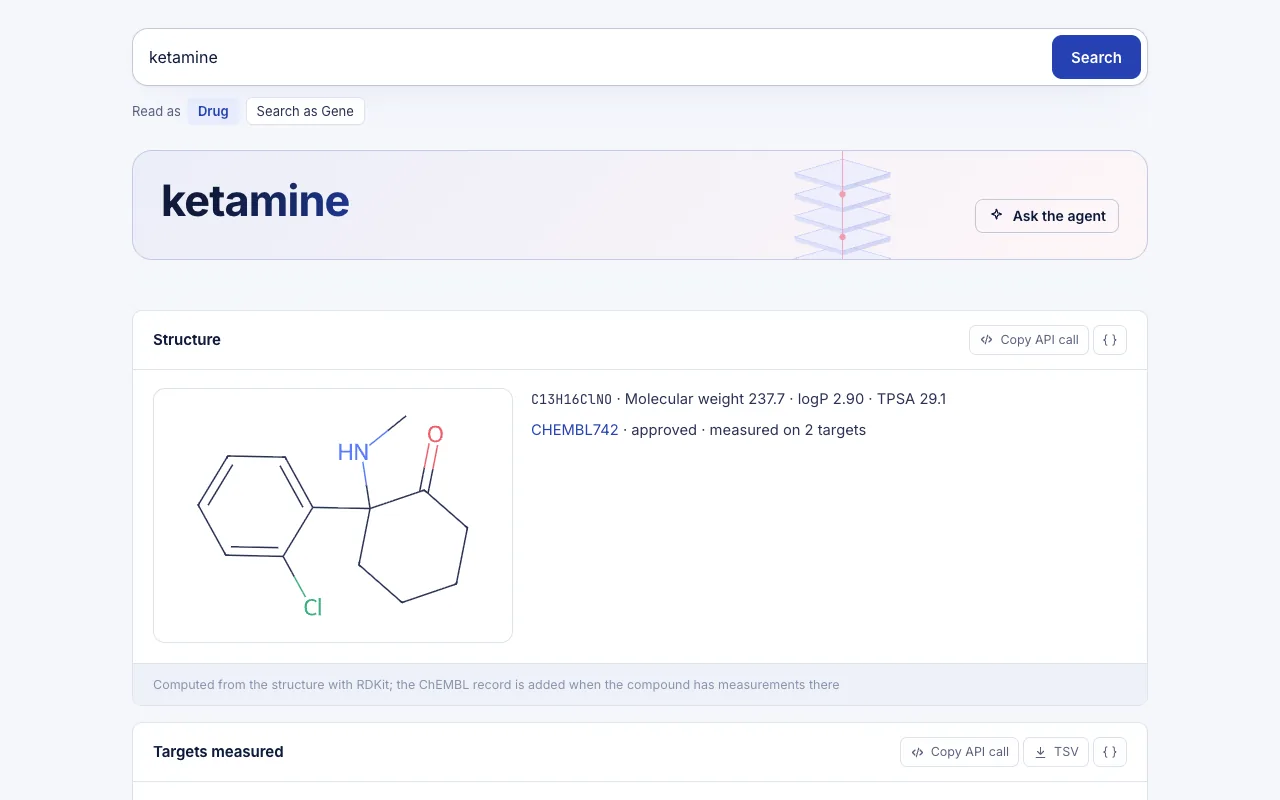
NCT07728851 is a registered Phase 2 trial of nebulized ketamine for severe asthma attacks in children. In ChEMBL, ketamine (CHEMBL742) has 46 targets, and the best measured pChEMBL is 6.75, on NMDA receptor subunit complexes (GRIN1 with GRIN2 family members). ClinicalTrials.gov lists 682 ketamine studies, 157 of them Phase 2. All data are as of 2026-11-06.
What we asked about the ketamine trial in Asthma Acute
The trial is titled "Nebulized Ketamine for Severe Asthma Attacks in Children". Its sponsor is Sultan Qaboos University, the phase is PHASE2, and the listed conditions are Asthma Acute and Exacerbation of Allergic Asthma. Its registered start (2027-01-01) lies after the data date, so no results can exist yet.
A new registration raises four practical questions:
- What is the intervention, as a compound?
- Which molecular targets has it been measured against, and how strongly?
- How many other trials already use it, and in which phases?
- Does target dependency in cancer models matter here? It does not, because this is a respiratory indication, so we left cancer dependency data out.
We ran one query, "ketamine", and let BioQ resolve the compound and fan out to the relevant sources.
What BioQ returned
The compound record from PubChem gives CID 3821, the InChIKey YQEZLKZALYSWHR-UHFFFAOYSA-N and 41 synonyms. It maps to the ChEMBL identifier CHEMBL742, which links the trial's intervention to the potency data below.
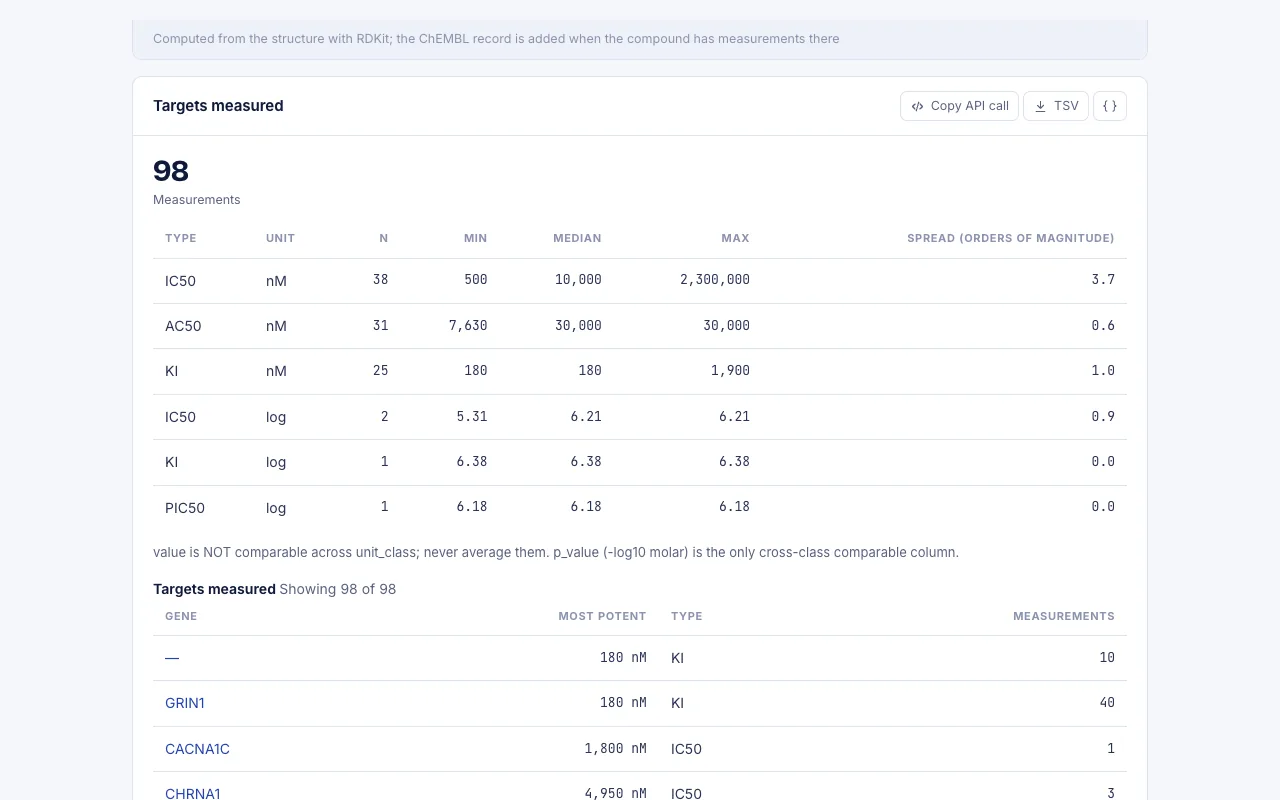
ChEMBL lists 46 targets for ketamine. Only 14 of them have exact measurements, meaning a value reported with an equals relation rather than a bound. The table shows the 8 strongest by best pChEMBL, which is the negative log10 of the molar potency.
| ChEMBL target | Gene | Best pChEMBL | Type | Exact measurements |
|---|---|---|---|---|
| CHEMBL1907604 | GRIN1, GRIN2A | 6.75 | KI | 7 |
| CHEMBL1907608 | GRIN1, GRIN2A, GRIN2B, GRIN2C, GRIN2D, GRIN3B, GRIN3A | 6.75 | KI | 19 |
| CHEMBL2094124 | GRIN1, GRIN2A, GRIN2B, GRIN2D, GRIN3B, GRIN2C, GRIN3A | 6.75 | KI | 4 |
| CHEMBL2096666 | GRIN1, GRIN2B | 6.75 | KI | 1 |
| CHEMBL2096680 | GRIN1, GRIN2A | 6.75 | KI | 2 |
| CHEMBL612545 | — | 6.75 | KI | 8 |
| CHEMBL1907603 | GRIN1, GRIN2B | 6.29 | IC50 | 5 |
| CHEMBL1940 | CACNA1C | 5.75 | IC50 | 1 |
The registered trial landscape for ketamine is much larger than any single indication. Of 682 matched studies, 88 are Phase 1, 157 are Phase 2 and 92 are Phase 3. The table below is a page of 6 studies, not a ranking.
| Trial | Phase | Status | Sponsor | Start | Enrollment |
|---|---|---|---|---|---|
| NCT02397889 | PHASE2/PHASE3 | COMPLETED | Icahn School of Medicine at Mount Sinai | 2015-05 | 30 |
| NCT05217706 | EARLY_PHASE1 | UNKNOWN | Rady Children's Hospital, San Diego | 2022-03 | 30 |
| NCT04082858 | PHASE1 | TERMINATED | St Patrick's Hospital, Ireland | 2020-01 | 3 |
| NCT04101474 | NA | COMPLETED | Assiut University | 2020-09 | 36 |
| NCT06185127 | PHASE3 | COMPLETED | University of Patras | 2019-09 | 50 |
| NCT02958566 | PHASE4 | UNKNOWN | University of Illinois College of Medici | 2017-01 | 80 |
The three queries behind this page drew on 3 distinct resources (ChEMBL, ClinicalTrials.gov and PubChem) and took 0.23 engine seconds in total. Doing the same by hand means resolving the compound name in one database, translating the identifier, searching the trial registry with a matching intervention term and filtering ChEMBL activities by assay type. BioQ does this in one step and names the source for each block.
What it means and how to read it
The strongest exact measurements sit on GRIN-family genes, which encode NMDA receptor subunits. Six of the 8 rows share a best pChEMBL of 6.75, all reported as KI. They differ in which subunit combination the ChEMBL target record represents, from GRIN1 with GRIN2B alone to a record listing many GRIN genes, and one record has no gene mapped. These are overlapping target definitions, so the repeated 6.75 should not be read as six independent confirmations. The number of exact measurements per record ranges from 1 to 19, so the best value rests on very different amounts of evidence.
One row, CHEMBL1907603 (GRIN1, GRIN2B), is an IC50-type value with a best pChEMBL of 6.29. A KI and an IC50 come from different assay designs, so comparing them directly is not clean. CACNA1C, a calcium channel gene, appears at 5.75 from a single exact measurement. That is a lead for follow-up, not an established off-target effect.
For the trial, these data describe the compound and its measured molecular interactions. They are in vitro numbers from ChEMBL. They tell you which targets ketamine binds or inhibits in assays, and how well characterized each is. They do not show what happens in the airways of a child during an asthma attack.
On the registry side, Phase 2 is the largest phase group among the 682 ketamine studies. The sample page also shows that ketamine trials differ in status, from COMPLETED to TERMINATED to UNKNOWN. A new Phase 2 entry therefore joins a crowded intervention field, but the sample does not show whether other trials address asthma. To check that, filter the full trial list by condition.
How to reproduce it in BioQ
- Open BioQ and enter the query below exactly as written.
- Read the compound block first and confirm CHEMBL742 as the resolved identity.
- Open the targets panel and sort by best pChEMBL. Check the exact-measurement column before trusting any value.
- Open the trials panel and use the phase counts to place the new study. Add "asthma" as a condition filter to see related registrations.
- Open the record for NCT07728851 to compare its sponsor, phase and conditions with the other results.
ketamineEach block carries its source and release (ChEMBL for potency, a ClinicalTrials.gov snapshot for trials, PubChem for identity), so you can cite the exact layer behind each number.
Limits: what the data do not show
- The potency data are biochemical. They do not give airway concentrations, dose-response in children or any clinical effect.
- Ketamine's mechanism in acute asthma is not addressed by these facts. Its measured NMDA receptor activity does not by itself explain why the trial's sponsor chose this indication.
- Only 14 of 46 targets have exact measurements, and the table shows only 8 rows. Weaker or bounded values are not displayed.
- The trial list is a page of 6 from 682 studies. Phase counts cover all matches, but they say nothing about quality, outcomes or safety.
- A registered Phase 2 trial with a future start date has no results. Nothing here supports a conclusion about benefit or harm.
- Target dependency in cancer models was not used, as it has no clear bearing on an asthma trial.
Data and method
The numbers on this page were read from the BioQ engine on 2026-11-06 (3 queries, 0.2 s of engine time in total). The tables are generated by code from the engine's answers; the text only restates them.
/chembl_potency, /clinicaltrials, /compound
Sources
- Nebulized Ketamine for Severe Asthma Attacks in Children (2027) — https://clinicaltrials.gov/study/NCT07728851
Run the same query yourself: ketamine
For research use only. This page summarises public data and is not medical advice.
BioQ is an AI search engine and agent with one goal: making biology research 100X faster. Ask in the web app, over the REST API, or from Claude, ChatGPT or Cursor through MCP.
Queries used
Frequently asked questions
What does trial NCT07728851 test?
It is a PHASE2 trial from Sultan Qaboos University called "Nebulized Ketamine for Severe Asthma Attacks in Children". The listed conditions are Asthma Acute and Exacerbation of Allergic Asthma.
What are ketamine's strongest measured targets in ChEMBL?
The best pChEMBL is 6.75, reported as KI on NMDA receptor subunit target records involving GRIN1 and GRIN2 family genes. One further record, GRIN1 with GRIN2B, has a best pChEMBL of 6.29 from an IC50.
How many ketamine trials are registered?
ClinicalTrials.gov lists 682 studies with ketamine as an intervention in this snapshot. Of these, 88 are Phase 1, 157 are Phase 2 and 92 are Phase 3.
How many ketamine targets have exact potency measurements?
ChEMBL lists 46 targets for ketamine (CHEMBL742), and 14 of them have exact measurements. The BioQ table shows the 8 strongest.
How fast does BioQ answer a query such as ketamine?
The 3 engine queries behind this page drew on 3 distinct resources and took 0.23 engine seconds in total.
Sources
- Trial Nebulized Ketamine for Severe Asthma Attacks in Children (2027)
- Dataset ClinicalTrials.gov
- Dataset PubChem
Results come from public databases as of the date shown and may change. BioQ gives research information, not medical advice.
More from the blog
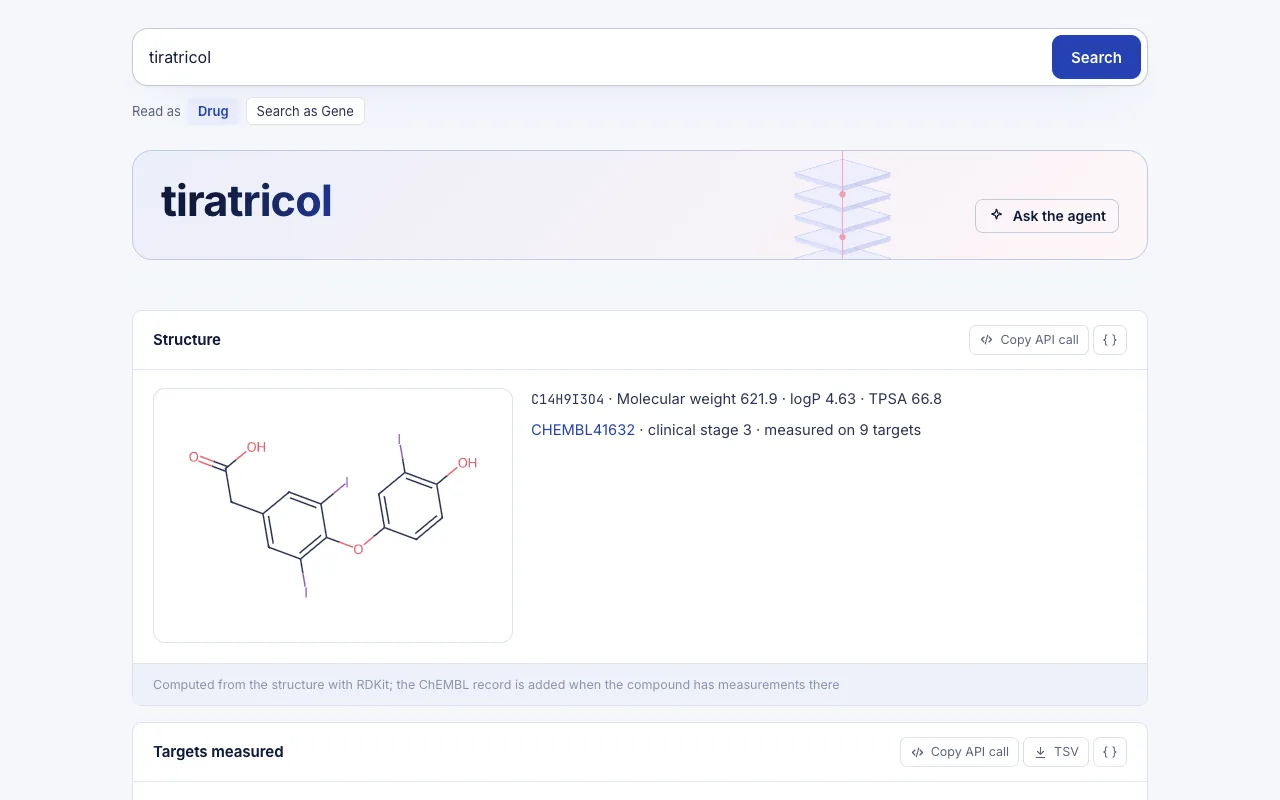
Tiratricol FDA approval: targets and potency in BioQ
Tiratricol FDA approval (Emcitate): ChEMBL shows 68 targets, THRB and THRA top by pChEMBL, and 3 registered trials on ClinicalTrials.gov, as of 2026-11-17.
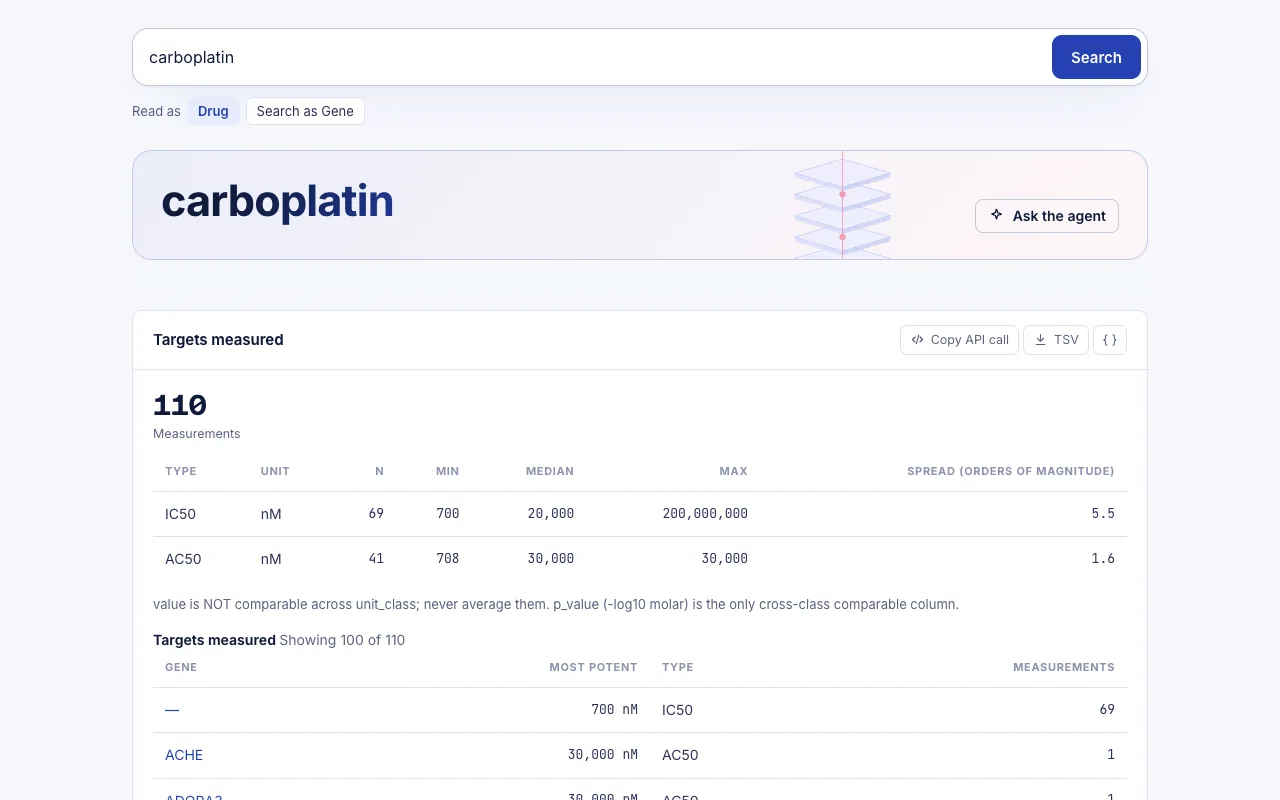
Carboplatin Non-Small Cell Lung Cancer trial: NCT07877584
NCT07877584 is a phase 3 NSCLC trial of PD-1 blockade with or without chemotherapy; BioQ adds carboplatin ChEMBL potency and ClinicalTrials.gov context.
Semaglutide new study: what BioQ data show
A new FAERS paper on semaglutide and panic attacks, set against ChEMBL potency, ClinicalTrials.gov registrations and PubChem identity as of 2026-11-15.