

Drug name to measured targets: imatinib in one query
Type imatinib into BioQ and get its ChEMBL measured targets, potency values, trial counts and PubChem identity in 0.34 engine seconds, data as of 2026-11-06.
Data as of November 6, 2026 · By the BioQ team
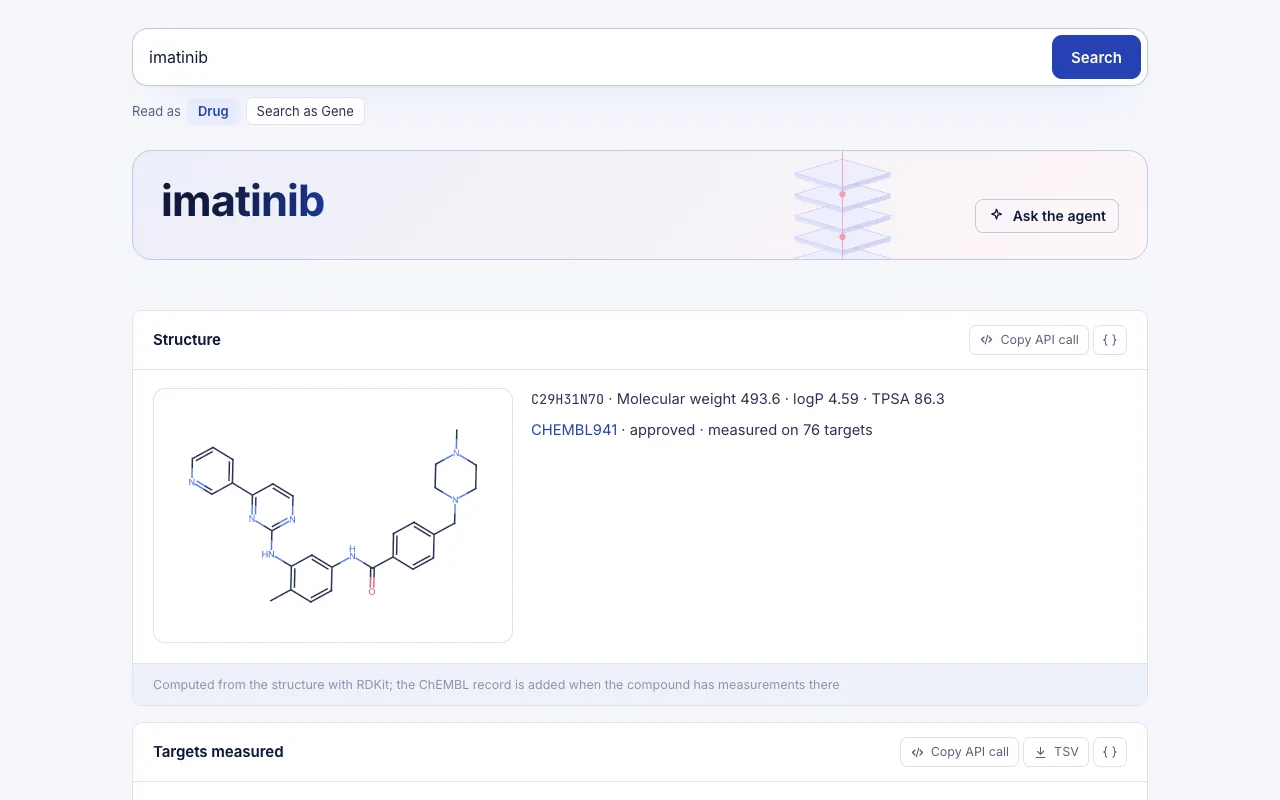
Querying imatinib in BioQ returns 944 ChEMBL targets with recorded activity, 489 of them with at least one exact measurement. This drug name to measured targets lookup drew on 3 resources and took 0.34 engine seconds. The same answer also carries 151 registered trials and the PubChem identity of the compound. All data are as of 2026-11-06.
What we asked: a drug name to measured targets
The task is common. You have a compound name and want to know which proteins it has actually been measured against, how strongly, and how many independent measurements stand behind each number. Typical reasons are checking an imatinib off-target before an experiment, building a polypharmacology list, or collecting candidates for drug repurposing.
The manual route means opening several databases one by one:
- ChEMBL for activity data.
- ClinicalTrials.gov for registered studies.
- PubChem for the compound identity.
You then have to reconcile identifiers between them. The BioQ route is a single query: imatinib. It resolves the name, pulls the potency table and the trial list, and returns each part with its source named.
What BioQ returned
The engine ran 3 queries across 3 distinct resources, for a total of 0.34 engine seconds. That figure is engine time only. It does not include the time you spend reading the result.
Compound identity (PubChem). The name resolves to PubChem CID 5291, InChIKey KTUFNOKKBVMGRW-UHFFFAOYSA-N, with 28 synonyms recorded. The ChEMBL identifier is CHEMBL941. This is the link that lets the activity data and the trial data refer to the same molecule.
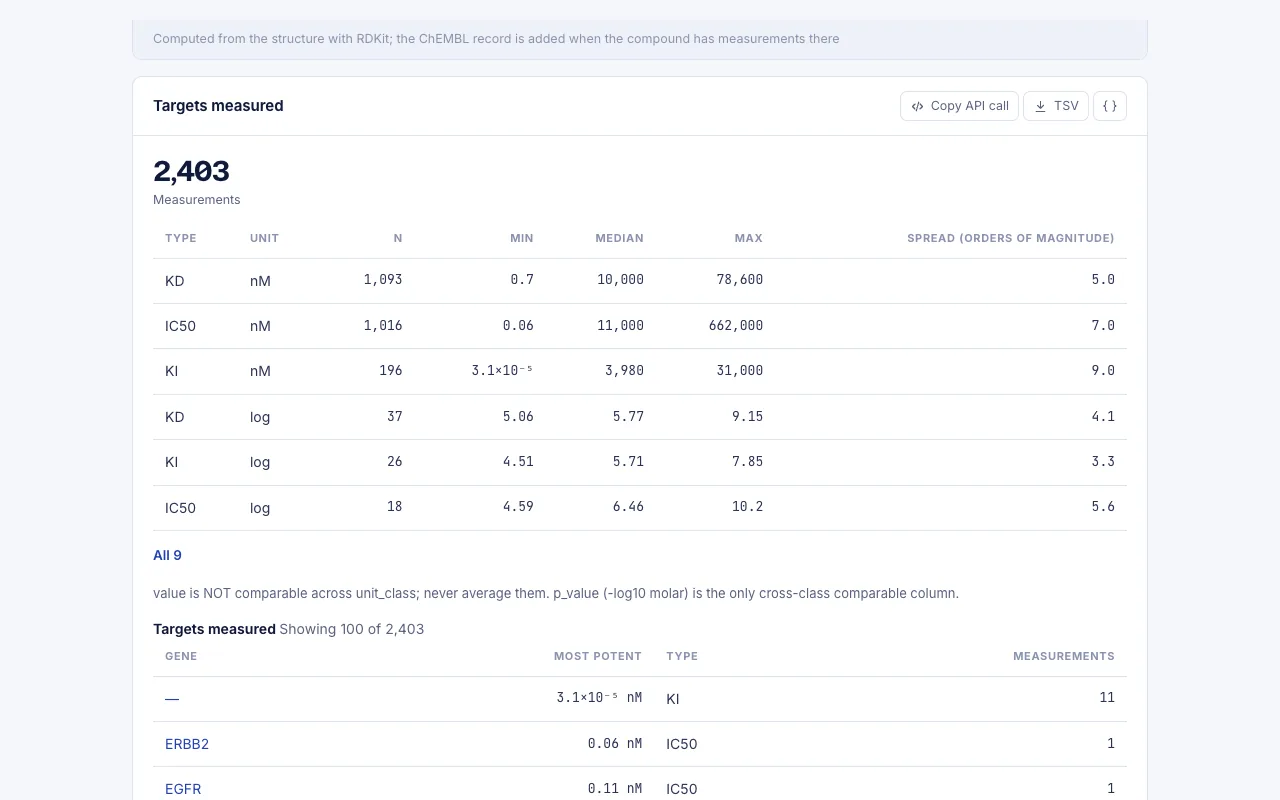
Measured targets (ChEMBL). In total 944 targets have data for CHEMBL941, and 489 of them have exact measurements. The table below shows the 8 strongest by pChEMBL, which is the negative log10 of the molar potency, so a higher value means a stronger measured potency.
| ChEMBL target | Gene | Best pChEMBL | Type | Exact measurements |
|---|---|---|---|---|
| CHEMBL612545 | — | 13.51 | KI | 49 |
| CHEMBL1824 | ERBB2 | 10.22 | IC50 | 1 |
| CHEMBL203 | EGFR | 9.96 | IC50 | 3 |
| CHEMBL385 | — | 9.82 | IC50 | 58 |
| CHEMBL614489 | — | 9.7 | IC50 | 3 |
| CHEMBL5319 | DDR1 | 9.15 | KD | 8 |
| CHEMBL1862 | ABL1 | 9 | KD | 106 |
| CHEMBL2096618 | ABL1, BCR | 8.96 | IC50 | 51 |
Registered trials (ClinicalTrials.gov). The snapshot matches 151 studies with imatinib as the intervention. Of these, 23 are phase 1, 73 are phase 2 and 41 are phase 3. The three phase counts do not add up to the total, because other phases are not broken out here. The table is one page of 6 studies, not the full list.
| Trial | Phase | Status | Sponsor | Start | Enrollment |
|---|---|---|---|---|---|
| NCT03328117 | PHASE1 | COMPLETED | Exvastat Ltd. | 2017-11 | 47 |
| NCT00787384 | PHASE2 | COMPLETED | Northern Italy Leukemia Group | 2004-10 | 25 |
| NCT00751036 | PHASE3 | TERMINATED | Novartis Pharmaceuticals | 2009-06 | 94 |
| NCT04598009 | PHASE2 | RECRUITING | University of California, San Francisco | 2021-03 | 25 |
| NCT04578847 | PHASE2 | UNKNOWN | National Research Center for Hematology, | 2020-01 | 100 |
| NCT05220280 | PHASE4 | UNKNOWN | Clinical Urology and Epidemiology Workin | 2022-02 | 400 |
What it means and how to read it
Read the potency table with three columns side by side: the pChEMBL value, the assay type and the number of exact measurements.
- ABL1 has the most support among the named kinases. It appears with a pChEMBL of 9.0 from KD measurements, backed by 106 exact measurements. A second entry mapped to ABL1 and BCR shows 8.96 from IC50, with 51 measurements. These are the most heavily documented rows in the table.
- Single values deserve caution. ERBB2 has the second-highest value, 10.22, but it rests on 1 exact measurement. EGFR shows 9.96 from 3 measurements. A high number with a count of 1 is a lead to verify in the original assay record, not a settled potency.
- Some targets have no gene symbol here. CHEMBL612545 has the highest value, 13.51 (type KI, 49 measurements), and CHEMBL385 and CHEMBL614489 also appear without a gene. Open the ChEMBL target record to see what the entity is before drawing conclusions. It may be an organism-level or non-human target.
- KIT and PDGFR are not in these 8 rows. If you came for the ABL1, KIT and PDGFR picture, raise the row limit or look at the full list of 944. The top-8 view is a ranking by best value, not a selectivity profile.
- DDR1 is an example of a less obvious hit. It appears with 9.15 from KD and 8 exact measurements.
For next steps, treat the list as a hypothesis set. For an off-target check, take the rows with several exact measurements and compare assay types. For repurposing, cross the gene symbols with the disease context you care about and look at the trial list for what has already been registered.
How to reproduce it in BioQ
- Open BioQ and paste the query below into the search box.
imatinib- Check that the compound resolved to CHEMBL941 (PubChem CID 5291). If the name is ambiguous, repeat the search with the identifier.
- In the targets view, read the pChEMBL column, then check the exact-measurement count for each row you plan to use.
- Extend the list beyond the 8 rows shown to look for specific families such as KIT or PDGFR.
- Open the trials block and check phase and status to see what has been registered.
- Note the ChEMBL release label shown with the result and the data date (2026-11-06) in your lab notes, so the result can be repeated later.
Limits: what the data do not show
- A pChEMBL value is a measured potency in a given assay. It does not say whether the interaction matters in cells, tissue or patients.
- The count of exact measurements reflects how often a target was tested and reported. Well-studied targets accumulate more data, so a low count can mean little testing as well as weak activity.
- Mixed assay types (KI, KD, IC50) are not strictly interchangeable. Compare like with like where you can.
- The 8 rows are a ranking of the strongest values, not a complete selectivity panel. Targets that were never tested do not appear, and absence is not evidence of no binding.
- Several rows carry no gene symbol in this view, so mapping them to proteins needs a manual check in the source record.
- The trial block counts registered studies. It says nothing about outcomes, and the phase counts shown cover only phases 1 to 3.
- This article describes data retrieval. It gives no medical, dosing or treatment guidance.
Data and method
The numbers on this page were read from the BioQ engine on 2026-11-06 (3 queries, 0.3 s of engine time in total). The tables are generated by code from the engine's answers; the text only restates them.
/chembl_potency, /clinicaltrials, /compound
Run the same query yourself: imatinib
For research use only. This page summarises public data and is not medical advice.
BioQ is an AI search engine and agent with one goal: making biology research 100X faster. Ask in the web app, over the REST API, or from Claude, ChatGPT or Cursor through MCP.
Queries used
Frequently asked questions
How many targets has imatinib been measured against in ChEMBL?
In ChEMBL, 944 targets have data for imatinib (CHEMBL941), and 489 of them have exact measurements. The default view shows the 8 strongest by pChEMBL.
Which imatinib target has the most exact measurements in the top results?
Among the 8 rows shown, ABL1 (KD, pChEMBL 9.0) has 106 exact measurements. The next largest counts are 58 for CHEMBL385 and 51 for the entry mapped to ABL1 and BCR.
What does pChEMBL mean in the imatinib target table?
pChEMBL is the negative log10 of the molar potency, so a higher number means a stronger measured potency. The table also shows the assay type and the count of exact measurements, which tell you how much support a value has.
How long does the imatinib query take in BioQ?
The engine ran 3 queries across 3 distinct resources in 0.34 seconds in total. That is engine time only, not reading or checking time.
How many imatinib trials are registered?
The ClinicalTrials.gov snapshot matches 151 studies, of which 23 are phase 1, 73 are phase 2 and 41 are phase 3. The data are as of 2026-11-06.
Sources
- Dataset ClinicalTrials.gov
- Dataset PubChem
Results come from public databases as of the date shown and may change. BioQ gives research information, not medical advice.
More from the blog
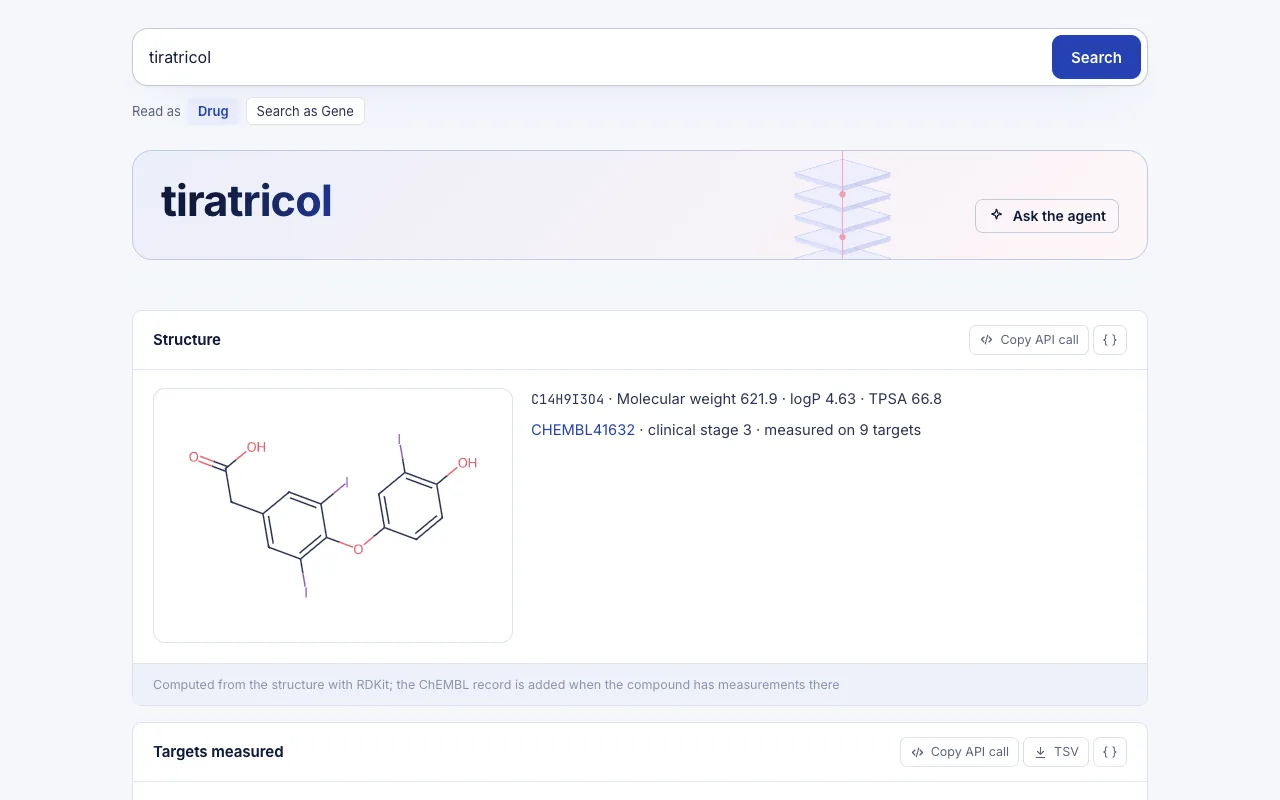
Tiratricol FDA approval: targets and potency in BioQ
Tiratricol FDA approval (Emcitate): ChEMBL shows 68 targets, THRB and THRA top by pChEMBL, and 3 registered trials on ClinicalTrials.gov, as of 2026-11-17.
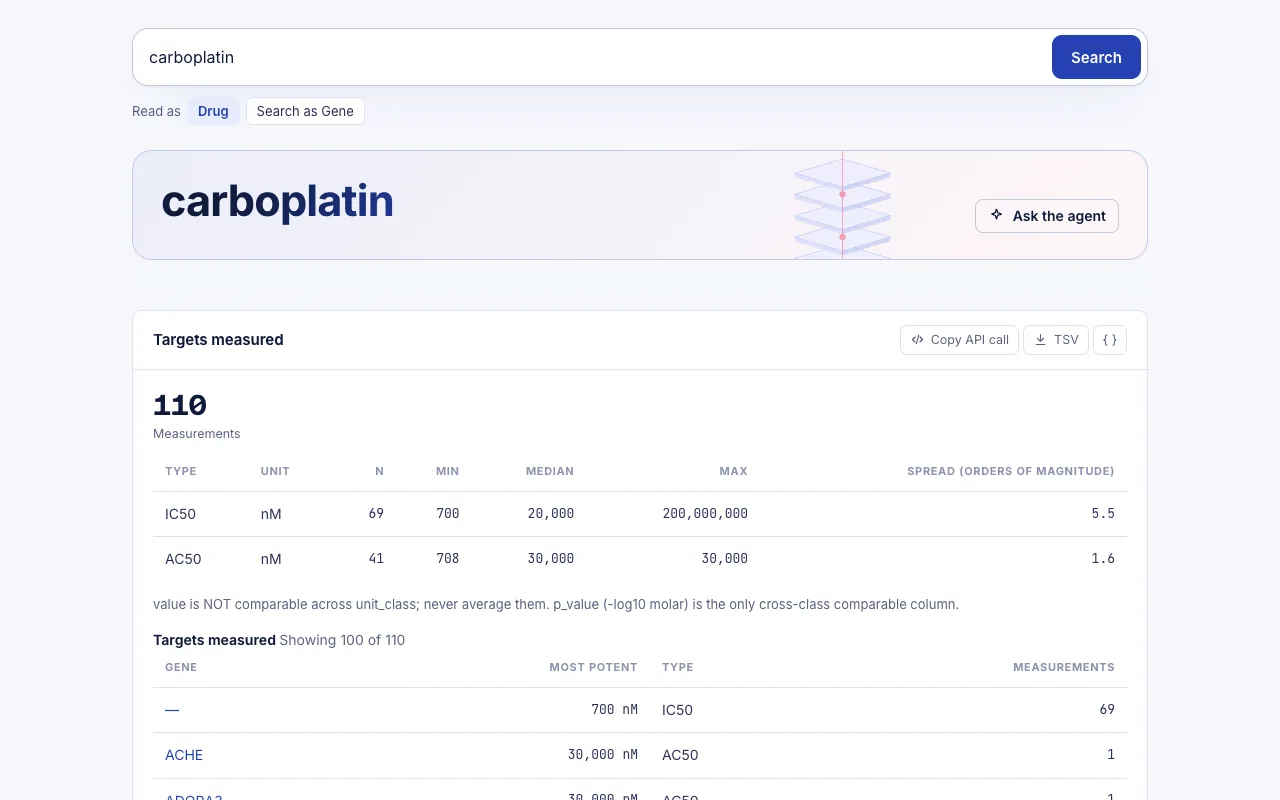
Carboplatin Non-Small Cell Lung Cancer trial: NCT07877584
NCT07877584 is a phase 3 NSCLC trial of PD-1 blockade with or without chemotherapy; BioQ adds carboplatin ChEMBL potency and ClinicalTrials.gov context.
Azacitidine Ropeginterferon trial NCT07646821
Phase 1b/2 trial NCT07646821 adds ropeginterferon alfa-2b to azacitidine in TP53-mutated MDS/AML; ChEMBL, ClinicalTrials.gov and DepMap data as of 2026-11-15.