

Clinical evidence for cancer variants: BRAF in CIViC
How to pull clinical evidence for cancer variants of BRAF from CIViC with one BioQ query, with evidence levels, drugs and disease links as of 2026-11-06.
Data as of November 6, 2026 · By the BioQ team
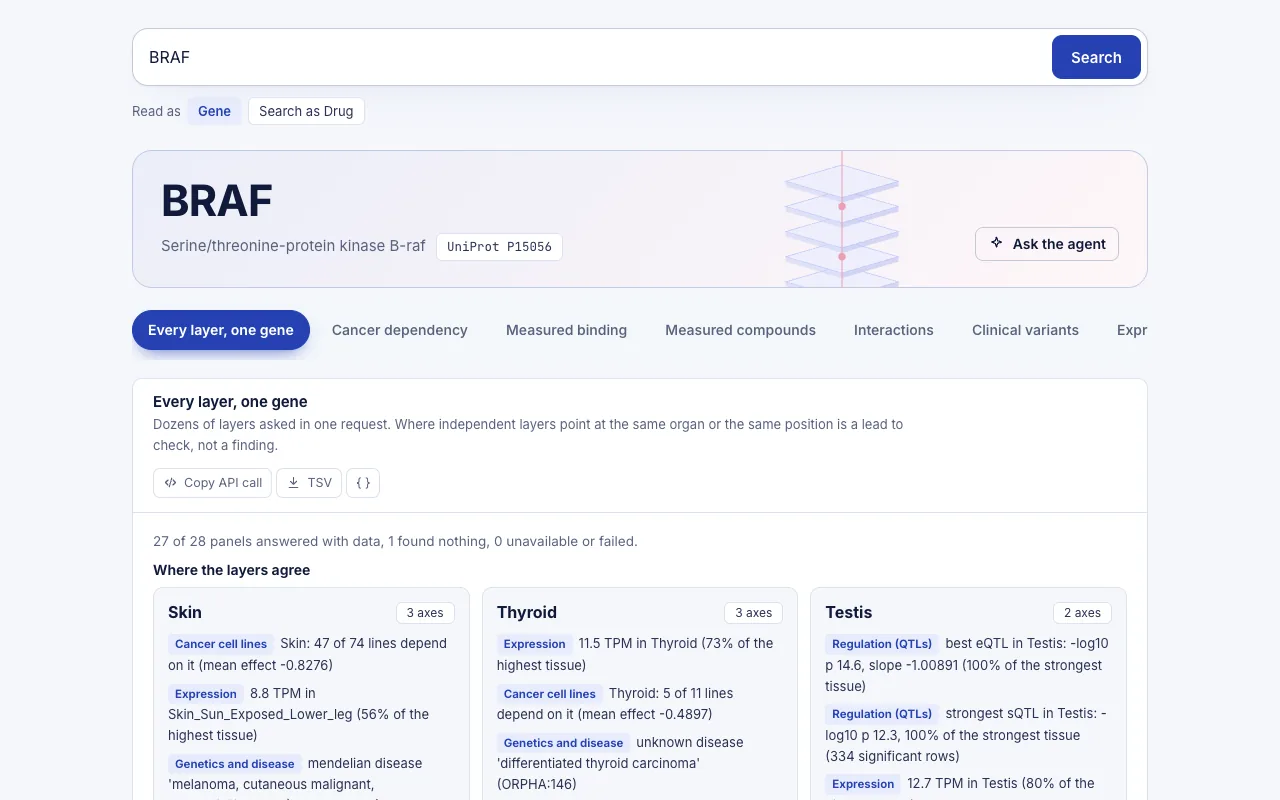
Clinical evidence for cancer variants of BRAF is one query away: CIViC holds 269 evidence records for the gene, and BioQ returned the first 6 together with Open Targets disease associations and a list of 29 known drugs. The engine ran 3 queries in 0.32 seconds in total. All data are as of 2026-11-06.
What we asked: clinical evidence for cancer variants of BRAF
The task is common. You have a gene, here BRAF, and you want to know which variants carry published clinical evidence, in which diseases, with which therapies, and at what evidence level. The next question is usually which diseases and drugs the gene is linked to at all.
The manual route is to open CIViC for the variant evidence, Open Targets for disease associations, then ChEMBL and ClinicalTrials.gov for compounds and trials. Each has its own gene search, its own columns and its own sort order, and you reconcile them yourself. In BioQ the same task is one query: BRAF.
What BioQ returned
The answer drew on 3 distinct resources through 3 engine queries, in 0.32 engine seconds in total. Each block names its source and release. The first block is CIViC (nightly release). Its evidence levels run from A to E, and A is the strongest. It holds 269 records for BRAF, and the table shows 6.
| Molecular profile | Disease | Therapies | Evidence level | Significance |
|---|---|---|---|---|
| BRAF V600 | Melanoma | — | B | Positive |
| BRAF V600E AND BRAF V600M | Melanoma | Dabrafenib | C | Sensitivity/Response |
| BRAF V600E | Thyroid Cancer | — | B | Positive |
| BRAF V600E | Papillary Thyroid Carcinoma | — | B | Positive |
| BRAF V600E | Melanoma | — | B | Poor Outcome |
| BRAF V600E | Melanoma | Trametinib, Mirdametinib | D | Resistance |
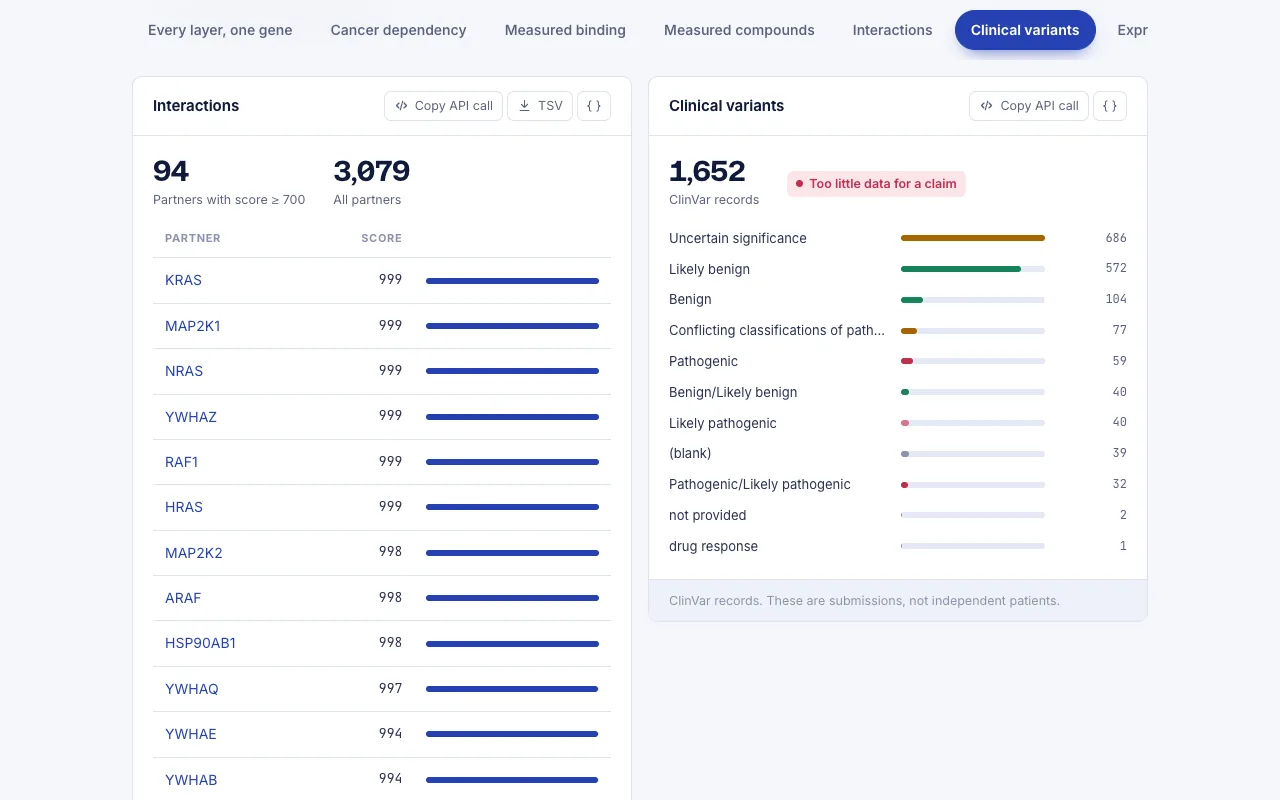
The second block is Open Targets, which scores gene-disease associations from 0 to 1. It lists 2978 diseases for BRAF, and the table shows the top 6.
| Disease | Association score | Evidence items |
|---|---|---|
| cardiofaciocutaneous syndrome | 0.878 | 291 |
| Noonan syndrome | 0.839 | 199 |
| melanoma | 0.82 | 13539 |
| cardiofaciocutaneous syndrome 1 | 0.764 | 172 |
| Noonan syndrome 7 | 0.76 | 179 |
| LEOPARD syndrome 3 | 0.757 | 152 |
The third block lists drugs known for the gene by clinical stage. It found 29 drugs and shows 6. pChEMBL is the negative log10 of the molar potency, so a higher value means stronger potency.
| Drug | Max clinical stage | Mechanism | Best exact pChEMBL | Type | Trials by name |
|---|---|---|---|---|---|
| Encorafenib | APPROVAL | Serine/threonine-protein kinase B-raf inhibitor | 9.52 | IC50 | 55 |
| Dabrafenib | APPROVAL | Serine/threonine-protein kinase B-raf inhibitor | 9.4 | IC50 | 102 |
| Sorafenib | APPROVAL | Serine/threonine-protein kinase B-raf inhibitor | 9 | IC50 | 363 |
| Regorafenib | APPROVAL | Serine/threonine-protein kinase B-raf inhibitor | 8.82 | IC50 | 182 |
| Vemurafenib | APPROVAL | Serine/threonine-protein kinase B-raf inhibitor | 8.49 | IC50 | 114 |
| Tovorafenib | APPROVAL | RAF serine/threonine protein kinase inhibitor | 7.03 | IC50 | 11 |
What it means and how to read it
Variant evidence. The CIViC rows are about BRAF V600E and related V600 profiles, and they point in different directions. In melanoma, V600E has a Positive entry at level B and a Poor Outcome entry, also at level B. It also has a Resistance entry at level D for Trametinib and Mirdametinib. The profile "BRAF V600E AND BRAF V600M" in melanoma links to Dabrafenib at level C with Sensitivity/Response. So the "Significance" column matters as much as the level. A level B row can describe prognosis or a diagnostic association rather than drug response, and you should read both columns together. Use this view to decide which rows to open in CIViC, not as a conclusion.
Predictive biomarker or not. For a predictive biomarker claim, filter on a therapy being named and on a response or resistance significance. Several rows here leave the therapy cell empty. They record an association with disease or outcome, not a drug-specific prediction.
Disease associations. The Open Targets top 6 is led by cardiofaciocutaneous syndrome (0.878) and Noonan syndrome (0.839), with melanoma at 0.82. Melanoma has 13539 evidence items, far more than the syndromes at the top of the list. The score reflects the aggregate of evidence types, so a higher score does not mean more evidence. These syndromes are germline conditions, which is a different context from somatic cancer variants. Keep the two apart when you write about BRAF.
Drugs. All 6 drugs shown have the clinical stage APPROVAL and are annotated as inhibitors of B-raf or RAF kinases. Encorafenib has the highest best exact pChEMBL (9.52, IC50), followed by Dabrafenib (9.4). Vemurafenib is at 8.49. The "Trials by name" column counts trials that match the drug name (Dabrafenib 102, Vemurafenib 114). It is not a count of BRAF-specific trials, and it says nothing about outcomes.
Next steps. Pick the variant and disease you care about and open the matching CIViC records to read the underlying citations. Then narrow the query to that variant, for example BRAF V600E in a single tumour type, and check the trial list for the drugs that appear.
How to reproduce it in BioQ
- Open BioQ and start a new search.
- Enter the gene symbol exactly as below.
BRAF- Read the CIViC block first. Check the evidence level and the significance column for each row.
- Compare the Open Targets block against the CIViC rows to see whether the disease context matches your question.
- Open the drug block for stage, mechanism and potency, and follow the named source for any row you plan to cite.
Every row carries its source and release, so you can check a value against the original resource.
Limits: what the data do not show
- The tables show 6 rows each. CIViC holds 269 records for BRAF, so most of the evidence is not on this page. Row order is not a ranking of importance.
- CIViC levels grade the strength of the evidence, not the size of a clinical benefit. Nothing here tells you whether a patient should receive a drug.
- Some CIViC rows have no therapy listed, so they cannot be read as drug-response evidence.
- Open Targets scores combine many evidence types. They do not separate germline from somatic context.
- pChEMBL values come from biochemical measurements. They do not predict clinical response, and the best exact value per drug can come from different assays.
- The trial counts are matches by drug name. They include trials unrelated to BRAF and say nothing about results.
- The data are a snapshot as of 2026-11-06, and CIViC updates nightly. Re-run the query before you cite a record.
Data and method
The numbers on this page were read from the BioQ engine on 2026-11-06 (3 queries, 0.3 s of engine time in total). The tables are generated by code from the engine's answers; the text only restates them.
/civic, /drugs, /ot_association
Run the same query yourself: BRAF
For research use only. This page summarises public data and is not medical advice.
BioQ is an AI search engine and agent with one goal: making biology research 100X faster. Ask in the web app, over the REST API, or from Claude, ChatGPT or Cursor through MCP.
Queries used
Frequently asked questions
How many CIViC evidence records exist for BRAF?
CIViC holds 269 evidence records for BRAF as of 2026-11-06. The BioQ query for BRAF shows 6 of them, with variant, disease, therapies, evidence level and significance.
What does the CIViC evidence level mean?
Levels run from A to E, and A is the strongest. In the BRAF results, BRAF V600E in melanoma appears at levels B and D, and the profile combining V600E and V600M with Dabrafenib appears at level C.
Which BRAF V600E entries are listed for melanoma?
The 6 shown rows include BRAF V600E in melanoma with significance Poor Outcome (level B), and with Resistance for Trametinib and Mirdametinib (level D). Because only 6 of 269 records are displayed, this is a sample, not the full picture.
How many drugs does BioQ list for BRAF?
BioQ found 29 drugs for BRAF and shows 6, all with the maximum clinical stage APPROVAL. Encorafenib has the highest best exact pChEMBL of those shown (9.52).
How long does the BRAF query take?
The engine ran 3 queries across 3 distinct resources in 0.32 seconds in total. That is the measured engine time, not an estimate of time saved.
Sources
Results come from public databases as of the date shown and may change. BioQ gives research information, not medical advice.
More from the blog
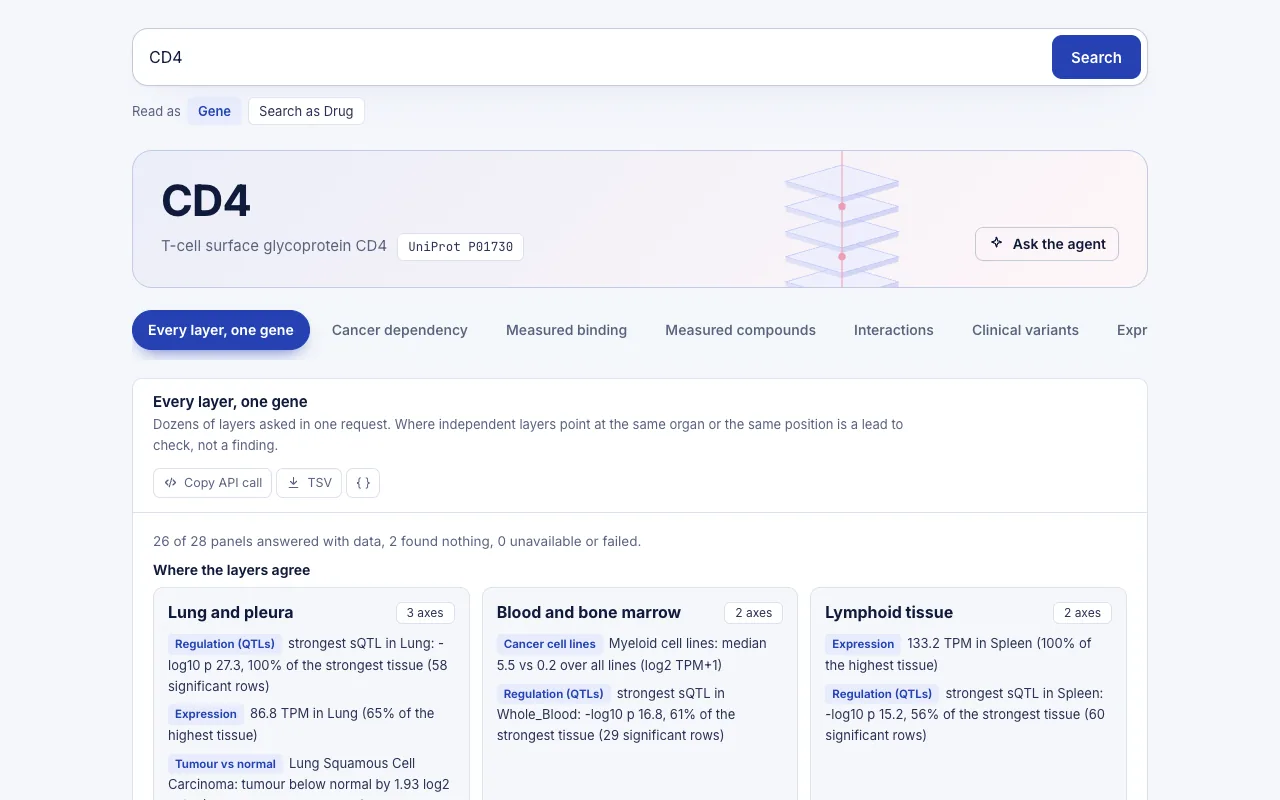
CD4 new study: CAR-NK cells and HIV rebound in context
A CD4-based CAR-NK paper on HIV rebound, placed in context with BioQ data on CD4: DepMap dependency, Open Targets diseases, drugs and Reactome pathways.
GSTM1 new study: cisplatin kidney injury in context
A 2026 paper links GSTM1 loss to worse cisplatin kidney injury; BioQ shows what DepMap, Open Targets, ChEMBL, Reactome and STRING say about GSTM1 today.
MYC new study: HCC microbiome paper and MYC data
A paper watch on Bacteroidetes and HCC immunotherapy resistance, with what DepMap, Open Targets, TCGA, CIViC and STRING show about MYC as of 2026-11-14.