

FGFR3 dependency and drugs in one query
FGFR3 dependency and drugs from seven public layers: 6 of 1178 DepMap lines depend on it, 32 drugs are listed, and bladder carcinoma is a top disease.
Data as of November 6, 2026 · By the BioQ team
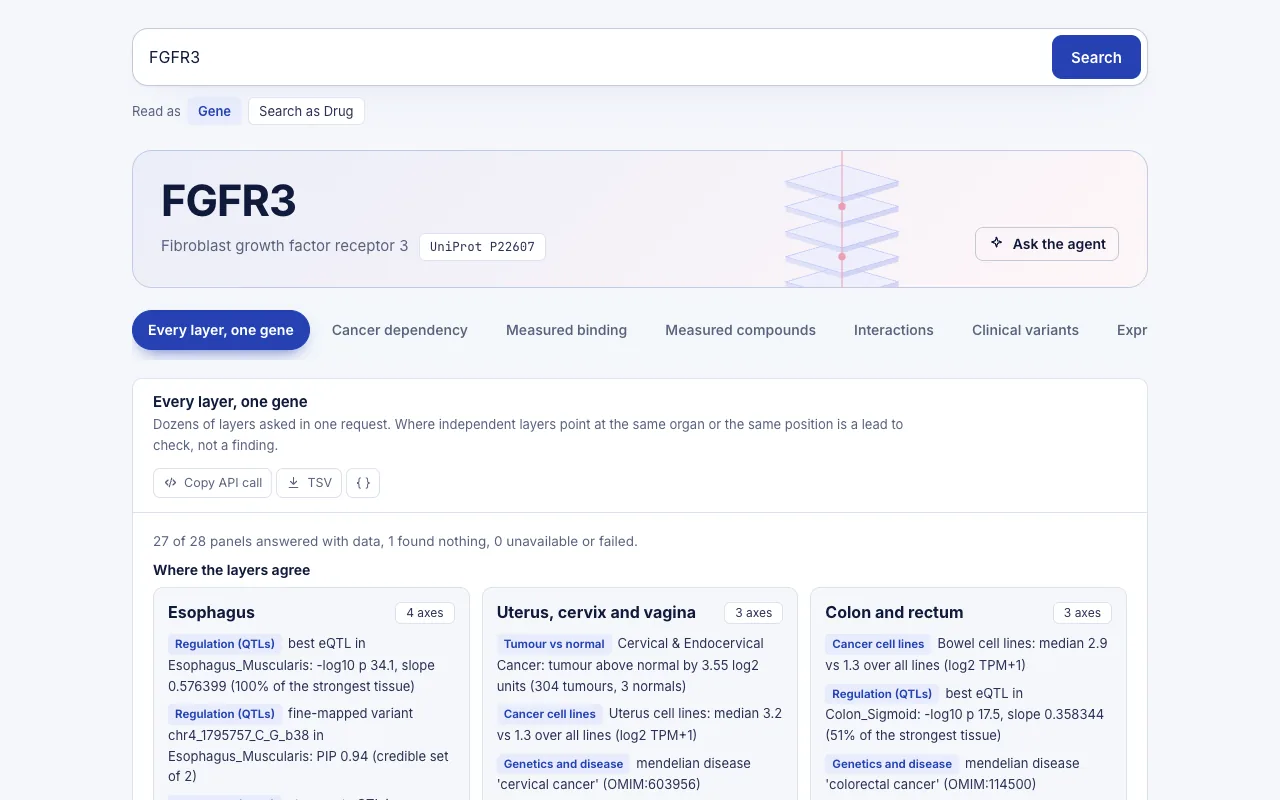
FGFR3 is not broadly essential in DepMap: 6 of 1178 cell lines count as dependent (0.5 percent), and the gene is not flagged common essential. Drug and disease layers still point strongly at it, with 32 drugs listed and bladder carcinoma among the top Open Targets associations. All values are as of 2026-11-06.
What we asked
We asked one question about one gene: what do the public layers say about FGFR3 right now? In practice that means five checks that researchers usually run in separate tools:
- Do cancer cell lines need it to grow (CRISPR dependency)?
- Which drugs are known, and how potent are they?
- Which diseases carry the evidence?
- Which pathways and partners is it embedded in?
- Is it over- or under-expressed in tumours?
The query was simply FGFR3. BioQ routed it to seven resources and returned the blocks below, each with its source and release.
What BioQ returned on FGFR3 dependency and drugs
The run took 7 engine queries and 0.75 engine seconds in total, drawing on 7 distinct resources. Doing the same by hand would mean opening DepMap, ChEMBL, Open Targets, ClinicalTrials.gov, CIViC, Reactome and STRING separately and reconciling gene identifiers between them. We did not time that route, so we make no claim about it beyond the number of tools involved.
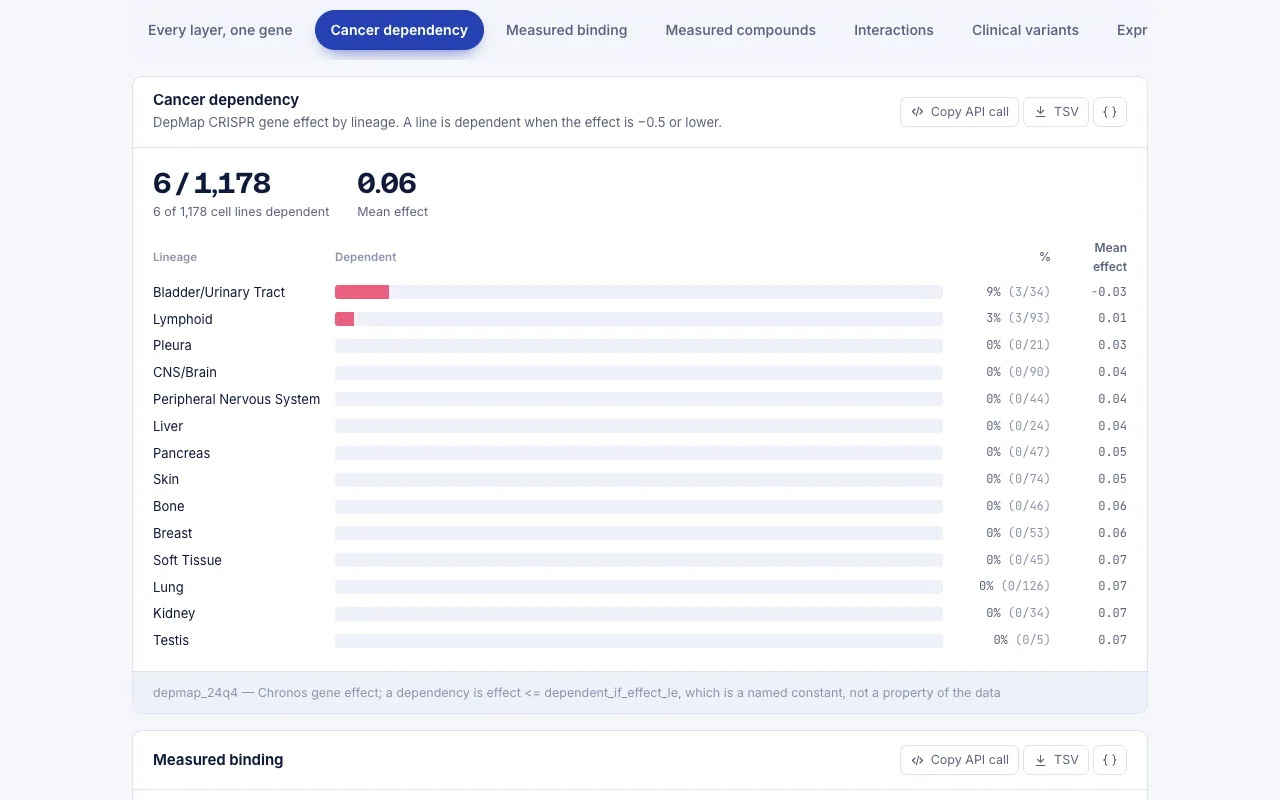
Dependency. The DepMap block (release depmap_24q4, Chronos gene effect) covers 1178 cell lines. The mean gene effect across all of them is 0.064, close to zero. The signal sits in two lineages:
| Lineage | Cell lines | Dependent | % dependent | Mean gene effect |
|---|---|---|---|---|
| Bladder/Urinary Tract | 34 | 3 | 8.8 | -0.029 |
| Lymphoid | 93 | 3 | 3.2 | 0.012 |
| Pleura | 21 | 0 | 0 | 0.031 |
| CNS/Brain | 90 | 0 | 0 | 0.041 |
| Peripheral Nervous System | 44 | 0 | 0 | 0.044 |
| Liver | 24 | 0 | 0 | 0.044 |
| Pancreas | 47 | 0 | 0 | 0.046 |
| Skin | 74 | 0 | 0 | 0.053 |
Drugs. BioQ lists 32 drugs for FGFR3 and shows the top 8 here. The potency column is the strongest exact pChEMBL value found, and the trial column counts trials matched by drug name, not by FGFR3.
| Drug | Max clinical stage | Mechanism | Best exact pChEMBL | Type | Trials by name |
|---|---|---|---|---|---|
| Erdafitinib | APPROVAL | Fibroblast growth factor receptor inhibitor | 10.18 | IC50 | 28 |
| Pemigatinib | APPROVAL | Fibroblast growth factor receptor 3 inhibitor | 10 | IC50 | 45 |
| Futibatinib | APPROVAL | Fibroblast growth factor receptor inhibitor | 9.49 | IC50 | 19 |
| Infigratinib | APPROVAL | Fibroblast growth factor receptor inhibitor | 9.18 | IC50 | 12 |
| Infigratinib Phosphate | APPROVAL | Fibroblast growth factor receptor inhibitor | 9.15 | IC50 | 1 |
| E-7090 | APPROVAL | Fibroblast growth factor receptor 3 inhibitor | 8.92 | IC50 | 0 |
| Ponatinib | APPROVAL | — | 8.66 | IC50 | 50 |
| Nintedanib | APPROVAL | Fibroblast growth factor receptor inhibitor | 8.23 | KI | 101 |
Disease evidence. Open Targets links FGFR3 to 4677 diseases. The six highest scores mix skeletal disorders and one cancer:
| Disease | Association score | Evidence items |
|---|---|---|
| achondroplasia | 0.825 | 817 |
| thanatophoric dysplasia type 1 | 0.819 | 171 |
| urinary bladder carcinoma | 0.804 | 846 |
| hypochondroplasia | 0.802 | 298 |
| Crouzon syndrome-acanthosis nigricans syndrome | 0.802 | 86 |
| Muenke syndrome | 0.796 | 148 |
Other layers, in brief.
- CIViC holds 73 records for FGFR3. The five shown are mostly bladder carcinoma. FGFR3 Mutation with infigratinib and FGFR3 Y373C are level B, FGFR3 S249C with pazopanib is level C, and the FGFR3::BAIAP2L1 fusion and FGFR3 overexpression entries are level D.
- Reactome lists 37 pathways. The most specific are Signaling by FGFR3 fusions in cancer, t(4;14) translocations of FGFR3 and FGFR3 mutant receptor activation.
- STRING v12 reports 1529 partners. The top six are FGF ligands (FGF2, FGF8, FGF9, FGF1, FGF18, FGF13) with combined scores of 997 to 999.
- TCGA/GTEx Toil has tumour and normal data for FGFR3 in 24 cancer types. Among the six shown, Kidney Chromophobe has the largest change, a log2 fold of -1.34, with a mean tumour value of 4.51 against a mean normal value of 11.39. Cervical & Endocervical Cancer is at 0.53.
What it means and how to read it
Three facts are worth checking before anything else.
1. The dependency is narrow, and bladder is where it shows. Across all lineages only 6 lines depend on FGFR3. Three of them are Bladder/Urinary Tract (3 of 34, 8.8 percent) and three are Lymphoid (3 of 93, 3.2 percent). Bladder is also the only shown lineage with a negative mean gene effect (-0.029). A gene can matter a great deal in a few cell lines and still average near zero, so the all-line mean of 0.064 should not be read as "irrelevant".
2. The disease and drug layers agree on bladder carcinoma. Open Targets gives urinary bladder carcinoma a score of 0.804 with 846 evidence items. CIViC's shown records are dominated by bladder carcinoma, and the DepMap signal is strongest in the bladder lineage. Three independent layers therefore point the same way. Be careful with the Open Targets ranking, though: achondroplasia (0.825, 817 evidence items) scores higher, and the next skeletal conditions sit close behind. That reflects germline gain-of-function biology, which is a different question from tumour dependency.
3. Potency is high across the shown drugs, but trial counts are not specificity. Erdafitinib has a top exact pChEMBL of 10.18 (IC50), and pemigatinib has 10.0. Nintedanib has 8.23 and is a Ki value, so it is not directly comparable with the IC50 rows. Ponatinib and nintedanib show 50 and 101 trials by name, yet both are multi-kinase agents. Their counts say nothing about FGFR3-directed use. The mechanism field is blank for ponatinib, which is a reminder to check annotations.
Where the layers differ, the differences are informative. Expression does not track dependency in any simple way: Kidney Chromophobe tumours show lower FGFR3 than normal tissue, while cervical cancer shows higher, and neither appears among the dependent lineages. Expression change alone is a weak guide to which tumours rely on the receptor. Variant-level evidence from CIViC (mutations, fusions) is a more specific lead than bulk expression.
How to reproduce it in BioQ
- Open BioQ and paste the query exactly as shown below.
- Run it and wait for the blocks to load.
- Read the DepMap block first, then compare the lineage rows with the disease and CIViC blocks.
- Open the drugs block and check the potency type (IC50 or Ki) before comparing values.
- Use the source label on each block to see the release and the original record.
FGFR3- To narrow the question, add a disease or a drug name to the query, for example a lineage, and check which blocks change.
Limits: what the data do not show
- Dependency is a CRISPR readout in cell lines. A line counts as dependent only below a named Chronos threshold, which is a chosen constant, not a property of the biology. Cell lines also lack the tumour microenvironment, and a few lines per lineage give wide uncertainty. With 34 bladder lines and 3 dependent, the 8.8 percent figure is a small-sample estimate.
- Dependency does not tell you the mechanism. DepMap does not say whether the dependent lines carry an FGFR3 mutation or fusion. Use the CIViC and Reactome blocks for hypotheses, and check the genotype of the lines yourself.
- Association scores are not effect sizes. An Open Targets score aggregates evidence types and counts. It does not say how strongly FGFR3 drives a disease.
- Potency is not clinical benefit. pChEMBL values come from biochemical or cell assays, and the table shows only one value per drug. It says nothing about selectivity, exposure, patient response or safety, and BioQ does not provide treatment advice.
- Trial counts are name matches. They include trials unrelated to FGFR3.
- TCGA/GTEx comparisons can be thin. Some cancer types have very few normal samples. The shown rows include 1 normal for Skin Cutaneous Melanoma and 3 for Cervical & Endocervical Cancer. Fold changes there are fragile.
- Only the top rows are shown. The tables display a subset (8 of 32 drugs, 5 of 73 CIViC records), so read the full lists before drawing conclusions.
Data and method
The numbers on this page were read from the BioQ engine on 2026-11-06 (7 queries, 0.8 s of engine time in total). The tables are generated by code from the engine's answers; the text only restates them.
/civic, /depmap, /drugs, /interaction, /ot_association, /pathway, /tcga
Run the same query yourself: FGFR3
For research use only. This page summarises public data and is not medical advice.
BioQ is an AI search engine and agent with one goal: making biology research 100X faster. Ask in the web app, over the REST API, or from Claude, ChatGPT or Cursor through MCP.
Queries used
Frequently asked questions
Is FGFR3 a common essential gene in DepMap?
No. In depmap_24q4 FGFR3 is not flagged common essential. Only 6 of 1178 cell lines count as dependent (0.5 percent), and the mean gene effect is 0.064.
Which lineages show FGFR3 CRISPR dependency?
Bladder/Urinary Tract has 3 dependent lines out of 34 (8.8 percent) and Lymphoid has 3 out of 93 (3.2 percent). The other lineages in the top rows have 0 dependent lines.
How many drugs are listed for FGFR3 and how potent are they?
BioQ lists 32 drugs. Among the 8 shown, erdafitinib has the highest exact pChEMBL at 10.18 (IC50), followed by pemigatinib at 10.0 and futibatinib at 9.49.
Which diseases does Open Targets associate most with FGFR3?
Open Targets links FGFR3 to 4677 diseases. The top scores are achondroplasia at 0.825 and thanatophoric dysplasia type 1 at 0.819, and urinary bladder carcinoma follows at 0.804 with 846 evidence items.
How long does the combined FGFR3 query take in BioQ?
The run used 7 engine queries across 7 distinct resources and took 0.75 engine seconds in total.
Sources
- Dataset DepMap CRISPR Chronos gene effect (24Q4)
- Dataset Open Targets Platform; ChEMBL; Drug Repurposing Hub
- Dataset TCGA pan-cancer expression (UCSC Xena Toil recompute)
- Dataset CIViC: Clinical Interpretation of Variants in Cancer
- Dataset Reactome pathway knowledgebase
- Dataset STRING v12 protein-protein interactions
Results come from public databases as of the date shown and may change. BioQ gives research information, not medical advice.
More from the blog
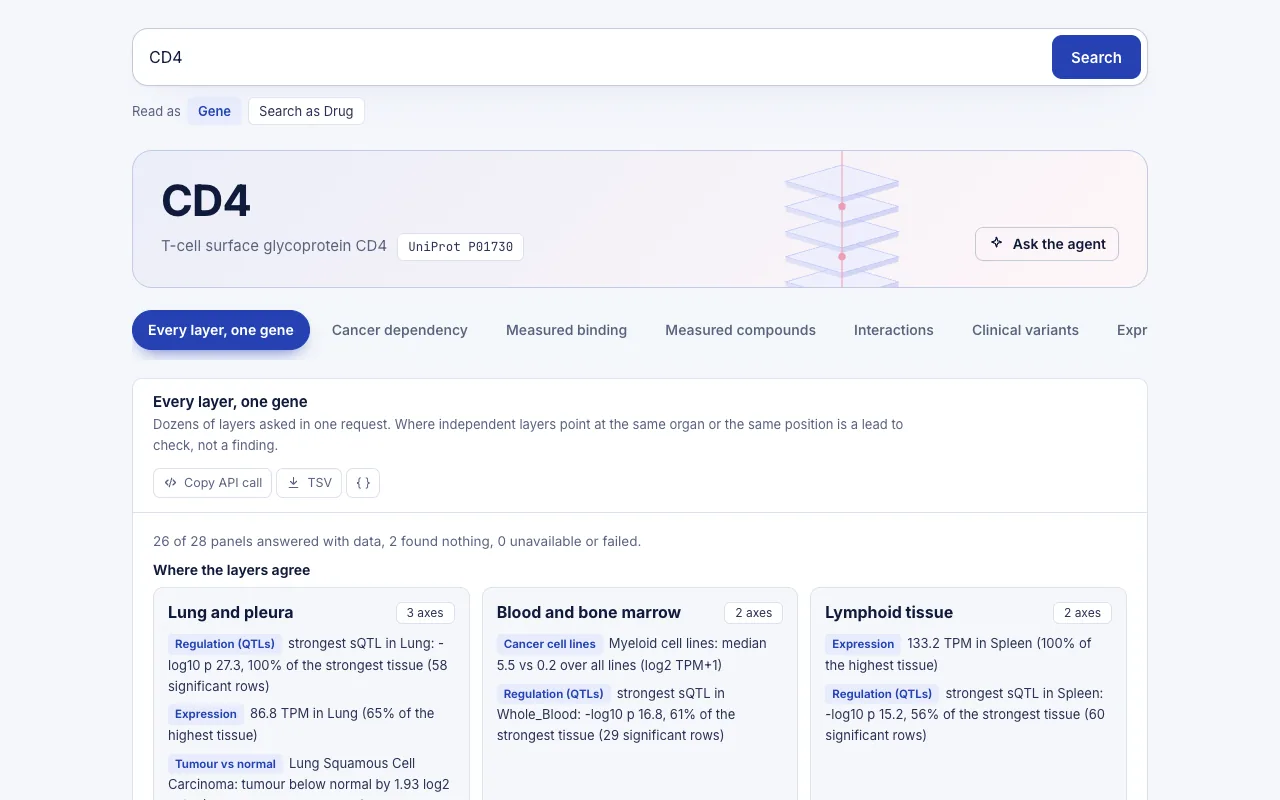
CD4 new study: CAR-NK cells and HIV rebound in context
A CD4-based CAR-NK paper on HIV rebound, placed in context with BioQ data on CD4: DepMap dependency, Open Targets diseases, drugs and Reactome pathways.
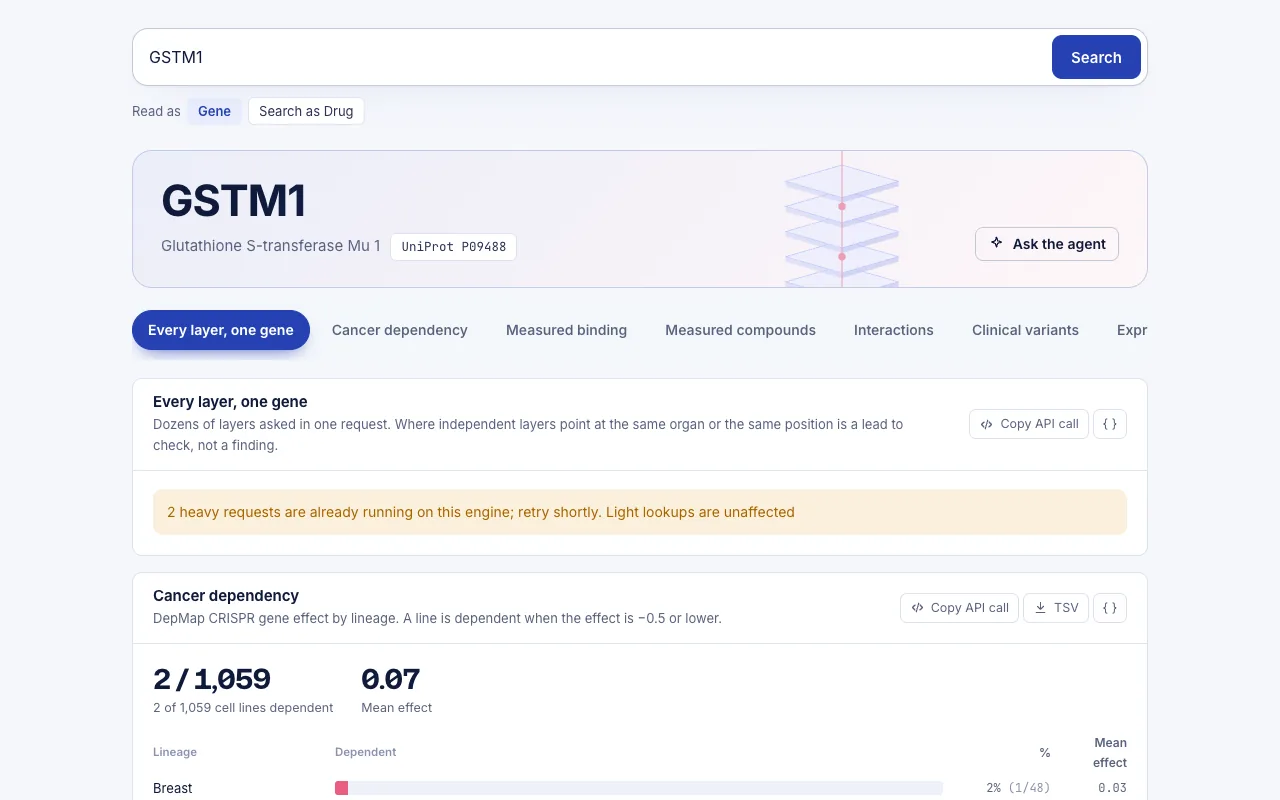
GSTM1 new study: cisplatin kidney injury in context
A 2026 paper links GSTM1 loss to worse cisplatin kidney injury; BioQ shows what DepMap, Open Targets, ChEMBL, Reactome and STRING say about GSTM1 today.
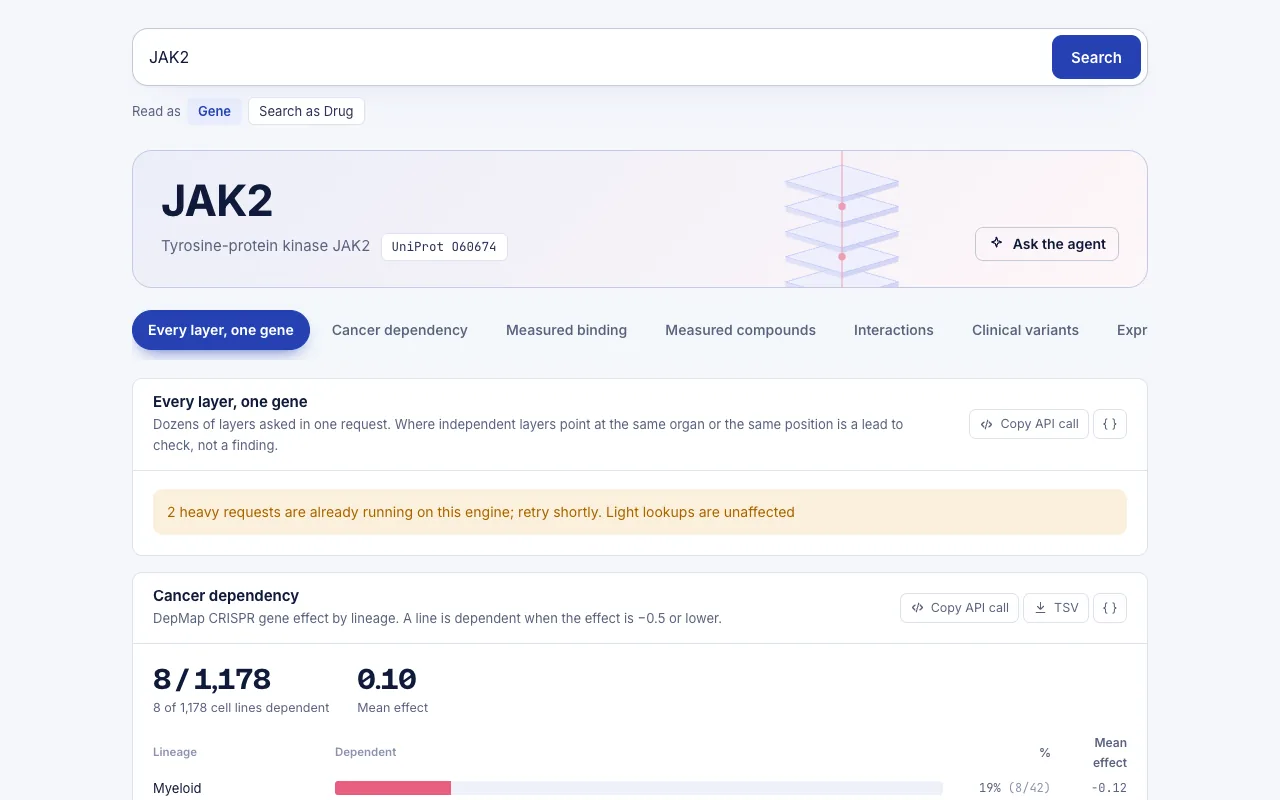
JAK2 vs TYK2: dependency and drugs side by side
JAK2 vs TYK2 in DepMap and drug databases: 8 of 1178 cell lines are dependent on JAK2, 11 on TYK2; 47 drugs are known for JAK2 and 20 for TYK2.