

DYRK1A new study: what BioQ data show today
A new DYRK1A study in pancreatic cancer, set against DepMap dependency, ChEMBL compounds, Open Targets diseases and TCGA expression as of 2026-11-13.
Data as of November 13, 2026 · By the BioQ team
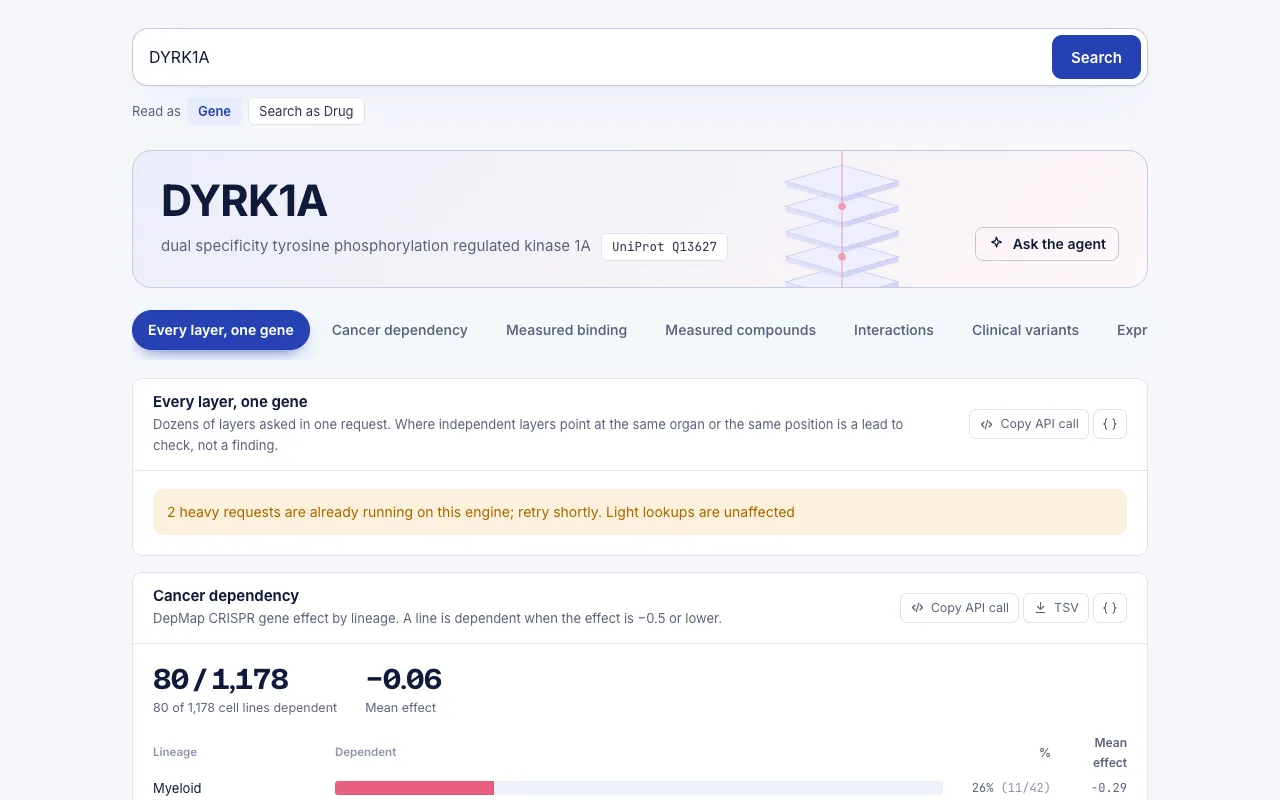
A new paper in Cell Death Discovery links DYRK1A to secretory signalling between pancreatic cancer cells and fibroblasts. The public data show a gene that is not broadly essential: 80 of 1178 DepMap cell lines (6.8%) depend on it, and the strongest signal is in myeloid and lymphoid lines. Its best-documented disease link in Open Targets is neurodevelopmental. All values are as of 2026-11-13.
What we asked
The paper, titled "DYRK1A coordinates tumor–stroma secretory programs that promote an immunosuppressive microenvironment in pancreatic cancer", touches a specific question. Does a kinase already implicated in pancreatic ductal adenocarcinoma (PDAC) growth also shape the signals that cancer cells and cancer-associated fibroblasts send to immune cells? Its experiments, including secretome profiling and migration assays, are the authors' own. BioQ did not run them and does not confirm or contradict them.
What BioQ can offer is context. We asked one question, "DYRK1A", and read what public data layers say about this gene today:
- how dependent cancer cell lines are on it
- which compounds are annotated against it
- which diseases it is linked to
- how its expression compares between tumour and normal tissue
- which pathways and interaction partners are recorded
What BioQ returned for DYRK1A
The query ran 7 engine queries in 4.21 seconds in total and drew on 6 distinct resources. Each table below names its source release.
CRISPR dependency
DepMap Chronos gene effect covers 1178 cell lines. A more negative value means the knockout lowered viability more. The mean gene effect across all lines is -0.06, and DYRK1A is not flagged as common essential.
| Lineage | Cell lines | Dependent | % dependent | Mean gene effect |
|---|---|---|---|---|
| Myeloid | 42 | 11 | 26.2 | -0.289 |
| Lymphoid | 93 | 16 | 17.2 | -0.265 |
| Cervix | 18 | 4 | 22.2 | -0.241 |
| Uterus | 34 | 3 | 8.8 | -0.139 |
| Breast | 53 | 4 | 7.5 | -0.124 |
| Bone | 46 | 6 | 13 | -0.117 |
| Soft Tissue | 45 | 4 | 8.9 | -0.085 |
| Eye | 15 | 2 | 13.3 | -0.08 |
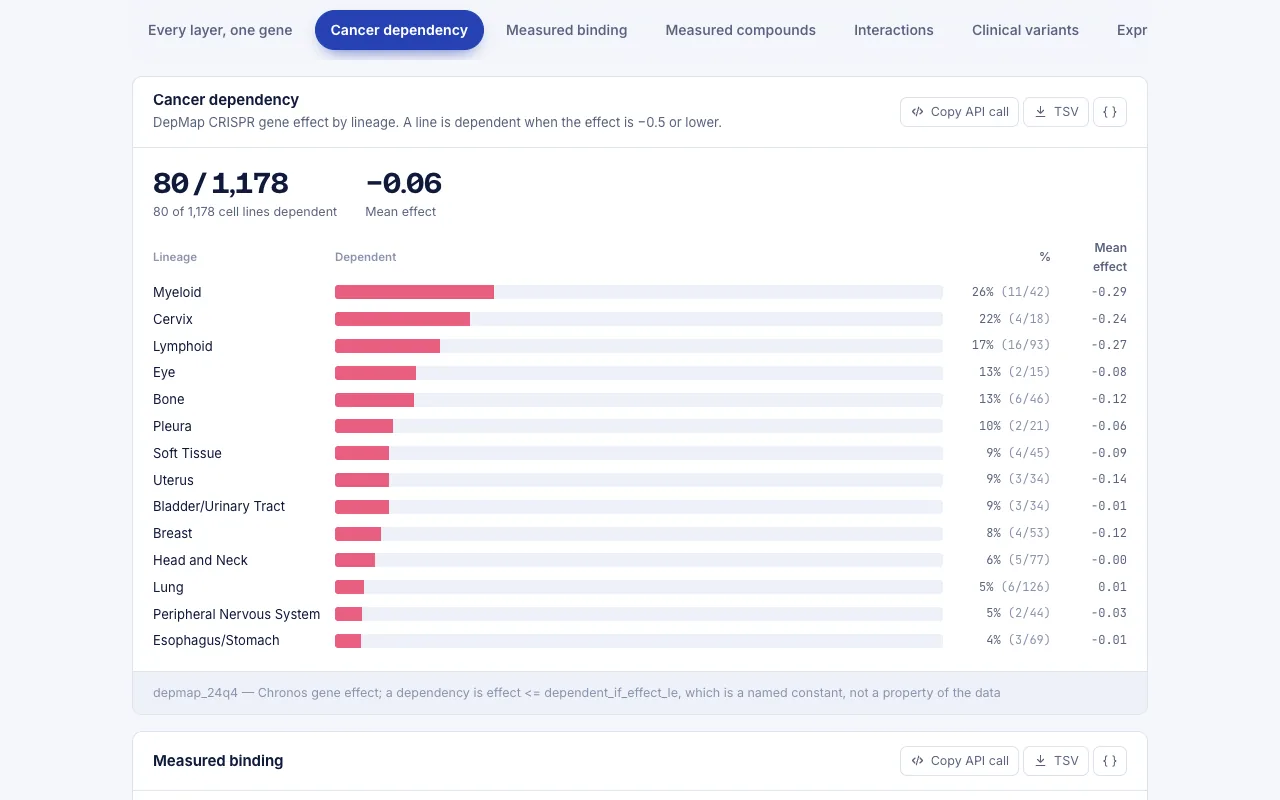
Myeloid lines lead on both measures: 11 of 42 are dependent (26.2%), with a mean gene effect of -0.289. Lymphoid lines follow at 16 of 93 (17.2%). Cervix is small (18 lines) but shows 4 dependent lines (22.2%). The eight lineages shown do not include pancreas, so this table says nothing direct about PDAC lines.
Compounds
Open Targets, ChEMBL, the Drug Repurposing Hub and ClinicalTrials.gov together list 4 drugs or compounds for DYRK1A.
| Drug | Max clinical stage | Mechanism | Best exact pChEMBL | Type | Trials by name |
|---|---|---|---|---|---|
| Lorecivivint | PHASE_3 | Dual specificity tyrosine-phosphorylation-regulated kinase 1A inhibito | 8.3 | EC50 | 6 |
| 2Wu7 | UNKNOWN | — | 7.67 | IC50 | 0 |
| Tc-S-7004 | UNKNOWN | — | — | — | 0 |
| Tg-003 | UNKNOWN | — | — | — | 0 |
Lorecivivint reaches PHASE_3 and is annotated as a DYRK1A inhibitor, with 6 trials found by name. Its highest exact pChEMBL is 8.3, but the measurement type is EC50, not IC50. Only 2Wu7 has an exact IC50-based value (7.67). Tc-S-7004 and Tg-003 have no exact potency value in this view. A higher pChEMBL means stronger potency.
Disease association
Open Targets links DYRK1A to 566 diseases. The six highest-scoring ones are all neurodevelopmental or genetic.
| Disease | Association score | Evidence items |
|---|---|---|
| DYRK1A-related intellectual disability syndrome | 0.778 | 884 |
| complex neurodevelopmental disorder | 0.622 | 19 |
| microcephaly | 0.61 | 84 |
| Intellectual disability | 0.555 | 125 |
| hereditary disease | 0.55 | 132 |
| Rare genetic intellectual disability with developmental anomaly | 0.516 | 11 |
Expression, pathways and partners
TCGA and GTEx data (Toil recompute) allow a tumour-versus-normal comparison in 24 cancer types. In the six rows BioQ shows, differences are small. Glioblastoma Multiforme has a log2 fold of -0.1 (153 tumours, 5 normals), and Sarcoma is the one positive row at 0.05. Reactome places DYRK1A in 4 pathways, from G0 and Early G1 (27 genes) up to Cell Cycle (657 genes). STRING v12 lists 1617 partners. The top six are led by DCAF7 (997), RNF169 (932) and RAD54L2 (925).
What it means and how to read it
Read the paper's claims and these data as two separate layers.
- Dependency. DepMap measures what happens when DYRK1A is removed from cancer cells grown alone. The paper concerns secreted factors and immune cell recruitment, which a monoculture screen cannot capture. A low pan-cancer dependency rate is therefore compatible with a role in signalling. The reverse also holds: dependency in myeloid lines does not link to the paper's monocyte and myeloid-derived suppressor cell findings.
- Compounds. The existence of annotated inhibitors, one of them in PHASE_3, shows the target is pharmacologically addressable in principle. The data here do not say which compound the authors used or whether any compound acts selectively in PDAC.
- Disease context. The strongest Open Targets association is DYRK1A-related intellectual disability syndrome (score 0.778, 884 evidence items). This is a reminder that the gene has a major role outside oncology. Cancer is not among the six top-scoring diseases.
- Expression. Bulk tumour expression is close to normal in the rows shown. Because bulk RNA mixes cancer cells and stroma, it cannot test the paper's observation that fibroblasts express DYRK1A at levels similar to cancer cells.
- Pathways and partners. The recorded annotations centre on cell cycle entry and on partners such as DCAF7. None of the six top partners is a chemokine or secreted factor.
In short, the public layers neither support nor challenge the paper's secretory mechanism. They give a baseline for how the gene behaves elsewhere.
How to reproduce it in BioQ
- Open BioQ and paste the query below into the search box.
- Wait for the panels to load. The dependency, compound, disease, expression, pathway and interaction blocks return together, each with its source.
- Open the DepMap panel and check whether a pancreatic lineage appears in the full list, not only in the top rows.
- Open the compound panel and compare the measurement type (IC50 or EC50) before comparing potency values.
DYRK1A- Note the data release date shown on each panel, since resources update on their own schedules.
Collecting the same six views by hand would mean visiting each resource separately. In BioQ they come from one query, with the engine time reported above.
Limits: what the data do not show
- The paper's results are the paper's. BioQ holds no secretome, conditioned-media or migration data.
- No pancreas-specific DepMap row, TCGA pancreatic row or PDAC association appears in the views shown, so we make no statement about PDAC from them.
- DepMap uses cell lines without stroma or immune cells. TCGA and GTEx are bulk tissue, so cell-type origin of DYRK1A expression is unresolved.
- Potency values come from different assay types. The EC50 for Lorecivivint is not comparable to an IC50, and two compounds have no exact value.
- Association scores in Open Targets reflect the amount and type of evidence, not the strength of biology in a given tissue.
- Nothing here is guidance on treatment or dosing.
Data and method
The numbers on this page were read from the BioQ engine on 2026-11-13 (7 queries, 4.2 s of engine time in total). The tables are generated by code from the engine's answers; the text only restates them.
/depmap, /drugs, /interaction, /ot_association, /pathway, /tcga
Sources
- DYRK1A coordinates tumor–stroma secretory programs that promote an immunosuppressive microenvironment in pancreatic cancer (2026) — doi:10.1038/s41420-026-03444-w
Run the same query yourself: DYRK1A
For research use only. This page summarises public data and is not medical advice.
BioQ is an AI search engine and agent with one goal: making biology research 100X faster. Ask in the web app, over the REST API, or from Claude, ChatGPT or Cursor through MCP.
Queries used
Frequently asked questions
Does DepMap show that DYRK1A is essential in cancer cell lines?
Not broadly. In DepMap, 80 of 1178 cell lines (6.8%) are dependent, the mean gene effect is -0.06, and DYRK1A is not flagged as common essential. Myeloid lines show the highest share, at 11 of 42 (26.2%).
Are there DYRK1A inhibitors with potency data in ChEMBL?
BioQ lists 4 drugs or compounds for DYRK1A. 2Wu7 has an exact IC50-based pChEMBL of 7.67. Lorecivivint, at PHASE_3, has 8.3, but that value is an EC50.
Which diseases does Open Targets link most strongly to DYRK1A?
Open Targets lists 566 diseases. The top is DYRK1A-related intellectual disability syndrome (score 0.778, 884 evidence items), followed by complex neurodevelopmental disorder (0.622) and microcephaly (0.61).
Does BioQ confirm the pancreatic cancer findings of the new DYRK1A study?
No. The paper's experimental results belong to the authors. BioQ shows public context as of 2026-11-13, and the views returned include no pancreas-specific rows.
Is DYRK1A expression different in tumours versus normal tissue?
TCGA and GTEx allow comparison in 24 cancer types. In the six rows shown, log2 fold changes range from -0.1 in Glioblastoma Multiforme to 0.05 in Sarcoma, which are small differences.
Sources
- Paper DYRK1A coordinates tumor–stroma secretory programs that promote an immunosuppressive microenvironment in pancreatic cancer (2026) DOI 10.1038/s41420-026-03444-w
- Dataset DepMap CRISPR Chronos gene effect (24Q4)
- Dataset Open Targets Platform; ChEMBL; Drug Repurposing Hub
- Dataset TCGA pan-cancer expression (UCSC Xena Toil recompute)
- Dataset Reactome pathway knowledgebase
- Dataset STRING v12 protein-protein interactions
Results come from public databases as of the date shown and may change. BioQ gives research information, not medical advice.
More from the blog
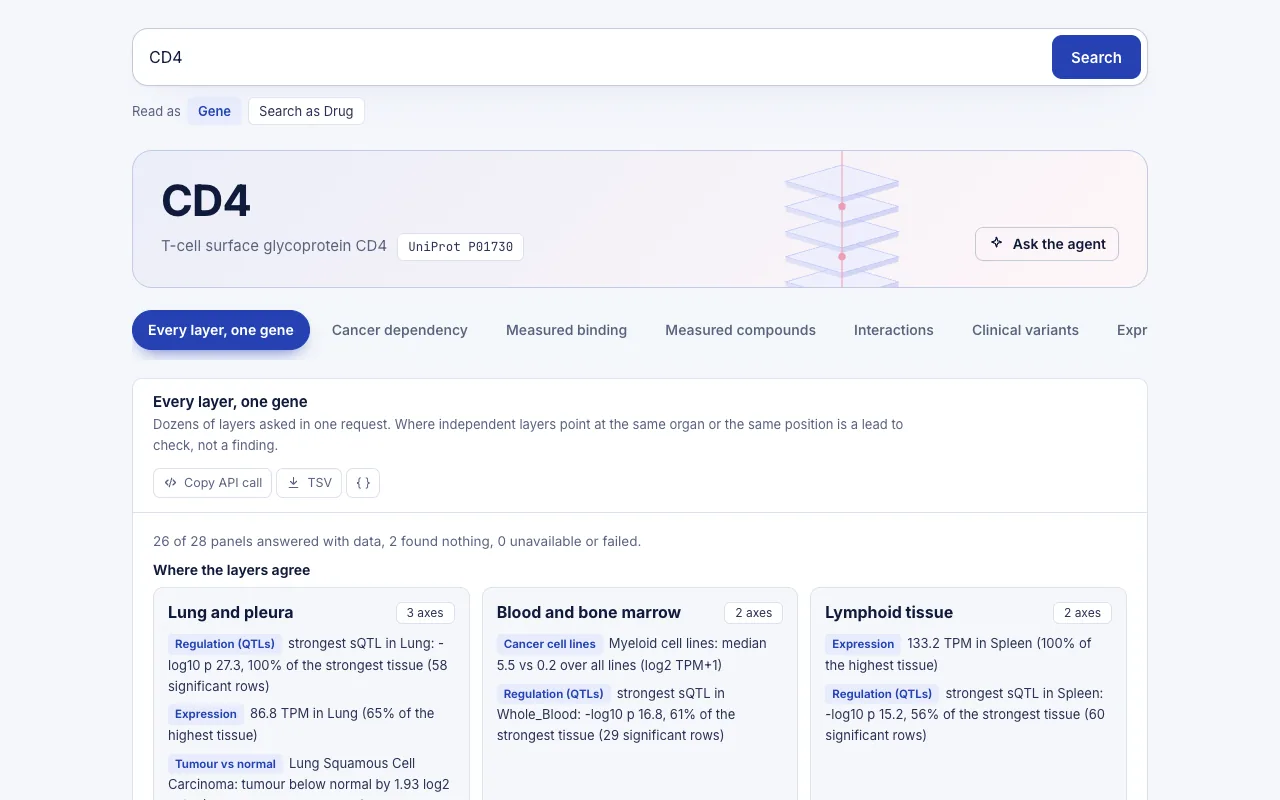
CD4 new study: CAR-NK cells and HIV rebound in context
A CD4-based CAR-NK paper on HIV rebound, placed in context with BioQ data on CD4: DepMap dependency, Open Targets diseases, drugs and Reactome pathways.
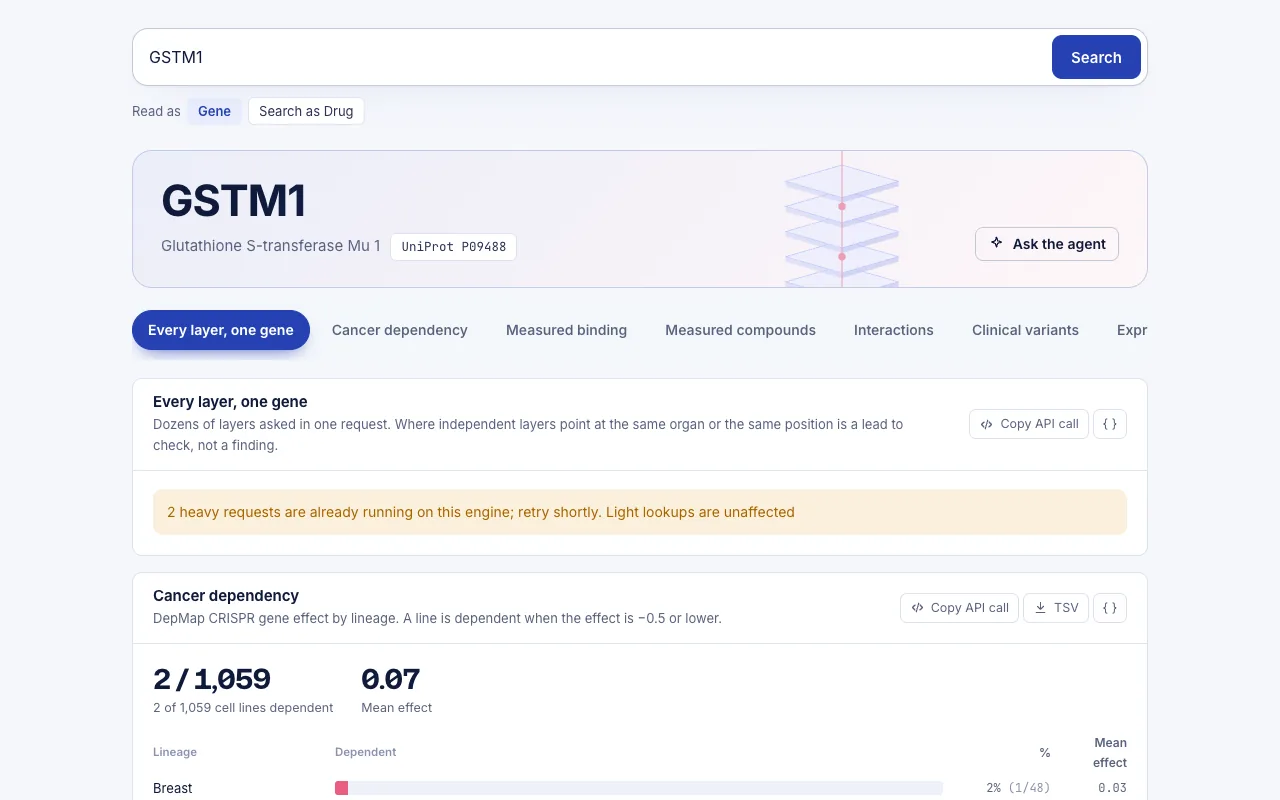
GSTM1 new study: cisplatin kidney injury in context
A 2026 paper links GSTM1 loss to worse cisplatin kidney injury; BioQ shows what DepMap, Open Targets, ChEMBL, Reactome and STRING say about GSTM1 today.
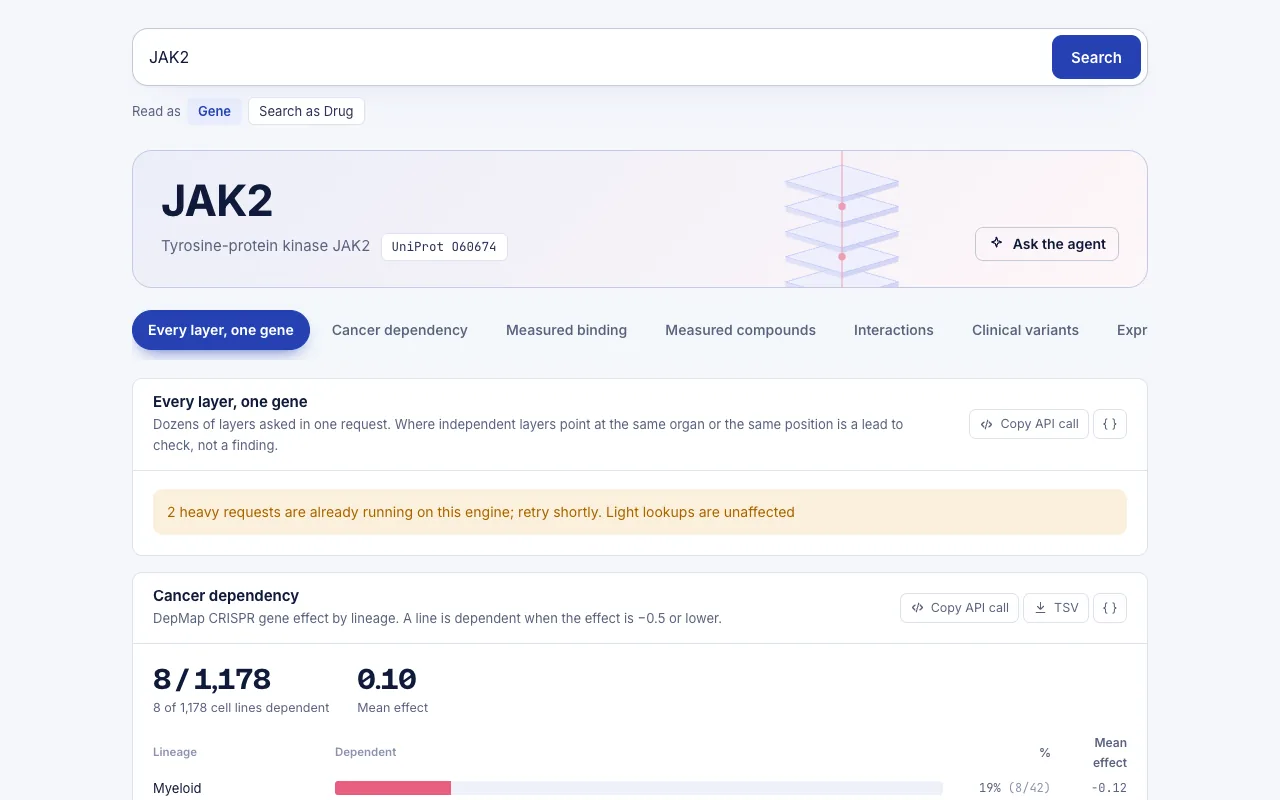
JAK2 vs TYK2: dependency and drugs side by side
JAK2 vs TYK2 in DepMap and drug databases: 8 of 1178 cell lines are dependent on JAK2, 11 on TYK2; 47 drugs are known for JAK2 and 20 for TYK2.