

Dantrolene Statins Induced Myopathy trial NCT06966843
NCT06966843 tests dantrolene in statin-induced myopathy; BioQ pulls its ChEMBL potency and 7 registered dantrolene trials, data as of 2026-11-11.
Data as of November 11, 2026 · By the BioQ team
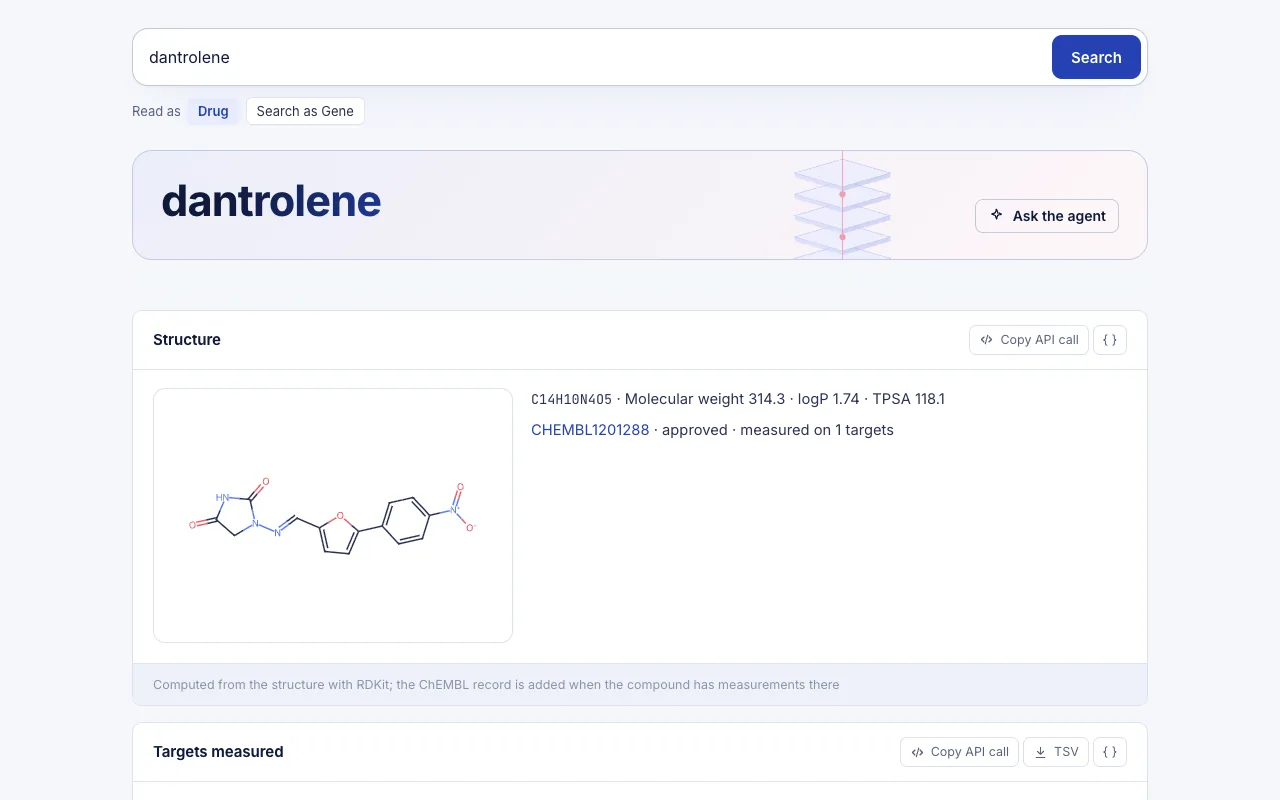
NCT06966843 is a PHASE2/PHASE3 trial from Tanta University that will test dantrolene in statin-induced myopathy. It is listed as not yet recruiting, with a planned start in 2027-10 and an enrollment of 23. In ChEMBL, dantrolene has 61 targets, but only 4 of them carry exact potency measurements. All figures are as of 2026-11-11.
What we asked about the dantrolene trial in statin-induced myopathy
The registry entry is titled "Dantrolene in Statin-induced Myopathy". The sponsor is Tanta University, the phase is PHASE2/PHASE3, and the condition is Statins Induced Myopathy. We wanted to know three things before the trial opens:
- What else has been registered for dantrolene, and where does this trial sit among those studies?
- Which molecular targets of dantrolene have measured potency, and how strong are those measurements?
- Is the compound identity unambiguous, so that the trial and the bioactivity data refer to the same molecule?
We did not ask for a dependency analysis in cancer models. Dantrolene is being tested here in a muscle-related condition, and that layer does not bear on this question.
What BioQ returned
The query "dantrolene" resolved to one compound. PubChem lists it under CID 6914273 with InChIKey OZOMQRBLCMDCEG-VIZOYTHASA-N and 28 synonyms. The ChEMBL identifier is CHEMBL1201288, and that identifier was used for the potency lookup below.
Registered trials
ClinicalTrials.gov returns 7 studies with dantrolene as an intervention. The phase counts are 3 for phase 1, 7 for phase 2 and 2 for phase 3. These counts overlap, most likely because studies registered with a combined phase, such as PHASE2/PHASE3, are tallied under both phases. The table shows 6 of the 7 studies.
| Trial | Phase | Status | Sponsor | Start | Enrollment |
|---|---|---|---|---|---|
| NCT06966843 | PHASE2/PHASE3 | NOT_YET_RECRUITING | Tanta University | 2027-10 | 23 |
| NCT03762109 | PHASE2 | COMPLETED | Beth Israel Deaconess Medical Center | 2019-07 | 116 |
| NCT01024972 | PHASE1/PHASE2 | COMPLETED | University of Massachusetts, Worcester | 2009-10 | 31 |
| NCT03109288 | PHASE1/PHASE2 | RECRUITING | National Institute of Allergy and Infect | 2017-08 | 250 |
| NCT00796900 | PHASE2/PHASE3 | TERMINATED | Medical University of Vienna | 2008-05 | 34 |
| NCT00964548 | PHASE1/PHASE2 | COMPLETED | University of Massachusetts, Worcester | 2007-07 | 10 |
NCT06966843 is the only one of the six shown that has not yet started. The other five include completed, recruiting and terminated studies, with start dates between 2007-07 and 2019-07. Enrollments range from 10 to 250. Tanta University's 23 participants make it one of the smaller studies in the list.
Measured potency
ChEMBL holds activity records for dantrolene against 61 targets. Only 4 targets have exact measurements, which are the ones that yield a usable pChEMBL value. The table shows the top 8 targets.
| ChEMBL target | Gene | Best pChEMBL | Type | Exact measurements |
|---|---|---|---|---|
| CHEMBL612545 | — | 7.23 | EC50 | 2 |
| CHEMBL1795168 | CISD1 | 5.68 | KI | 2 |
| CHEMBL226 | ADORA1 | 4.6 | AC50 | 1 |
| CHEMBL6020 | ABCB11 | 4.46 | AC50 | 2 |
| CHEMBL1790 | AVPR2 | — | — | 0 |
| CHEMBL1833 | HTR2B | — | — | 0 |
| CHEMBL1867 | ADRA2A | — | — | 0 |
| CHEMBL1882 | CHRNA4 | — | — | 0 |
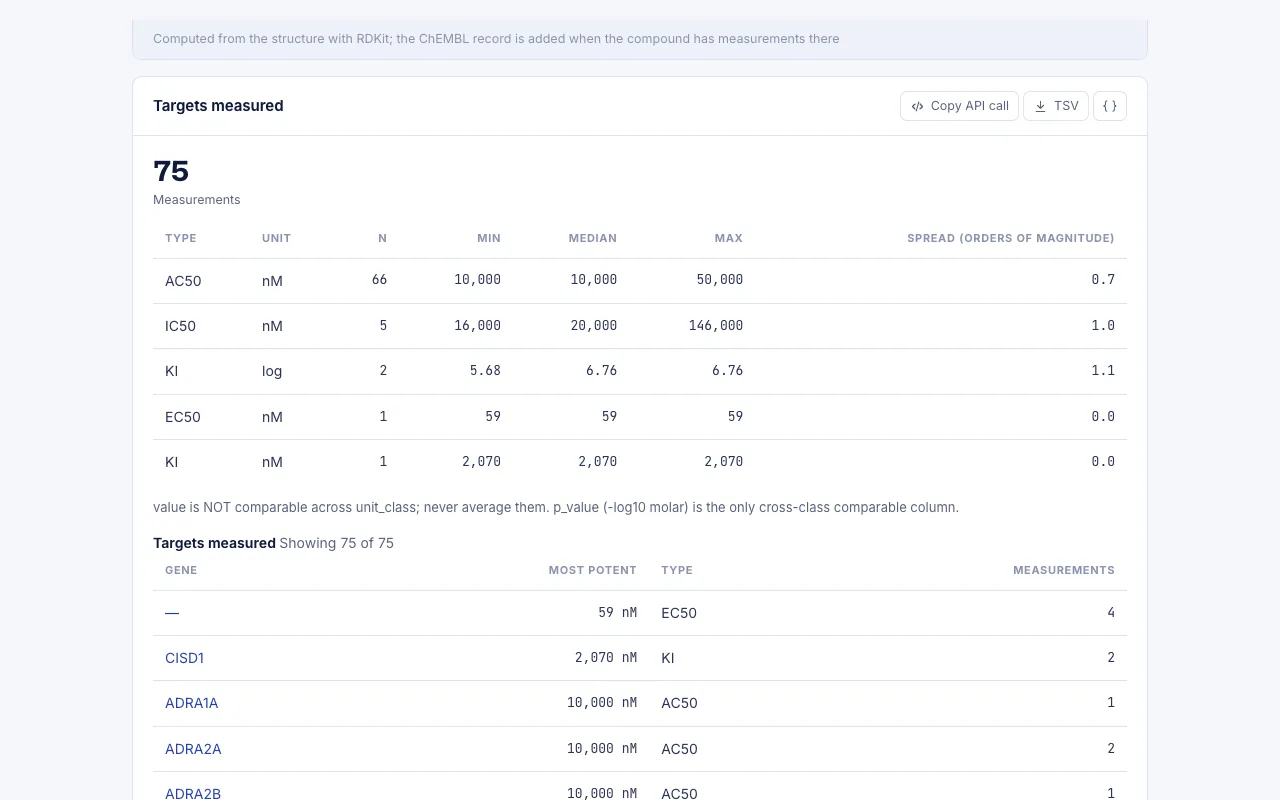
The strongest entry is CHEMBL612545, with a best pChEMBL of 7.23 from an EC50 and 2 exact measurements. No gene symbol is mapped to it in this view. Next is CISD1 at 5.68 (KI, 2 exact measurements), then ADORA1 at 4.6 (AC50, 1 measurement) and ABCB11 at 4.46 (AC50, 2 measurements). The remaining four rows (AVPR2, HTR2B, ADRA2A and CHRNA4) are linked to dantrolene in ChEMBL but have no exact measurement and so no pChEMBL value.
What it means and how to read it
pChEMBL is the negative log10 of a molar potency, so a higher value means a stronger measured effect. A value of 7.23 is a clearly stronger readout than 4.46. The two are not interchangeable, though, because the "Type" column differs. An EC50 describes a functional response, a KI describes binding affinity, and an AC50 comes from a screening-style activity assay. Compare values within the same type, and treat cross-type ranking with caution.
For a reader following NCT06966843, the useful points are these:
- The registry record gives the condition and the intervention. It does not, in the facts we pulled, state why dantrolene was chosen. The ChEMBL table cannot supply that rationale either.
- In the 8 rows shown, the targets with a measured value are an unmapped ChEMBL target, CISD1, ADORA1 and ABCB11. Whether any of them relates to muscle biology or to statin exposure is a question for the trial's authors and the primary literature, not for this table.
- Most of the 61 targets lack exact measurements. A long target list in ChEMBL therefore says little about which interactions are quantitatively established.
- The trial is one of 7 registered dantrolene studies, and the other five shown began years earlier. That gives some context on how much clinical work exists around the compound, but it says nothing about how well it works in myopathy.
How to reproduce it in BioQ
The three results above came from one query. BioQ ran 3 engine queries across 3 distinct resources (ChEMBL, ClinicalTrials.gov and PubChem) in 5.42 engine seconds in total. Doing the same by hand means resolving the compound name to an identifier, searching the trial registry by intervention, and filtering the ChEMBL activity records to exact measurements.
- Open BioQ and paste the query below.
dantrolene- Check the compound identity first: CHEMBL1201288 and PubChem CID 6914273.
- Open the trials block and find NCT06966843 by its phase, status and sponsor.
- Open the potency block and compare the "Exact measurements" column with the total target count before reading any pChEMBL value.
- Every row names its source, so you can follow it back to the ChEMBL or ClinicalTrials.gov record.
Limits: what the data do not show
- The registry data describe a planned trial. They contain no results, and nothing here speaks to whether dantrolene helps, harms or does nothing in statin-induced myopathy. Nothing here is medical or dosing advice.
- The start date of 2027-10 and the enrollment of 23 are registry entries and may change before recruitment begins.
- Potency values come from assays that may not reflect the cell types or tissues relevant to myopathy. A pChEMBL value shows that a measurement exists, not that the interaction matters in muscle.
- One top target has no gene symbol in this view, and four of the eight shown have no pChEMBL value. The potency picture is incomplete by construction.
- The phase counts are overlapping tallies of registered studies, not a measure of evidence.
- We did not examine cancer dependency data, statin safety literature or muscle expression, so no claim is made about them.
Data and method
The numbers on this page were read from the BioQ engine on 2026-11-11 (3 queries, 5.4 s of engine time in total). The tables are generated by code from the engine's answers; the text only restates them.
/chembl_potency, /clinicaltrials, /compound
Sources
- Dantrolene in Statin-induced Myopathy (2027) — https://clinicaltrials.gov/study/NCT06966843
Run the same query yourself: dantrolene
For research use only. This page summarises public data and is not medical advice.
BioQ is an AI search engine and agent with one goal: making biology research 100X faster. Ask in the web app, over the REST API, or from Claude, ChatGPT or Cursor through MCP.
Queries used
Frequently asked questions
What is NCT06966843?
NCT06966843 is a PHASE2/PHASE3 trial of dantrolene in statin-induced myopathy, sponsored by Tanta University. As of 2026-11-11 it is listed as not yet recruiting, with a start in 2027-10 and an enrollment of 23.
How many clinical trials of dantrolene are registered?
ClinicalTrials.gov returns 7 studies with dantrolene as an intervention. The phase counts are 3 for phase 1, 7 for phase 2 and 2 for phase 3, and these tallies overlap.
What is the strongest measured potency of dantrolene in ChEMBL?
The best pChEMBL value is 7.23, an EC50 against CHEMBL612545 with 2 exact measurements. Next is CISD1 at 5.68 (KI). Only 4 of the 61 targets have exact measurements.
What is the ChEMBL ID of dantrolene?
The ChEMBL identifier is CHEMBL1201288. PubChem lists the compound as CID 6914273 with 28 synonyms.
How long did the BioQ lookup take?
The 3 engine queries drew on 3 distinct resources and took 5.42 engine seconds in total.
Sources
- Trial Dantrolene in Statin-induced Myopathy (2027)
- Dataset ClinicalTrials.gov
- Dataset PubChem
Results come from public databases as of the date shown and may change. BioQ gives research information, not medical advice.
More from the blog
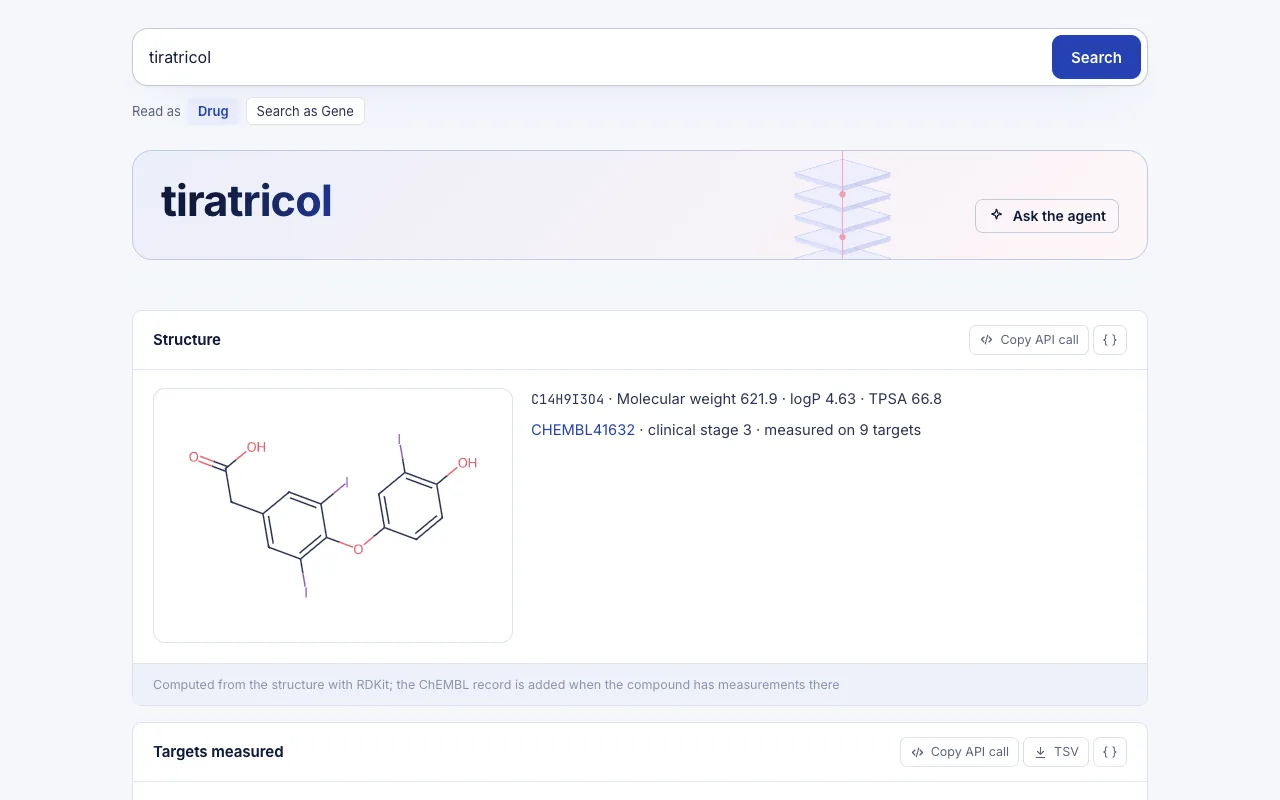
Tiratricol FDA approval: targets and potency in BioQ
Tiratricol FDA approval (Emcitate): ChEMBL shows 68 targets, THRB and THRA top by pChEMBL, and 3 registered trials on ClinicalTrials.gov, as of 2026-11-17.
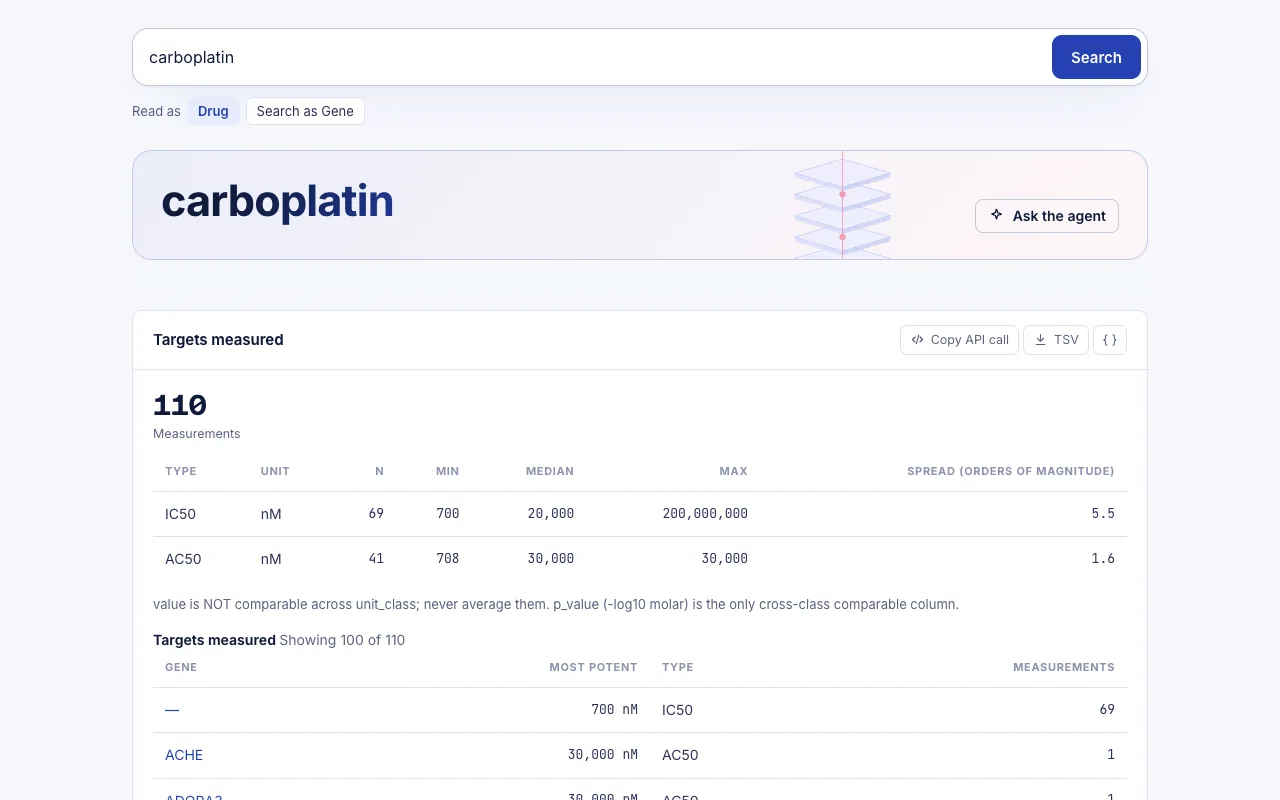
Carboplatin Non-Small Cell Lung Cancer trial: NCT07877584
NCT07877584 is a phase 3 NSCLC trial of PD-1 blockade with or without chemotherapy; BioQ adds carboplatin ChEMBL potency and ClinicalTrials.gov context.
Semaglutide new study: what BioQ data show
A new FAERS paper on semaglutide and panic attacks, set against ChEMBL potency, ClinicalTrials.gov registrations and PubChem identity as of 2026-11-15.