

CDK9 new study: what BioQ data show today
A 2026 Cancer Letters paper on CDK9 degradation in gastroesophageal cancer, placed in context with DepMap, ChEMBL, Open Targets, TCGA and STRING data.
Data as of November 6, 2026 · By the BioQ team
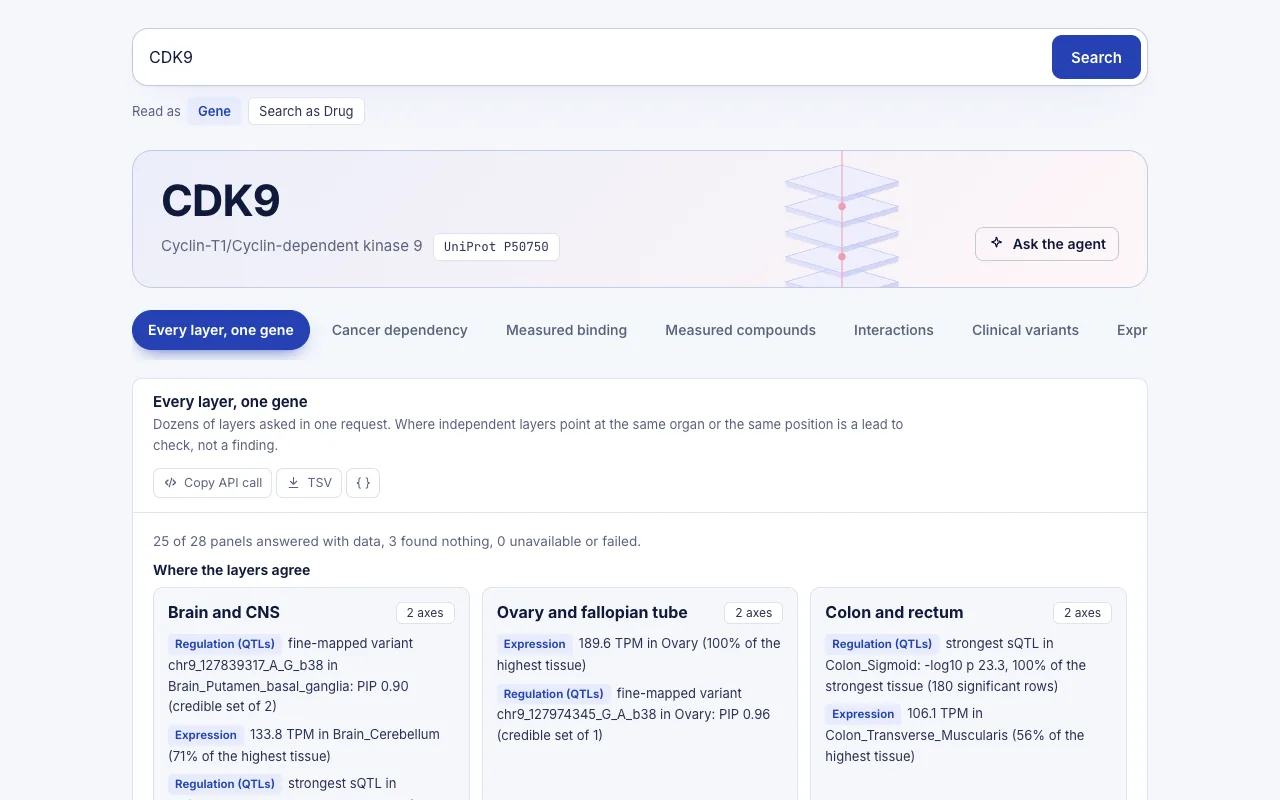
In DepMap (depmap_24q4), CDK9 knockout lowers viability in 1171 of 1178 cell lines (99.4%), with a mean Chronos gene effect of -1.448. In the 69 Esophagus/Stomach lines, all 69 are dependent. That is the background for a 2026 Cancer Letters paper on CDK9 degradation in gastroesophageal cancer. All data here are as of 2026-11-06.
What the new CDK9 study touches
The paper (DOI 10.1016/j.canlet.2026.218916) asks whether removing the CDK9 protein, rather than blocking its kinase activity, is a workable strategy in gastroesophageal cancer. It also asks whether this helps in radiation-resistant tumours. It brings in chromatin remodeling and YAP1/TEAD signalling as the proposed mechanism. The authors built a PROTAC-type degrader, YX0597, and tested it in the lab.
Everything the paper reports about that degrader, its effects in cells and animals, and its mechanism belongs to the paper. BioQ did not reproduce it, and nothing below confirms or contradicts it. What BioQ can do is show what public data layers say about CDK9 itself, so you can place the paper in context quickly:
- Is CDK9 a dependency in these cancers?
- What is already known about drugs against it?
- Where does CDK9 sit in disease and interaction networks?
What BioQ returned
We ran the single query CDK9. The first table is the DepMap CRISPR result by lineage, ordered by mean gene effect. A more negative Chronos value means the knockout reduced viability more. The dependency call uses a named threshold constant, not a property of the data.
| Lineage | Cell lines | Dependent | % dependent | Mean gene effect |
|---|---|---|---|---|
| Lymphoid | 93 | 93 | 100 | -1.547 |
| Myeloid | 42 | 42 | 100 | -1.54 |
| Eye | 15 | 15 | 100 | -1.527 |
| Liver | 24 | 24 | 100 | -1.499 |
| Bone | 46 | 46 | 100 | -1.48 |
| CNS/Brain | 90 | 90 | 100 | -1.477 |
| Head and Neck | 77 | 77 | 100 | -1.475 |
| Esophagus/Stomach | 69 | 69 | 100 | -1.468 |
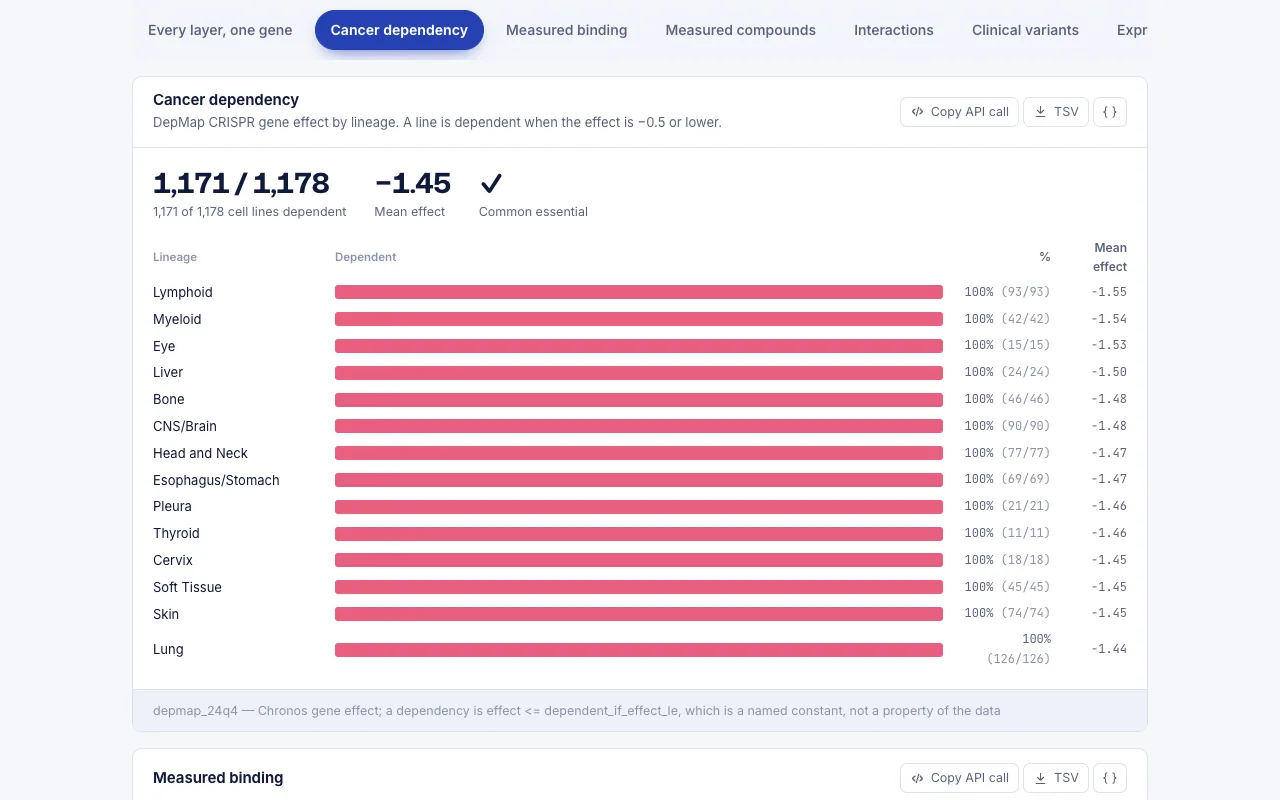
The Esophagus/Stomach lineage has a mean gene effect of -1.468. That is close to the top lineages, such as Lymphoid at -1.547 and Myeloid at -1.54. CDK9 is flagged as common essential.
The second table lists drugs known for CDK9, drawn from Open Targets, ChEMBL, the Drug Repurposing Hub and ClinicalTrials.gov. In total 13 drugs are linked to the gene, and eight are shown.
| Drug | Max clinical stage | Mechanism | Best exact pChEMBL | Type | Trials by name |
|---|---|---|---|---|---|
| Alvocidib | PHASE_3 | Cyclin-dependent kinase 9 inhibitor | 9.15 | KI | 55 |
| Dinaciclib | PHASE_3 | Cyclin-dependent kinase 9 inhibitor | 9 | IC50 | 13 |
| At-7519 | PHASE_2 | Cyclin-dependent kinase inhibitor | 8.3 | IC50 | 0 |
| Roniciclib | PHASE_2 | Cyclin-dependent kinase inhibitor | 8.3 | IC50 | 0 |
| Seliciclib | PHASE_2 | Cyclin-dependent kinase 9 inhibitor | 7.37 | IC50 | 3 |
| Zotiraciclib | PHASE_1_2 | Cyclin-dependent kinase 9 inhibitor | 9 | KD | 1 |
| Bms-387032 | PHASE_1 | Cyclin-dependent kinase 9 inhibitor | 9 | IC50 | 0 |
| Rgb-286638 | PHASE_1 | Cyclin-dependent kinase 9 inhibitor | 9 | IC50 | 1 |
The potency column is the best exact pChEMBL value, where higher means stronger. The measurement type differs between rows (KI, IC50, KD), so compare rows with care. Alvocidib reaches 9.15 as a KI, while dinaciclib reaches 9.0 as an IC50. Both are at PHASE_3, with 55 and 13 trials found by drug name respectively.
The third table shows the Open Targets disease associations. CDK9 has 410 associated diseases, and six are shown.
| Disease | Association score | Evidence items |
|---|---|---|
| HIV infectious disease | 0.596 | 38 |
| Global developmental delay | 0.464 | 4 |
| Intellectual disability | 0.371 | 2 |
| choanal atresia | 0.37 | 2 |
| disease of genitourinary system | 0.37 | 1 |
| Hearing impairment | 0.37 | 1 |
Three further layers fit in a sentence each:
- TCGA/GTEx Toil: 24 cancer types have both tumour and normal samples. The six rows BioQ returned show small log2 fold differences, for example 0.08 in Head & Neck Squamous Cell Carcinoma (518 tumours, 44 normals). The returned rows do not include a gastroesophageal comparison.
- Reactome: 39 pathways are listed. The most specific ones concern Tat-mediated HIV elongation, such as R-HSA-176034.
- STRING v12: 1497 interaction partners are listed. Several, including CCNT1, BRD4, AFF4 and HEXIM1, score 999.
What it means and how to read it
Dependency. The DepMap result says CDK9 loss is damaging across almost every cell line tested. Esophagus/Stomach lines are no exception. This fits the paper's choice of CDK9 as a target in this tumour type. It also raises the question any CDK9 programme faces: a gene that nearly every line needs leaves little room to separate tumour from normal cells by dependency alone. The paper's in vivo work addresses tolerability, not these data.
Expression. The paper reports higher CDK9 in gastroesophageal tumours than in normal tissue. In the TCGA rows BioQ returned, the tumour-versus-normal differences are small, and no gastroesophageal row is among them. Do not read this as a contradiction. The returned rows are a short selection, and the paper may use other cohorts or methods. Run the expression check for your tumour type of interest before drawing a conclusion.
Drugs. The known CDK9 drugs in the table are inhibitors by mechanism, and several are broader CDK inhibitors. The degrader YX0597 is not among the eight rows shown. Degraders act by a different mechanism from the inhibitors listed, so the potency values above are not a benchmark for it.
Disease association. The top Open Targets associations are HIV infectious disease (score 0.596, 38 evidence items) and developmental or congenital phenotypes. Cancer does not lead this list. The top Reactome pathways point to the same biology, CDK9 in transcription elongation. The STRING partners CCNT1 and BRD4 are also well-known members of the elongation machinery. This is context for why inhibiting CDK9 changes transcription broadly. It is not evidence about gastroesophageal cancer.
Speed and sources. This overview drew on 6 distinct resources through 7 engine queries, in 1.6 engine seconds in total. Getting the same overview by hand means visiting each resource, matching identifiers and reading its release notes. Every block above names its source and release.
How to reproduce it in BioQ
- Open BioQ and enter the gene symbol exactly as below.
- Run the query and wait for the answer blocks to load.
- Open the DepMap block and find the Esophagus/Stomach row. Check the release label and the threshold note.
- Open the drug block and compare the measurement types before comparing potency.
CDK9- Open the TCGA block and look for the tumour types you care about. Check the sample counts next to each fold change.
Limits: what the data do not show
- The paper's results are not tested here. BioQ holds no data on YX0597, its effect on RNA Pol II phosphorylation, MCL-1, chromatin accessibility or YAP1/TEAD. Nothing here confirms those findings.
- Cell-line dependency is not tumour behaviour. Chronos scores come from CRISPR knockout in cultured lines. They say nothing about degradation by a small molecule, radiation resistance or growth in a living animal.
- Dependency in nearly all lines is not selectivity. The data show that CDK9 is broadly needed, not that a therapeutic window exists.
- The expression rows are a selection. Only the six rows returned are discussed. They are not a full survey of gastroesophageal tissue or of survival associations.
- Potency values are heterogeneous. The pChEMBL values mix KI, IC50 and KD measurements, and trial counts are matched by drug name. Neither describes efficacy in patients.
- Association scores are not causal. Open Targets scores summarise the weight of evidence. The leading HIV and developmental associations reflect what has been studied, not relevance to cancer.
Data and method
The numbers on this page were read from the BioQ engine on 2026-11-06 (7 queries, 1.6 s of engine time in total). The tables are generated by code from the engine's answers; the text only restates them.
/depmap, /drugs, /interaction, /ot_association, /pathway, /tcga
Sources
- CDK9 degradation suppresses gastroesophageal cancer growth and overcomes radiation resistance through chromatin remodeling and YAP1/TEAD downregulation (2026) — doi:10.1016/j.canlet.2026.218916
Run the same query yourself: CDK9
For research use only. This page summarises public data and is not medical advice.
BioQ is an AI search engine and agent with one goal: making biology research 100X faster. Ask in the web app, over the REST API, or from Claude, ChatGPT or Cursor through MCP.
Queries used
Frequently asked questions
Is CDK9 a dependency in esophageal and stomach cancer cell lines?
In DepMap (depmap_24q4), all 69 Esophagus/Stomach lines are classed as dependent on CDK9, with a mean Chronos gene effect of -1.468. Across all lineages, 1171 of 1178 lines (99.4%) are dependent, and CDK9 is flagged as common essential.
Which CDK9 inhibitors have reached the clinic according to BioQ?
BioQ lists 13 drugs for CDK9 and shows eight. Alvocidib and dinaciclib are at PHASE_3, with best exact pChEMBL values of 9.15 (KI) and 9.0 (IC50). At-7519, roniciclib and seliciclib are at PHASE_2.
Does BioQ contain data on the CDK9 degrader YX0597?
No. The drug rows BioQ returned for CDK9 are inhibitors by mechanism, and the degrader is not among the eight shown. The paper's results on YX0597 are the paper's own.
Which diseases are most associated with CDK9 in Open Targets?
CDK9 has 410 associated diseases in Open Targets. The top one is HIV infectious disease (score 0.596, 38 evidence items), followed by global developmental delay (0.464).
How many interaction partners does CDK9 have in STRING?
STRING v12 lists 1497 partners for CDK9. Six partners, including MLLT1, CCNT1, BRD4, CCNT2, AFF4 and HEXIM1, have the combined score 999.
Sources
- Paper CDK9 degradation suppresses gastroesophageal cancer growth and overcomes radiation resistance through chromatin remodeling and YAP1/TEAD downregulation (2026) DOI 10.1016/j.canlet.2026.218916
- Dataset DepMap CRISPR Chronos gene effect (24Q4)
- Dataset Open Targets Platform; ChEMBL; Drug Repurposing Hub
- Dataset TCGA pan-cancer expression (UCSC Xena Toil recompute)
- Dataset Reactome pathway knowledgebase
- Dataset STRING v12 protein-protein interactions
Results come from public databases as of the date shown and may change. BioQ gives research information, not medical advice.
More from the blog
CD4 new study: CAR-NK cells and HIV rebound in context
A CD4-based CAR-NK paper on HIV rebound, placed in context with BioQ data on CD4: DepMap dependency, Open Targets diseases, drugs and Reactome pathways.
GSTM1 new study: cisplatin kidney injury in context
A 2026 paper links GSTM1 loss to worse cisplatin kidney injury; BioQ shows what DepMap, Open Targets, ChEMBL, Reactome and STRING say about GSTM1 today.
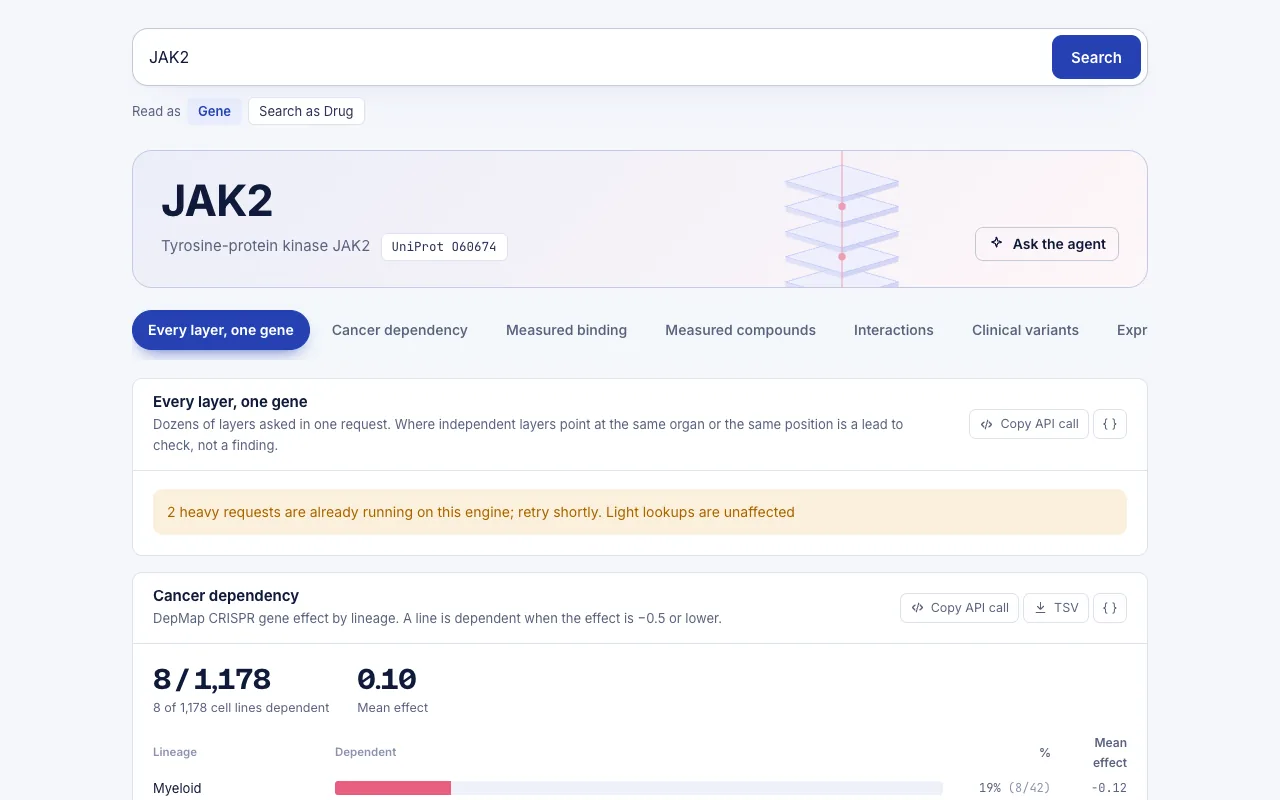
JAK2 vs TYK2: dependency and drugs side by side
JAK2 vs TYK2 in DepMap and drug databases: 8 of 1178 cell lines are dependent on JAK2, 11 on TYK2; 47 drugs are known for JAK2 and 20 for TYK2.