

Avatrombopag Thrombocytopenia trial NCT07895017
NCT07895017 tests avatrombopag around CAR T-cell therapy; BioQ adds ChEMBL potency, 38 registered avatrombopag trials and compound identity, as of 2026-11-06.
Data as of November 6, 2026 · By the BioQ team
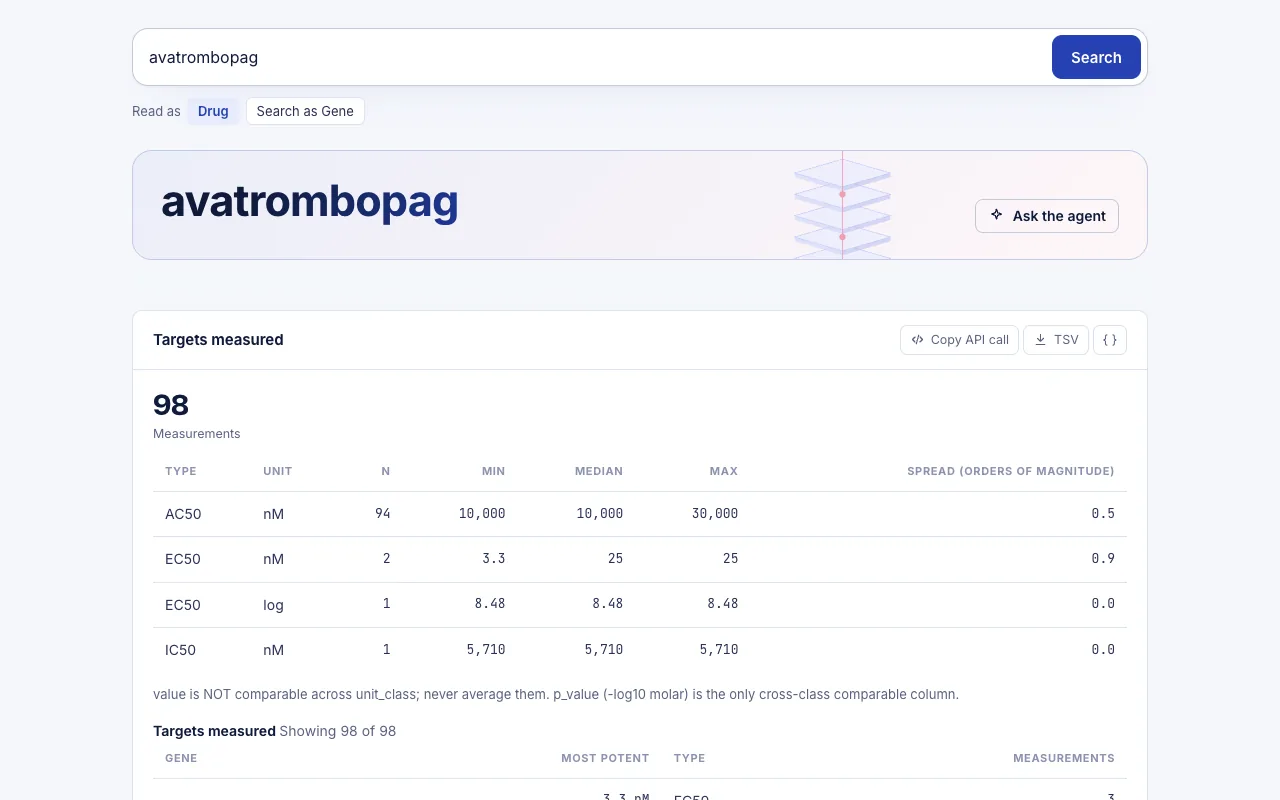
NCT07895017 is a new PHASE2 trial from the University of Virginia that gives avatrombopag before and after CAR T-cell therapy in people with Thrombocytopenia. BioQ links 38 registered avatrombopag studies, 19 of them Phase 2, and 75 ChEMBL targets, of which 5 have exact potency measurements. All numbers are as of 2026-11-06.
What we asked about the avatrombopag Thrombocytopenia trial
The trial is titled "Time-limited Treatment With Avatrombopag Pre- and Post-CAR T-cell Therapy to Prevent Post-CAR T-cell Cytopenias". The sponsor is the University of Virginia, the phase is PHASE2, the listed start is 2026-11, and the registered condition is Thrombocytopenia. The registration describes a time-limited course of avatrombopag on both sides of CAR T-cell infusion, aimed at preventing low blood counts after the cell therapy.
A new registration invites three questions about the drug. What does ChEMBL say about its measured potency and targets? How many other trials of avatrombopag exist, and at which phases? Which compound exactly is meant, so that records from different databases can be joined? We ran one query, "avatrombopag", and read all three answers from the result.
What BioQ returned
The query ran 3 engine queries against 3 distinct resources (ChEMBL, ClinicalTrials.gov and PubChem) in 0.21 engine seconds in total.
Compound identity. PubChem lists avatrombopag as CID 9852519 with InChIKey OFZJKCQENFPZBH-UHFFFAOYSA-N and 20 synonyms. It maps to ChEMBL as CHEMBL2103883. This is the identifier that ties the potency table to the trial list.
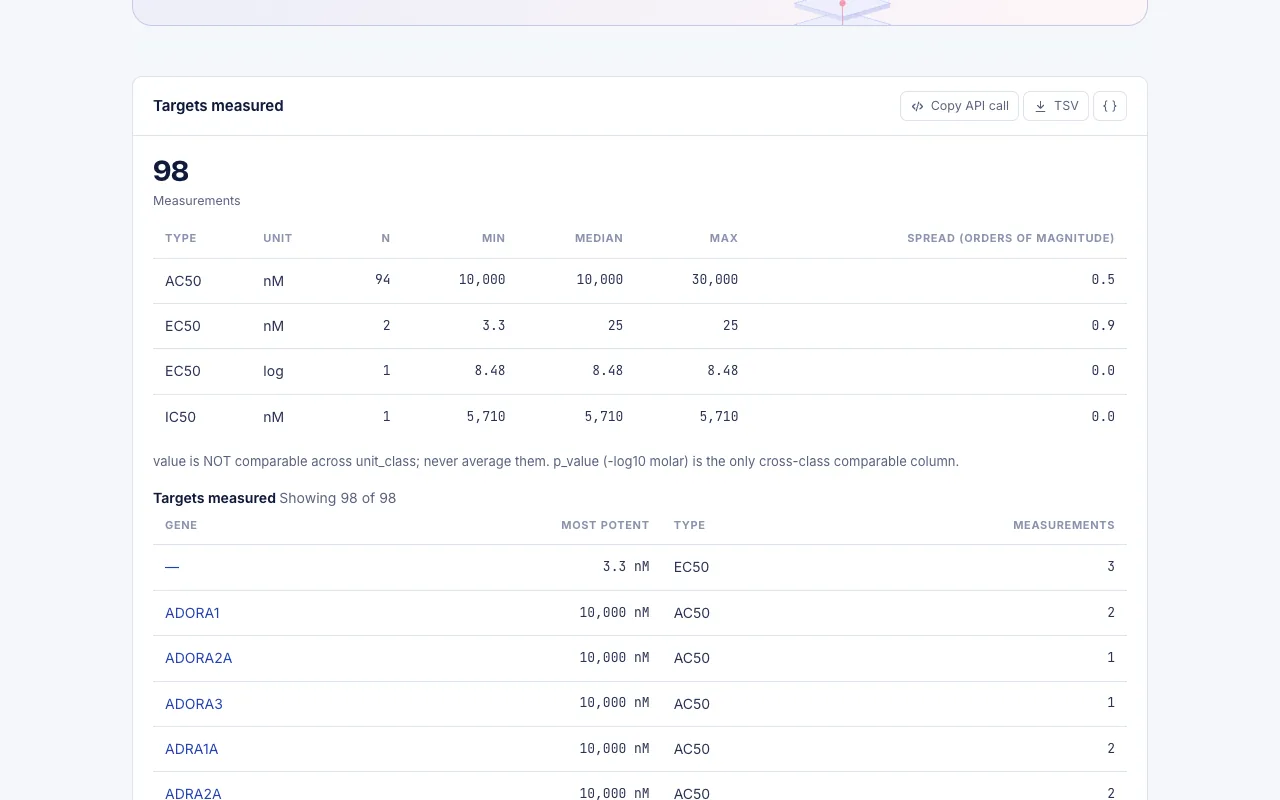
Measured potency. The current ChEMBL release holds activity records for 75 targets of avatrombopag. Only 5 of them have exact measurements. The table shows the 8 strongest entries; pChEMBL is the negative log10 of the molar potency, so higher means more potent.
| ChEMBL target | Gene | Best pChEMBL | Type | Exact measurements |
|---|---|---|---|---|
| CHEMBL614524 | — | 8.48 | EC50 | 1 |
| CHEMBL612545 | — | 7.6 | EC50 | 1 |
| CHEMBL4303835 | — | 5.24 | IC50 | 1 |
| CHEMBL240 | KCNH2 | 4.91 | AC50 | 1 |
| CHEMBL221 | PTGS1 | 4.7 | AC50 | 1 |
| CHEMBL1785 | EDNRB | — | — | 0 |
| CHEMBL1821 | CHRM4 | — | — | 0 |
| CHEMBL1833 | HTR2B | — | — | 0 |
Other trials. ClinicalTrials.gov matches 38 studies with avatrombopag as the intervention: 2 Phase 1, 19 Phase 2 and 7 Phase 3. The table below is one page of 6 studies, not the full set.
| Trial | Phase | Status | Sponsor | Start | Enrollment |
|---|---|---|---|---|---|
| NCT01433978 | PHASE3 | TERMINATED | Eisai Inc. | 2012-03 | 24 |
| NCT02809768 | PHASE1 | COMPLETED | Eisai Inc. | 2016-04 | 48 |
| NCT04993885 | PHASE2 | RECRUITING | Institute of Hematology & Blood Diseases | 2021-09 | 52 |
| NCT04949009 | — | UNKNOWN | Shandong University | 2021-03 | 400 |
| NCT05823376 | — | RECRUITING | Anhui Provincial Hospital | 2023-05 | 40 |
| NCT06001567 | PHASE2 | UNKNOWN | Second Affiliated Hospital of Guangzhou | 2023-08 | 30 |
What it means and how to read it
The potency table has two parts. The top two rows are EC50 values, 8.48 for CHEMBL614524 and 7.6 for CHEMBL612545. EC50 describes a functional effect, not binding inhibition. Neither row carries a gene symbol in this result, so the table alone does not say which protein those ChEMBL targets are. Open the two target records in ChEMBL before drawing a conclusion about mechanism.
The rows below them are much weaker. CHEMBL4303835 has an IC50 of 5.24. KCNH2 has an AC50 of 4.91 and PTGS1 an AC50 of 4.7. These are single exact measurements (1 each), so they read as isolated assay results, not as a profile. EDNRB, CHRM4 and HTR2B appear in the list with 0 exact measurements, meaning only censored or inexact records exist for them.
The trial list gives context for NCT07895017. Avatrombopag has been studied by industry sponsors and by academic centres, with statuses ranging from TERMINATED and COMPLETED to RECRUITING and UNKNOWN. The earliest page entries are two Eisai Inc. studies, NCT01433978 (PHASE3, terminated, enrollment 24) and NCT02809768 (PHASE1, completed, enrollment 48). The University of Virginia trial belongs to the group of academic Phase 2 studies, such as NCT04993885 (RECRUITING, enrollment 52) and NCT06001567 (UNKNOWN, enrollment 30). Its setting around CAR T-cell therapy is specific, and the list page shown here does not tell us whether other avatrombopag trials share it.
A dependency analysis in cancer models, which we would use for an oncology target, does not apply here. The trial tests a drug for a blood-count problem, not a tumour vulnerability, and the result contains no DepMap data for this question.
Why one query helps. Doing this by hand means searching ChEMBL for the compound, matching its identifier to PubChem, and filtering ClinicalTrials.gov by intervention and phase. BioQ resolved the name once and returned all three views, each labelled with its source and release, in 0.21 engine seconds. The saving is in joining records by identifier, not in the reading of them, which still needs a scientist.
How to reproduce it in BioQ
- Open BioQ and enter the query exactly as shown below.
- Start with the compound identity and confirm CHEMBL2103883 is the entry you intend.
- Check the potency table and note which rows have exact measurements and which lack a gene symbol.
- Open the trial list, filter by phase or status, and look up NCT07895017 for the registered design.
avatrombopag- Note the data date shown with the answer, because trial registrations and ChEMBL releases change.
Limits: what the data do not show
- The data describe the drug and its registry context. They do not show what the trial will find, whether avatrombopag prevents cytopenias after CAR T-cell therapy, or how the regimen will be dosed. We give no treatment advice.
- The registration records a start of 2026-11. A listed start does not mean enrolment has begun, and this answer does not report enrollment for NCT07895017.
- ChEMBL potency comes from assays run in different systems and mixes EC50, IC50 and AC50 values. Only 5 of 75 targets have exact measurements, and each shown value rests on a single record, so rankings are tentative.
- Two of the strongest targets have no gene symbol in this result. We cannot name the proteins from this table, so we do not state a mechanism of action here.
- The trial table is a page of 6 from 38 studies. Phase counts cover all matches, but the remaining studies include entries without a phase label, and a ClinicalTrials.gov search is the place to confirm the full list.
Data and method
The numbers on this page were read from the BioQ engine on 2026-11-06 (3 queries, 0.2 s of engine time in total). The tables are generated by code from the engine's answers; the text only restates them.
/chembl_potency, /clinicaltrials, /compound
Sources
- Time-limited Treatment With Avatrombopag Pre- and Post-CAR T-cell Therapy to Prevent Post-CAR T-cell Cytopenias (2026) — https://clinicaltrials.gov/study/NCT07895017
Run the same query yourself: avatrombopag
For research use only. This page summarises public data and is not medical advice.
BioQ is an AI search engine and agent with one goal: making biology research 100X faster. Ask in the web app, over the REST API, or from Claude, ChatGPT or Cursor through MCP.
Queries used
Frequently asked questions
What is NCT07895017?
NCT07895017 is a PHASE2 trial sponsored by the University of Virginia, starting 2026-11, that tests time-limited avatrombopag before and after CAR T-cell therapy. The registered condition is Thrombocytopenia.
How many other avatrombopag trials are registered?
ClinicalTrials.gov lists 38 studies with avatrombopag as the intervention as of 2026-11-06: 2 in Phase 1, 19 in Phase 2 and 7 in Phase 3.
What is the measured potency of avatrombopag in ChEMBL?
ChEMBL records 75 targets for CHEMBL2103883, of which 5 have exact measurements. The best pChEMBL values are 8.48 and 7.6, both EC50, on targets without a gene symbol in this result.
Does avatrombopag hit off-target proteins such as KCNH2?
ChEMBL lists KCNH2 with an AC50 of 4.91 and PTGS1 with 4.7, one exact measurement each. These are weak, single-assay values and do not establish a pharmacological profile.
Which database identifiers belong to avatrombopag?
PubChem CID 9852519, InChIKey OFZJKCQENFPZBH-UHFFFAOYSA-N and ChEMBL ID CHEMBL2103883. PubChem lists 20 synonyms.
Sources
Results come from public databases as of the date shown and may change. BioQ gives research information, not medical advice.
More from the blog
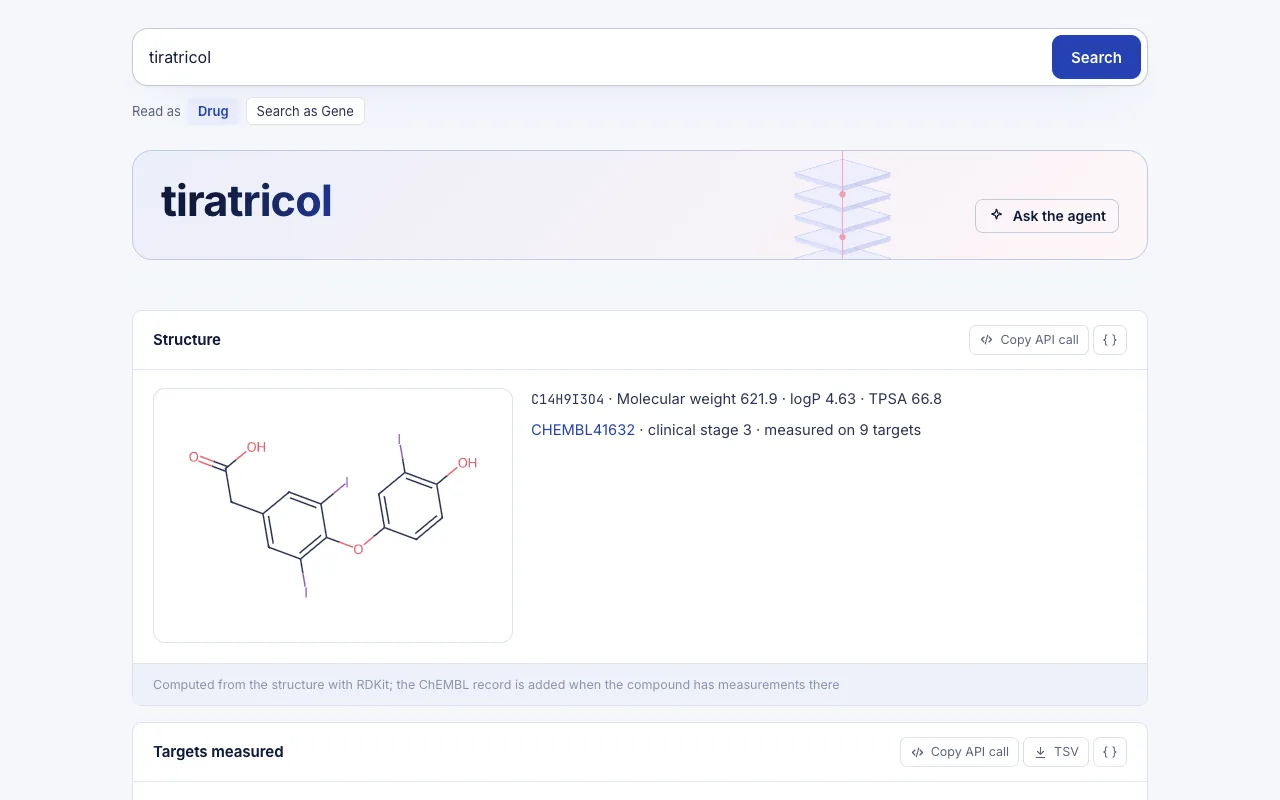
Tiratricol FDA approval: targets and potency in BioQ
Tiratricol FDA approval (Emcitate): ChEMBL shows 68 targets, THRB and THRA top by pChEMBL, and 3 registered trials on ClinicalTrials.gov, as of 2026-11-17.
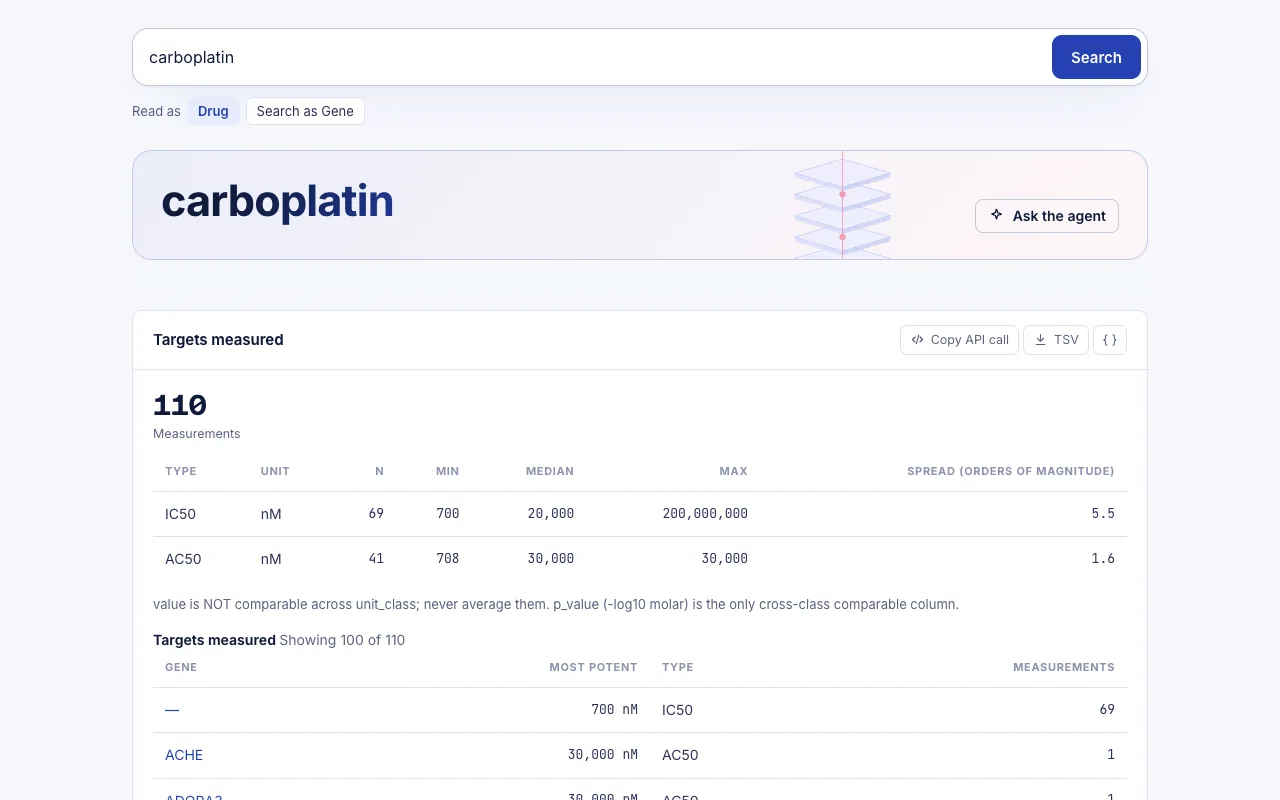
Carboplatin Non-Small Cell Lung Cancer trial: NCT07877584
NCT07877584 is a phase 3 NSCLC trial of PD-1 blockade with or without chemotherapy; BioQ adds carboplatin ChEMBL potency and ClinicalTrials.gov context.
Semaglutide new study: what BioQ data show
A new FAERS paper on semaglutide and panic attacks, set against ChEMBL potency, ClinicalTrials.gov registrations and PubChem identity as of 2026-11-15.