

ATM new study: E2, CIP2A and TOPBP1 in context
A 2026 Cell Reports paper links HPV E2 to ATM activation; BioQ's DepMap, ChEMBL, Open Targets and TCGA data show where ATM stands as of 2026-11-06.
Data as of November 6, 2026 · By the BioQ team
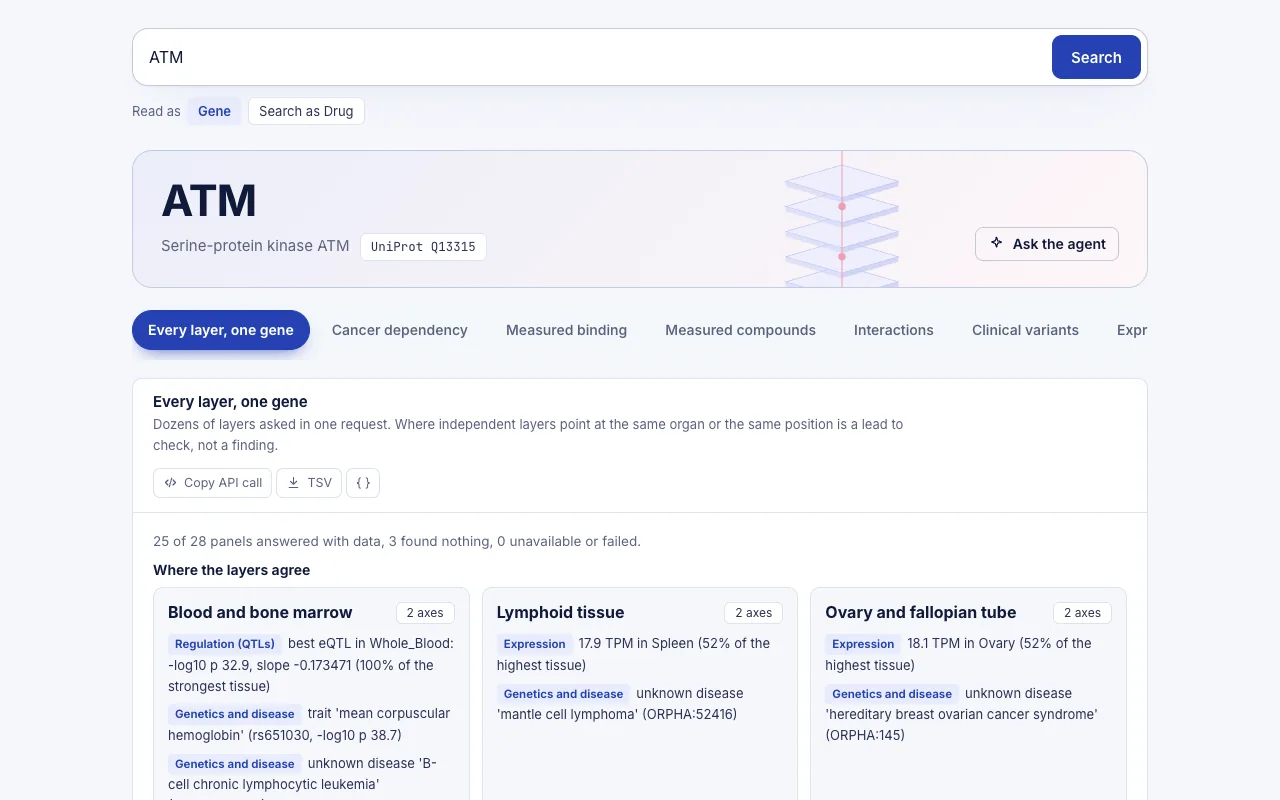
In the DepMap data (release depmap_24q4), ATM is not a common-essential gene: 8 of 1178 cell lines count as dependent, which is 0.7 percent, and the mean Chronos gene effect is -0.008. The gene has 5 drugs listed, and its strongest disease association in Open Targets is ataxia telangiectasia (score 0.875). This is the background for a 2026 Cell Reports paper on papillomavirus E2 and ATM. All data are as of 2026-11-06.
What we asked about the new ATM study
The paper (DOI 10.1016/j.celrep.2026.118209) asks how the papillomavirus protein E2 switches on the DNA damage response in differentiating epithelium. It reports a route through CIP2A, TOPBP1 and PP2A that ends in ATM phosphorylation. It also describes E2 holding ATM and TOPBP1 together while ATR stays quiet. Those results, and the experiments behind them in keratinocytes, mouse lesions and head and neck cancer lines, belong to the paper's authors. BioQ did not test or reproduce any of it.
Our question was narrower: what do public data layers say about ATM today? A reader can use the answer to judge how much weight ATM-directed hypotheses carry in a given tissue, drug class or disease. We ran the single query ATM and read what came back.
What BioQ returned
The query drew on 7 distinct resources in 7 engine queries, in 1.6 engine seconds in total. The first table shows CRISPR dependency by lineage from DepMap.
| Lineage | Cell lines | Dependent | % dependent | Mean gene effect |
|---|---|---|---|---|
| Uterus | 34 | 1 | 2.9 | -0.111 |
| Head and Neck | 77 | 0 | 0 | -0.084 |
| Bladder/Urinary Tract | 34 | 1 | 2.9 | -0.074 |
| Esophagus/Stomach | 69 | 1 | 1.5 | -0.069 |
| Thyroid | 11 | 0 | 0 | -0.068 |
| Lung | 126 | 1 | 0.8 | -0.041 |
| Bone | 46 | 0 | 0 | -0.037 |
| Lymphoid | 93 | 1 | 1.1 | -0.036 |
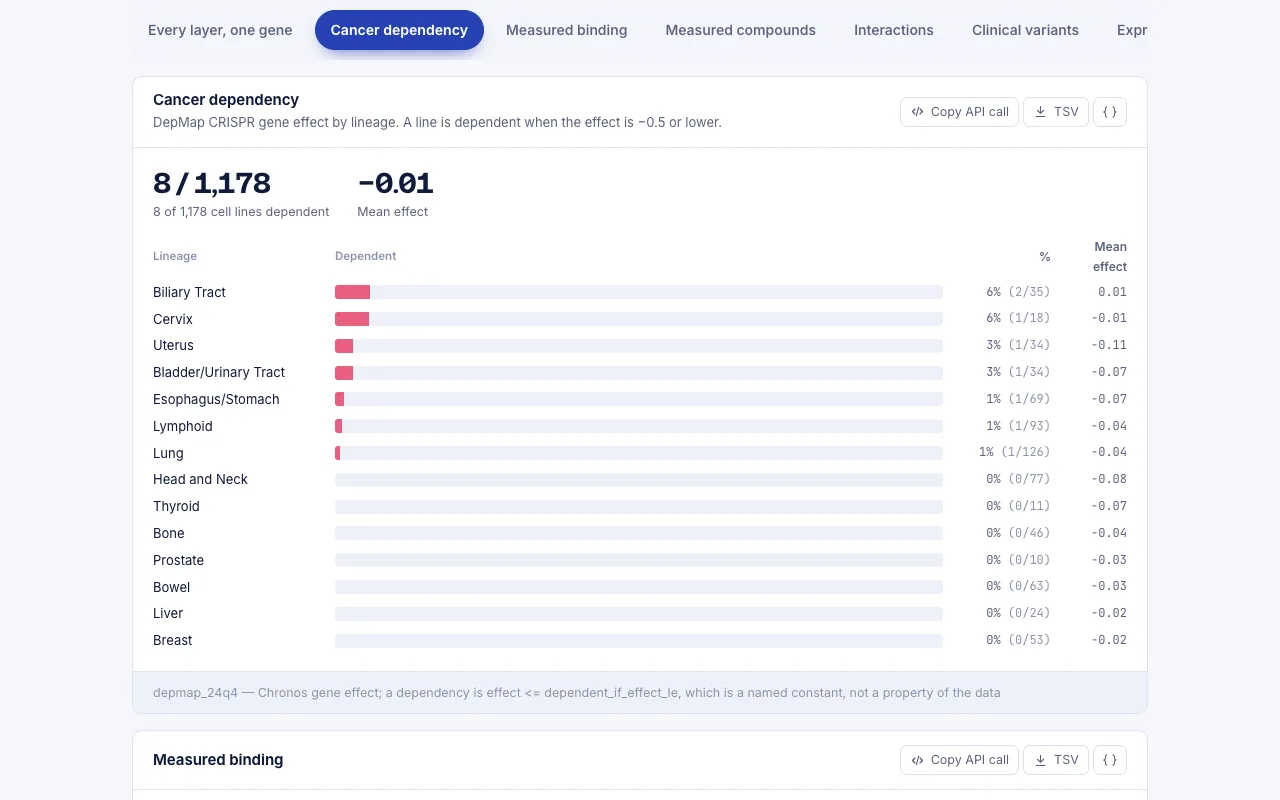
Head and Neck has 77 lines and none are dependent, with a mean gene effect of -0.084. Uterus has 34 lines and 1 dependent, with a mean of -0.111. Those are the most negative lineage means in the table, and they are still small. ATM is also flagged as not common essential.
The second table lists drugs known for the gene, with the exact pChEMBL value where ChEMBL holds one.
| Drug | Max clinical stage | Mechanism | Best exact pChEMBL | Type | Trials by name |
|---|---|---|---|---|---|
| Caffeine | APPROVAL | — | 3.7 | IC50 | 220 |
| Berzosertib | PHASE_2 | — | 7.36 | KI | 17 |
| Ku-55933 | IND | — | 8.66 | KI | 0 |
| Ku 60019 | UNKNOWN | — | 9.1 | IC50 | 0 |
| Cgk-733 | UNKNOWN | — | — | — | 0 |
The exact pChEMBL values run from 3.7 for Caffeine (IC50) to 9.1 for Ku 60019 (IC50). Higher means stronger potency. Berzosertib reaches PHASE_2 with 17 trials by name. The 220 trials by name for Caffeine are a name match and say nothing about ATM inhibition. Cgk-733 has no exact value in this view.
The third table shows the Open Targets disease associations.
| Disease | Association score | Evidence items |
|---|---|---|
| ataxia telangiectasia | 0.875 | 16042 |
| breast cancer | 0.778 | 2141 |
| breast carcinoma | 0.764 | 1730 |
| cancer | 0.757 | 3275 |
| neoplasm | 0.747 | 3429 |
| hereditary breast carcinoma | 0.739 | 6212 |
Open Targets links ATM to 1566 diseases. Ataxia telangiectasia leads with 16042 evidence items. Breast cancer follows at 0.778, then breast carcinoma, cancer, neoplasm and hereditary breast carcinoma.
Four other layers returned the following:
- TCGA/GTEx Toil: 24 cancer types have both tumour and normal samples. In Breast Invasive Carcinoma (1092 tumours, 113 normals) the log2 fold is -0.09. Sarcoma is the only one of the six rows shown with a positive fold (0.09).
- Reactome: 61 pathways. The most specific is Sensing of DNA Double Strand Breaks (R-HSA-5693548), with 6 genes.
- STRING v12: 3253 partners. MSH2, MSH6, NBN, TP53, MRE11 and ATR all score 999.
- CIViC: 32 records. Examples include ATM Mutation with Olaparib in Hematologic Cancer (level D) and ATM S2289* with Olaparib in Prostate Cancer (level C).
What it means and how to read it
The paper puts ATM at the centre of a viral mechanism. The public data fit that picture only loosely, and the data cannot confirm or refute the mechanism.
- Sensing and pathway context. ATM sits in a DNA double-strand break sensing pathway in Reactome. In STRING it is tightly linked to NBN, MRE11, TP53 and ATR. The paper's ATM-versus-ATR framing therefore involves two kinases that the interaction data already place close together. STRING scores are functional association, not proof of a direct physical contact.
- Dependency. A mean gene effect of -0.008 across 1178 lines indicates that ATM loss rarely cuts viability on its own in these models. Head and Neck shows no dependent line out of 77. If ATM activity matters in HPV-positive disease, a single-gene knockout screen is not the likeliest place for it to show, and DepMap's lineage labels do not say which lines carry HPV.
- Drugs. The ATM-directed compounds listed range in development stage from IND to PHASE_2. Their potencies are measured against the kinase in biochemical assays. Nothing here links them to papillomavirus biology.
- Disease links. The association scores reflect inherited and tumour genetics. They do not reflect viral infection.
How to reproduce it in BioQ
- Open BioQ and type the gene symbol as the query, exactly as below.
ATM- Read the dependency panel first. Check the lineage rows for Head and Neck and Uterus against the pooled figures.
- Open the drug panel and compare the exact pChEMBL values and the assay type (IC50 or KI) before comparing compounds.
- Scroll to the Open Targets, TCGA, Reactome, STRING and CIViC panels. Each answer names its source and release.
- Repeat with TOPBP1, CIP2A or ATR to place the other proteins named in the paper.
Doing this by hand means visiting DepMap, ChEMBL, Open Targets, TCGA/GTEx, CIViC, Reactome and STRING separately. Here it was 7 resources in 1.6 engine seconds.
Limits: what the data do not show
- The paper's results are the paper's. BioQ holds no data on E2, HPV16, MmuPV1 or keratinocyte differentiation, and none of the tables above tests the E2 mechanism.
- DepMap measures knockout effect in cultured cell lines. It does not measure kinase activity, phosphorylation or viral replication.
- The pChEMBL values come from different assays and are not directly comparable across compounds. The trial counts are name matches.
- TCGA/GTEx compares RNA levels. It cannot tell you about ATM activation, which depends on phosphorylation.
- CIViC evidence at levels C and D is limited in strength. Nothing here supports treatment decisions.
- The tables show only the top rows. Open Targets and STRING hold many more.
Data and method
The numbers on this page were read from the BioQ engine on 2026-11-06 (7 queries, 1.6 s of engine time in total). The tables are generated by code from the engine's answers; the text only restates them.
/civic, /depmap, /drugs, /interaction, /ot_association, /pathway, /tcga
Sources
- E2 displacement of CIP2A from TOPBP1 activates the DNA damage response during papillomavirus life cycles (2026) — doi:10.1016/j.celrep.2026.118209
Run the same query yourself: ATM
For research use only. This page summarises public data and is not medical advice.
BioQ is an AI search engine and agent with one goal: making biology research 100X faster. Ask in the web app, over the REST API, or from Claude, ChatGPT or Cursor through MCP.
Queries used
Frequently asked questions
Is ATM a common essential gene in DepMap?
No. In DepMap release depmap_24q4, ATM is flagged as not common essential. 8 of 1178 cell lines are dependent, which is 0.7 percent, and the mean Chronos gene effect is -0.008.
Do head and neck cancer cell lines depend on ATM?
Not in this data. The Head and Neck lineage has 77 lines and 0 are dependent, with a mean gene effect of -0.084. DepMap does not label which lines are HPV-positive.
Which ATM inhibitors does ChEMBL list with exact potency?
Four of the 5 drugs listed have an exact pChEMBL value: Caffeine (3.7, IC50), Berzosertib (7.36, KI), Ku-55933 (8.66, KI) and Ku 60019 (9.1, IC50). Cgk-733 has no exact value. The values come from different assays.
What is ATM most associated with in Open Targets?
Ataxia telangiectasia, with an association score of 0.875 and 16042 evidence items. Breast cancer follows at 0.778. ATM has links to 1566 diseases in total.
Does BioQ confirm the E2 and CIP2A mechanism in the new paper?
No. The mechanism is the paper's own result. BioQ shows public context on ATM from 7 resources, such as dependency, drugs and pathways, but holds no viral data.
Sources
- Paper E2 displacement of CIP2A from TOPBP1 activates the DNA damage response during papillomavirus life cycles (2026) DOI 10.1016/j.celrep.2026.118209
- Dataset DepMap CRISPR Chronos gene effect (24Q4)
- Dataset Open Targets Platform; ChEMBL; Drug Repurposing Hub
- Dataset TCGA pan-cancer expression (UCSC Xena Toil recompute)
- Dataset CIViC: Clinical Interpretation of Variants in Cancer
- Dataset Reactome pathway knowledgebase
- Dataset STRING v12 protein-protein interactions
Results come from public databases as of the date shown and may change. BioQ gives research information, not medical advice.
More from the blog
CD4 new study: CAR-NK cells and HIV rebound in context
A CD4-based CAR-NK paper on HIV rebound, placed in context with BioQ data on CD4: DepMap dependency, Open Targets diseases, drugs and Reactome pathways.
GSTM1 new study: cisplatin kidney injury in context
A 2026 paper links GSTM1 loss to worse cisplatin kidney injury; BioQ shows what DepMap, Open Targets, ChEMBL, Reactome and STRING say about GSTM1 today.
JAK2 vs TYK2: dependency and drugs side by side
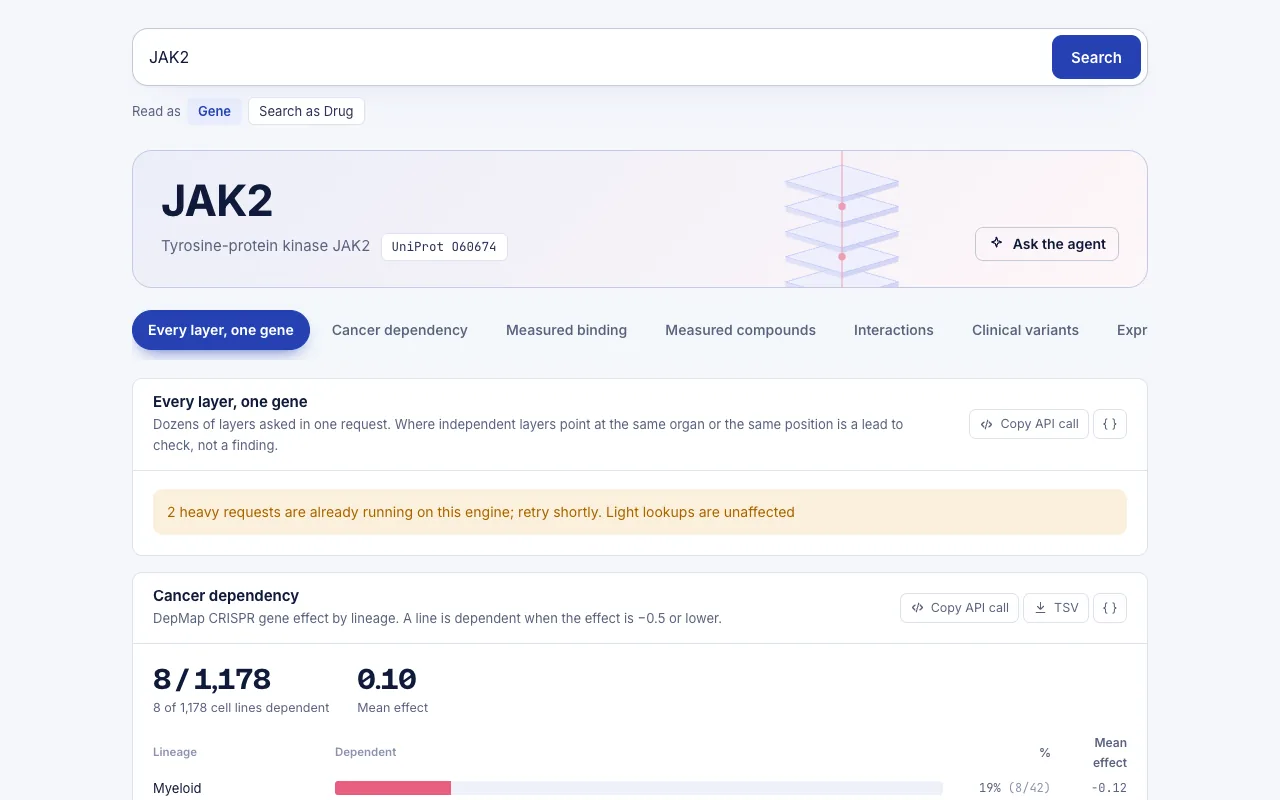
JAK2 vs TYK2 in DepMap and drug databases: 8 of 1178 cell lines are dependent on JAK2, 11 on TYK2; 47 drugs are known for JAK2 and 20 for TYK2.