

Zanzalintinib Anaplastic Thyroid Cancer Trial: NCT07470489
Phase 2 trial NCT07470489 pairs zanzalintinib with cemiplimab in BRAF wild-type anaplastic thyroid cancer; ChEMBL, ClinicalTrials.gov and DepMap data inside.
Data as of November 16, 2026 · By the BioQ team
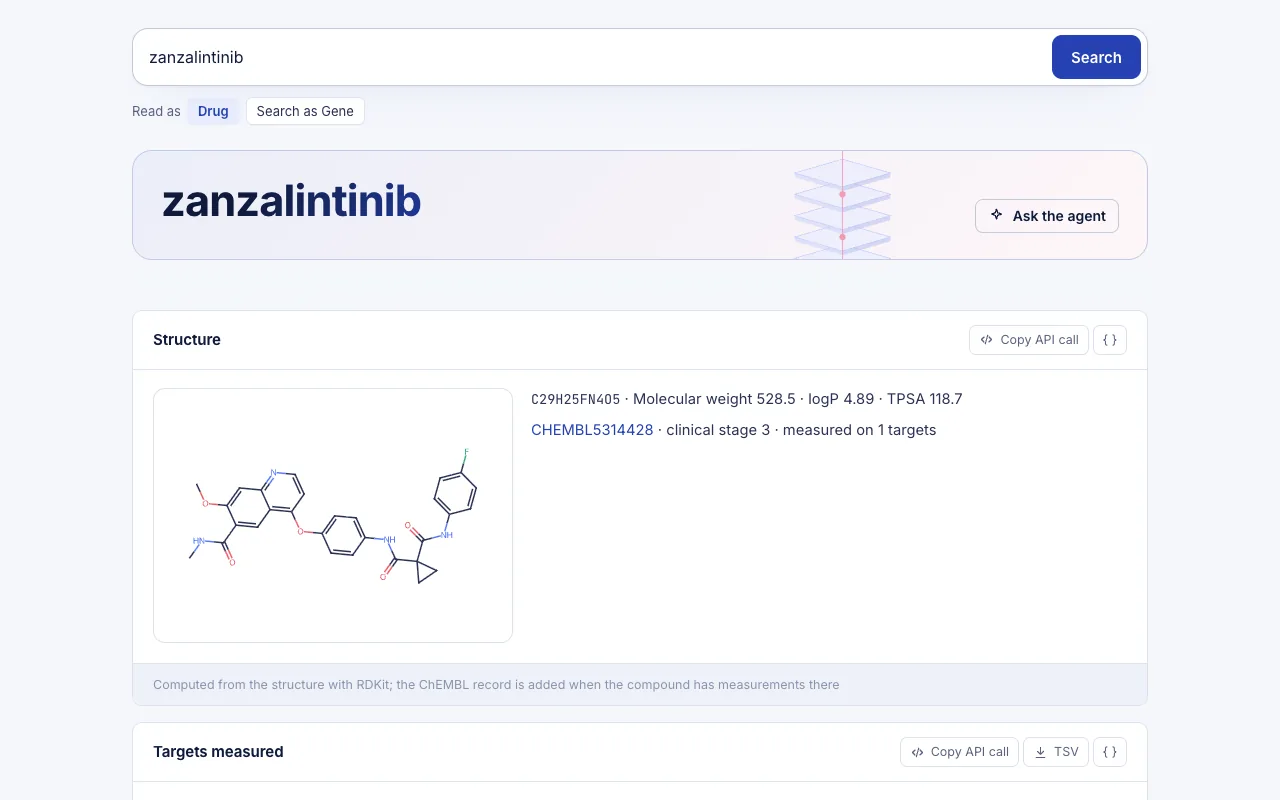
NCT07470489 is a phase 2 trial from M.D. Anderson Cancer Center that combines zanzalintinib with cemiplimab in BRAF wild-type anaplastic thyroid cancer. As of 2026-11-16, ChEMBL holds one exact potency measurement for zanzalintinib (AXL, pChEMBL 8.24), ClinicalTrials.gov lists 42 studies of the drug, and DepMap shows BRAF dependency in 5 of 11 thyroid cell lines.
What we asked about the zanzalintinib trial in anaplastic thyroid cancer
The registry entry is titled "Zanzalintinib Plus Cemiplimab for the Treatment of BRAF Wild-Type Anaplastic Thyroid Cancer". The sponsor is M.D. Anderson Cancer Center, the phase is PHASE2, the listed condition is Anaplastic Thyroid Cancer, and the registered start falls in early 2027. The trial is therefore a planned study, not a reported result.
A new registration raises a few practical questions, and we put them to BioQ with a single query, "zanzalintinib":
- Which targets of zanzalintinib have measured potency, and how many of those measurements are exact?
- What other trials of the drug are registered, and in which phases?
- Is the compound identity unambiguous across databases?
- The trial restricts enrollment to BRAF wild-type disease. What does a CRISPR screen say about BRAF dependency in thyroid models?
What BioQ returned
The compound resolves to PubChem CID 139350422 and ChEMBL ID CHEMBL5314428, with 14 synonyms recorded. The InChIKey is JSPCKALGNNVYOO-UHFFFAOYSA-N. Searching under any of those names should therefore reach the same molecule.
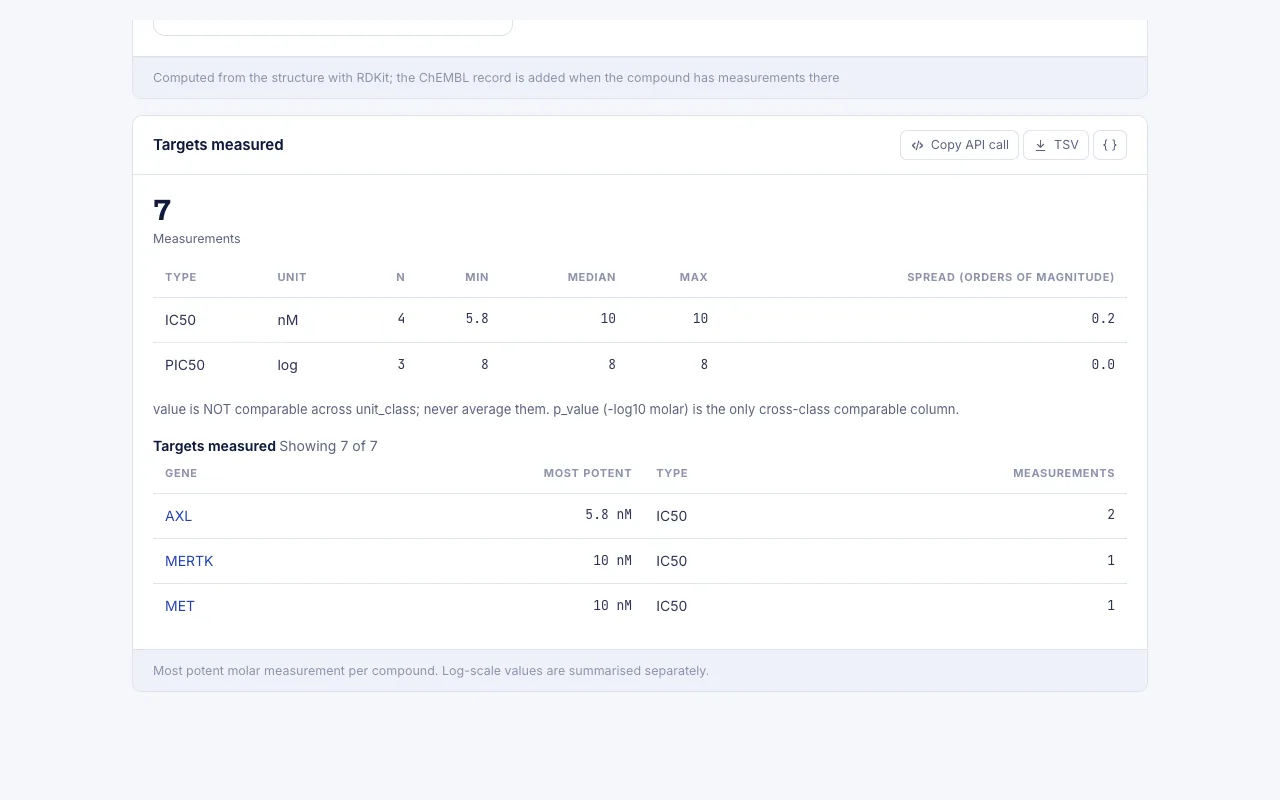
The current ChEMBL release lists 3 targets for zanzalintinib. Only 1 of them has an exact measurement:
| ChEMBL target | Gene | Best pChEMBL | Type | Exact measurements |
|---|---|---|---|---|
| CHEMBL4895 | AXL | 8.24 | IC50 | 1 |
| CHEMBL3717 | MET | — | — | 0 |
| CHEMBL5331 | MERTK | — | — | 0 |
ClinicalTrials.gov matches 42 studies by intervention name: 13 in phase 1, 29 in phase 2 and 6 in phase 3. The phase counts overlap, because a PHASE1/PHASE2 study is counted in both. The table below is a page of 6 studies, not the full list:
| Trial | Phase | Status | Sponsor | Start | Enrollment |
|---|---|---|---|---|---|
| NCT06571734 | PHASE2 | RECRUITING | Northwestern University | 2024-09 | 73 |
| NCT07620574 | PHASE3 | ENROLLING_BY_INVITATION | Exelixis | 2026-07 | 5000 |
| NCT07773454 | PHASE1 | NOT_YET_RECRUITING | Exelixis | 2026-09 | 18 |
| NCT07489495 | PHASE3 | RECRUITING | Merck Sharp & Dohme LLC | 2026-04 | 758 |
| NCT06794229 | PHASE2 | RECRUITING | Qian Qin | 2025-10 | 69 |
| NCT07878689 | PHASE1/PHASE2 | NOT_YET_RECRUITING | University of Texas Southwestern Medical | 2026-12 | 36 |
For the BRAF question, DepMap (Chronos gene effect) covers 1178 cell lines. Of these, 84 (7.1%) are dependent on BRAF, the mean gene effect is -0.108, and BRAF is not flagged as common essential. By lineage:
| Lineage | Cell lines | Dependent | % dependent | Mean gene effect |
|---|---|---|---|---|
| Skin | 74 | 47 | 63.5 | -0.828 |
| Thyroid | 11 | 5 | 45.5 | -0.49 |
| Bowel | 63 | 13 | 20.6 | -0.272 |
| Liver | 24 | 2 | 8.3 | -0.124 |
| Pancreas | 47 | 0 | 0 | -0.113 |
The Open Targets, ChEMBL and Drug Repurposing Hub layer also lists 29 drugs for BRAF. The ones shown by clinical stage are all at the approval stage, including Encorafenib, Dabrafenib and Vemurafenib. We use that list only as context, because zanzalintinib is not described as a BRAF drug.
What it means and how to read it
Potency. The single exact measurement is an IC50 against AXL, with a pChEMBL of 8.24. pChEMBL is the negative log10 of the molar potency, so a higher value means a stronger measurement. MET and MERTK are linked to the compound in ChEMBL, but no exact measurement is attached to either in this release. Read them as targets with a recorded association and no exact potency value. Do not treat them as weak or inactive.
Other trials. The 42 registered studies show that zanzalintinib is already in broad clinical testing, with most studies in phase 2. The six rows shown have different sponsors, including Exelixis, Merck Sharp & Dohme LLC and academic centers, and enrollment ranges from 18 to 5000. The new thyroid trial adds a rare tumor setting and a combination partner, cemiplimab, which the title names. We did not retrieve data on cemiplimab here.
BRAF. The trial excludes BRAF-mutant disease, so the DepMap numbers need careful reading. Thyroid lines show 5 dependent out of 11 (45.5%) with a mean gene effect of -0.49. Skin is higher, with 47 of 74 lines (63.5%) and a mean of -0.828. Pancreas has 0 of 47. These figures describe how much cell viability depends on BRAF in each lineage. They do not say which lines carry a BRAF mutation, so they cannot tell you how a BRAF wild-type tumor behaves. The point is narrower: BRAF status is a meaningful axis in thyroid models, and it is consistent with the trial's decision to define its population by that axis.
Speed. The answer drew on 5 distinct resources through 5 engine queries, which took 1.83 seconds of engine time in total. The resources include ChEMBL, ClinicalTrials.gov, PubChem and DepMap. By hand you would search each of those separately, reconcile the compound names and then compare the results. That is the work BioQ does in one step, with the source shown on each block.
How to reproduce it in BioQ
- Open BioQ and enter the compound name exactly as written below.
- Run the query and read the compound block to confirm the identifiers (PubChem CID, ChEMBL ID).
- Open the target panel and check the exact measurement count next to each target before comparing potencies.
- Open the trial list and filter by phase or status. Search for NCT07470489 to see the registry entry itself.
- For the BRAF context, run a second query on the gene BRAF and open the lineage table for DepMap and the drug list.
zanzalintinibLimits: what the data do not show
- The facts here do not show whether NCT07470489 is counted among the 42 studies. The six rows displayed are only one page, and the new trial is not among them.
- One exact potency value, for AXL alone, is a thin basis. It says nothing about cellular activity, selectivity across the kinome or exposure in patients.
- ChEMBL lists MET and MERTK without exact values, so no potency comparison between the three targets is possible from these data.
- DepMap reports BRAF dependency across lineages without splitting by mutation status. Thyroid has only 11 lines, and none of them is described here as anaplastic or BRAF wild-type.
- A CRISPR dependency is a statement about cell lines. It is not evidence about tumors in patients or about the effect of zanzalintinib.
- Nothing here addresses efficacy, safety, dosing or how the combination with cemiplimab would behave. A registered phase 2 trial describes a plan, and outcomes come only after it reports.
- The data are as of 2026-11-16. Registry entries and ChEMBL releases change.
Data and method
The numbers on this page were read from the BioQ engine on 2026-11-16 (5 queries, 1.8 s of engine time in total). The tables are generated by code from the engine's answers; the text only restates them.
/chembl_potency, /clinicaltrials, /compound, /depmap, /drugs
Sources
- Zanzalintinib Plus Cemiplimab for the Treatment of BRAF Wild-Type Anaplastic Thyroid Cancer (2027) — https://clinicaltrials.gov/study/NCT07470489
Run the same query yourself: zanzalintinib
For research use only. This page summarises public data and is not medical advice.
BioQ is an AI search engine and agent with one goal: making biology research 100X faster. Ask in the web app, over the REST API, or from Claude, ChatGPT or Cursor through MCP.
Queries used
Frequently asked questions
What does NCT07470489 test?
It is a PHASE2 trial from M.D. Anderson Cancer Center that combines zanzalintinib with cemiplimab in BRAF wild-type Anaplastic Thyroid Cancer. The registered start is in early 2027, so no results are available.
What is the measured potency of zanzalintinib in ChEMBL?
ChEMBL lists 3 targets for zanzalintinib, and only AXL has an exact measurement: an IC50 with a pChEMBL of 8.24. MET and MERTK have 0 exact measurements.
How many clinical trials of zanzalintinib are registered?
The ClinicalTrials.gov snapshot matches 42 studies by intervention name: 13 in phase 1, 29 in phase 2 and 6 in phase 3. A PHASE1/PHASE2 study is counted in both phases.
Is BRAF a dependency in thyroid cancer cell lines?
In DepMap Chronos, 5 of 11 thyroid cell lines (45.5%) are dependent on BRAF, with a mean gene effect of -0.49. The data do not split lines by BRAF mutation status.
Which identifiers does zanzalintinib have?
PubChem lists CID 139350422 and 14 synonyms, and ChEMBL lists CHEMBL5314428. The InChIKey is JSPCKALGNNVYOO-UHFFFAOYSA-N.
Sources
Results come from public databases as of the date shown and may change. BioQ gives research information, not medical advice.
More from the blog
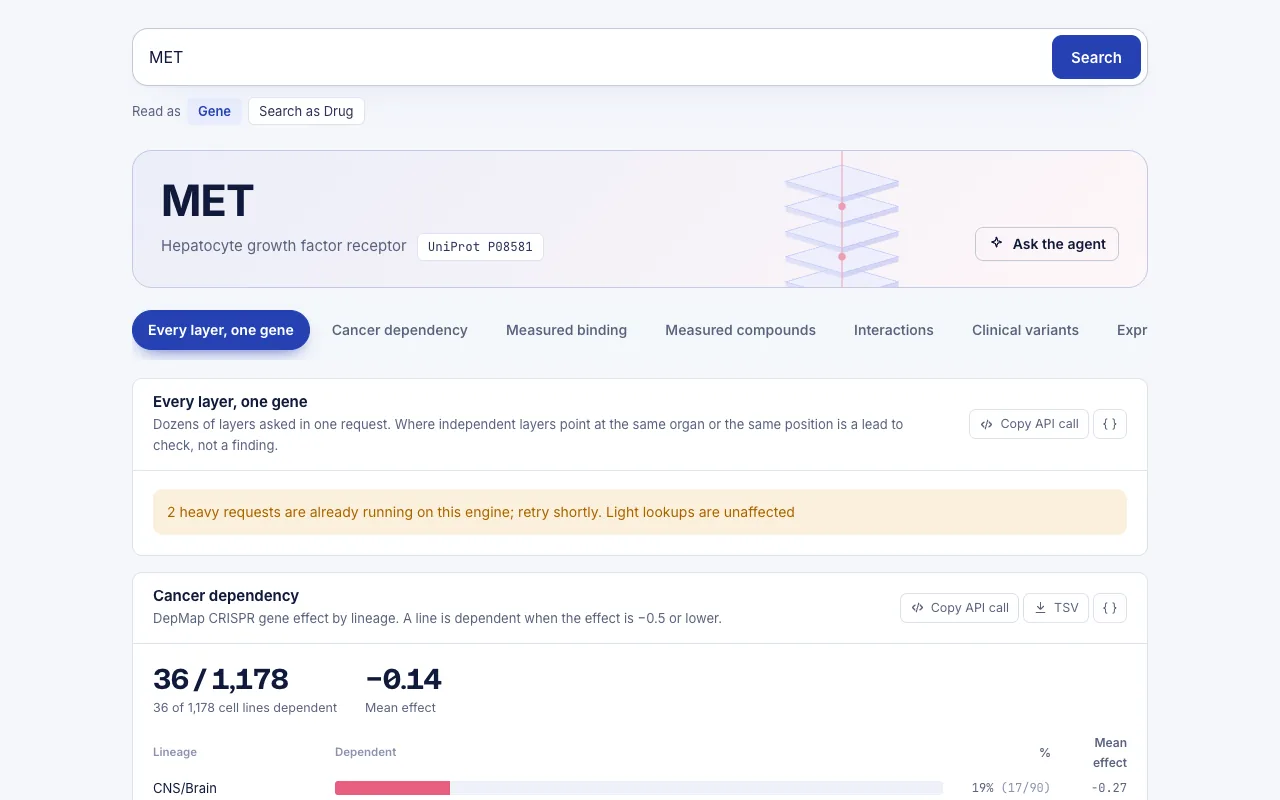
MET dependency and drugs in one query
MET dependency and drugs in one query: DepMap Chronos, ChEMBL potency, Open Targets, CIViC, TCGA and Reactome read together, with data as of 2026-11-06.
MDM2 vs MDM4: dependency and drugs side by side
MDM2 vs MDM4 in DepMap 24q4 Chronos data and drug annotations: 384 of 1178 cell lines depend on MDM2, 142 on MDM4; 12 drugs listed for MDM2, 1 for MDM4.
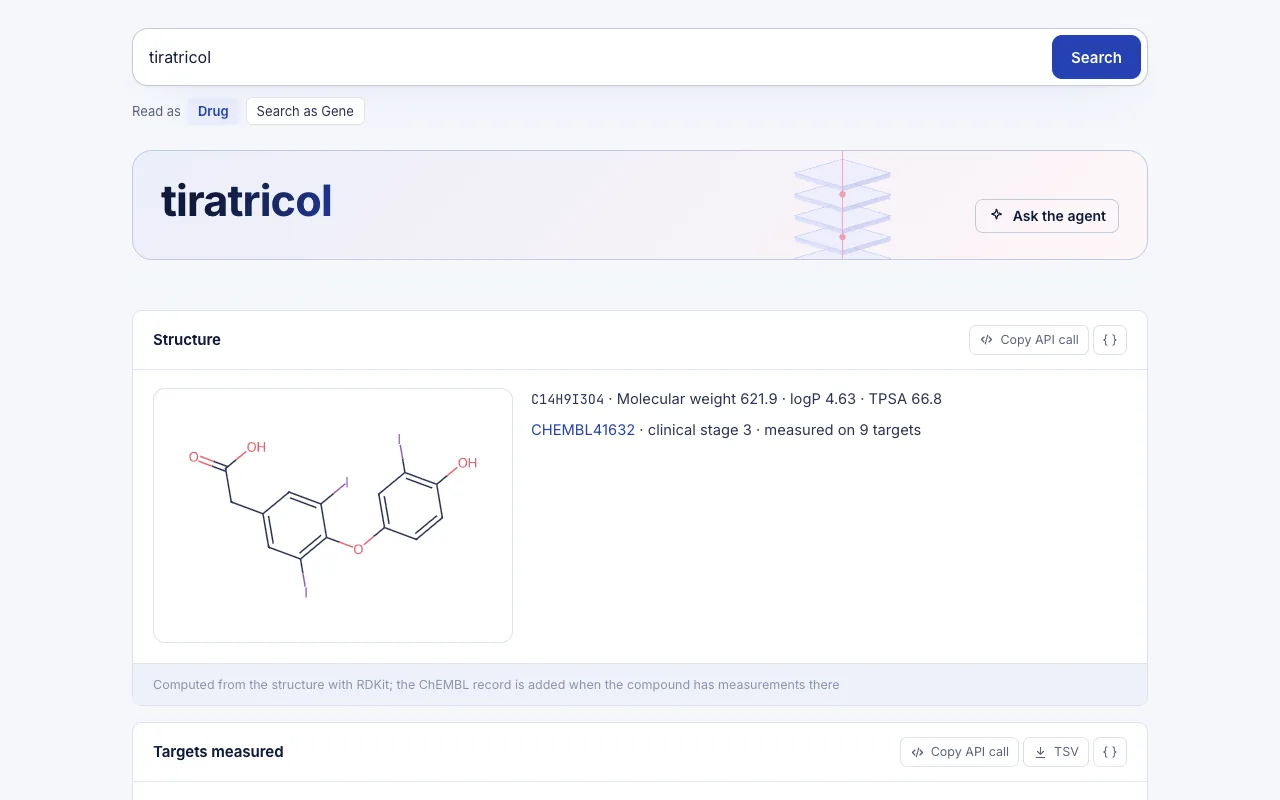
Tiratricol FDA approval: targets and potency in BioQ
Tiratricol FDA approval (Emcitate): ChEMBL shows 68 targets, THRB and THRA top by pChEMBL, and 3 registered trials on ClinicalTrials.gov, as of 2026-11-17.