

RET dependency and drugs in one BioQ query
RET is not a broad CRISPR dependency in DepMap, yet 29 drugs and 1873 disease links exist; one BioQ query reads seven public resources as of 2026-11-06.
Data as of November 6, 2026 · By the BioQ team
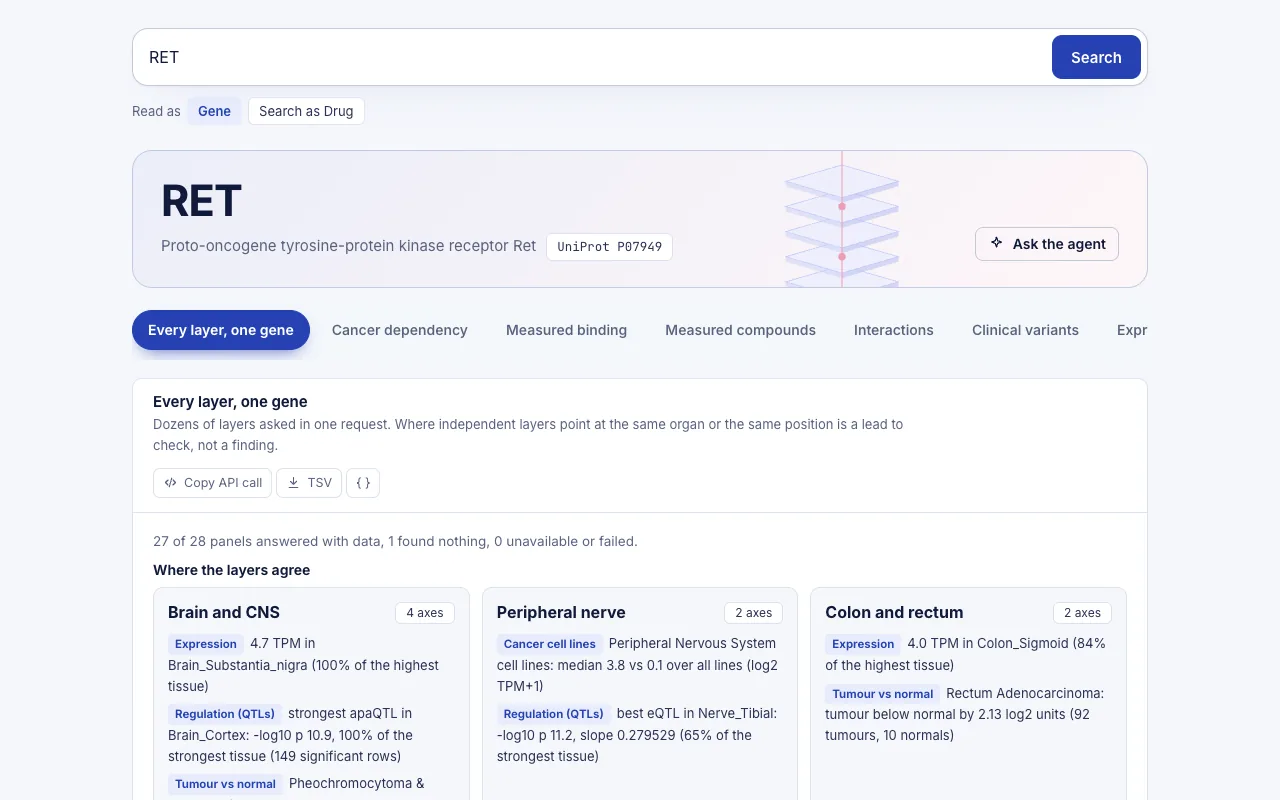
RET is not a broad CRISPR dependency: in DepMap, 1 of 1178 cell lines counts as dependent (0.1 percent), and the mean Chronos gene effect is -0.097. The same query returns 29 known drugs, 1873 associated diseases in Open Targets and 52 CIViC records. All values are as of 2026-11-06.
What we asked
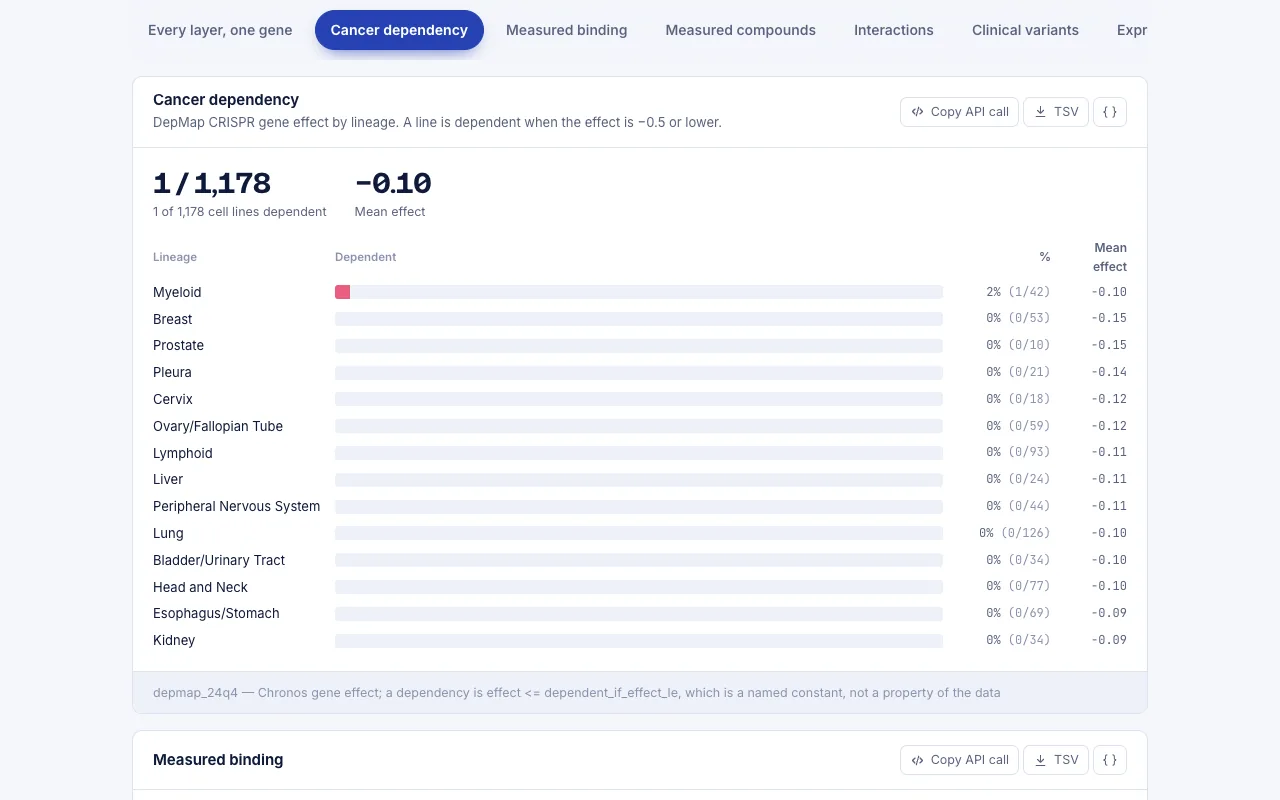
We typed a single word, RET, and asked BioQ to assemble what the public layers say about this gene today. A target review usually asks five questions: does the gene matter for cell survival, which drugs act on it, which diseases point to it, where is it expressed, and which pathways and partners surround it.
The answer draws on 7 distinct resources: DepMap, Open Targets with ChEMBL and related drug sources, TCGA/GTEx, CIViC, Reactome and STRING. BioQ ran 7 engine queries in 0.81 seconds of engine time. Doing the same by hand means opening each resource, finding the right gene identifier and reconciling the outputs. The engine time does not include the time you spend reading the results.
What BioQ returned for RET dependency and drugs
Dependency. The DepMap block reports the Chronos gene effect, where a more negative value means the knockout reduced viability more. RET is not flagged as common essential. The table shows the eight lineages with the most negative mean effect. None of them contains a dependent line, so the single dependent line is in a lineage outside this table.
| Lineage | Cell lines | Dependent | % dependent | Mean gene effect |
|---|---|---|---|---|
| Breast | 53 | 0 | 0 | -0.154 |
| Prostate | 10 | 0 | 0 | -0.15 |
| Pleura | 21 | 0 | 0 | -0.138 |
| Cervix | 18 | 0 | 0 | -0.124 |
| Ovary/Fallopian Tube | 59 | 0 | 0 | -0.115 |
| Lymphoid | 93 | 0 | 0 | -0.11 |
| Liver | 24 | 0 | 0 | -0.11 |
| Peripheral Nervous System | 44 | 0 | 0 | -0.106 |
Drugs. BioQ lists 29 drugs for RET and shows eight. All eight shown have reached the approval stage. The potency column is the best exact pChEMBL value, the negative log10 of the molar potency, so higher means stronger in that assay.
| Drug | Max clinical stage | Mechanism | Best exact pChEMBL | Type | Trials by name |
|---|---|---|---|---|---|
| Selpercatinib | APPROVAL | Tyrosine-protein kinase receptor RET inhibitor | 10 | IC50 | 35 |
| Vandetanib | APPROVAL | Tyrosine-protein kinase receptor RET inhibitor | 9.89 | IC50 | 57 |
| Ponatinib | APPROVAL | — | 9.52 | IC50 | 50 |
| Pralsetinib | APPROVAL | Tyrosine-protein kinase receptor RET inhibitor | 9.52 | IC50 | 12 |
| Regorafenib | APPROVAL | Tyrosine-protein kinase receptor RET inhibitor | 8.82 | IC50 | 182 |
| Quizartinib | APPROVAL | Tyrosine-protein kinase receptor RET inhibitor | 8.8 | KD | 33 |
| Cabozantinib | APPROVAL | — | 8.62 | IC50 | 187 |
| Alectinib | APPROVAL | Tyrosine-protein kinase receptor RET inhibitor | 8.32 | IC50 | 62 |
Disease evidence. Open Targets links RET to 1873 diseases. The top of the list is dominated by endocrine and neural crest conditions.
| Disease | Association score | Evidence items |
|---|---|---|
| multiple endocrine neoplasia type 2A | 0.86 | 1596 |
| medullary thyroid gland carcinoma | 0.86 | 2470 |
| multiple endocrine neoplasia type 2B | 0.827 | 734 |
| Hirschsprung disease | 0.794 | 731 |
| pheochromocytoma | 0.78 | 1140 |
| multiple endocrine neoplasia type 2 | 0.771 | 4089 |
Expression, variants, pathways and partners. TCGA/GTEx has tumour and normal samples for RET in 24 cancer types. The largest positive difference is in Pheochromocytoma & Paraganglioma: mean tumour 13.3 against mean normal 8.91 (log2 fold 0.58), from 177 tumours and 3 normals. Thymoma goes the other way, with a log2 fold of -0.97.
CIViC holds 52 records for RET. The five shown are all in Medullary Thyroid Carcinoma. RET Mutation and RET M918T each carry a level B Poor Outcome entry. RET C634W and RET M918T each carry a level D Resistance entry for Motesanib. RET M918T also has a level D Sensitivity/Response entry for the JAK2 Inhibitor AZD1480.
Reactome lists 16 pathways, most specific first: Formation of the nephric duct (18 genes), Formation of the ureteric bud (21 genes) and RET signaling (41 genes) are among the five shown. STRING v12 reports 1348 partners. The six shown (GFRA3, NRTN, GFRA1, ARTN, GDNF, GFRA2) all score 999.
What it means and how to read it
Three observations are worth checking before anything else.
- Dependency and drug availability point in different directions, and that is expected. A pan-lineage CRISPR screen averages over many cell lines. With 1 dependent line in 1178, RET does not behave like a gene that most cell lines need. Approved RET-directed drugs sit alongside this because the disease context is narrow. The disease and variant layers (medullary thyroid carcinoma, multiple endocrine neoplasia type 2A and 2B, with scores of 0.86, 0.86 and 0.827) describe the setting where RET matters. Read the DepMap table as a statement about the average cell line, not about RET-altered tumours.
- Potency values are comparable only within the same assay type. Selpercatinib shows a best exact pChEMBL of 10.0 (IC50), Vandetanib 9.89, and Ponatinib and Pralsetinib 9.52. Quizartinib's 8.8 is a KD value, not an IC50. The trial counts (35 for Selpercatinib, 182 for Regorafenib, 187 for Cabozantinib) are trials found by drug name. They are not RET-specific trials, and multi-kinase drugs accumulate many trials for other reasons. The mechanism field is empty for Ponatinib and Cabozantinib, which reflects annotation in the sources and not an absence of RET activity.
- Evidence counts and scores measure different things. "Multiple endocrine neoplasia type 2" has the most evidence items (4089) but a lower score (0.771) than the two entries at 0.86. The score integrates evidence types, so the item count alone does not rank the diseases.
The layers also agree on the biology. The pathway list leads with kidney development (nephric duct, ureteric bud) and RET signaling, and the six top STRING partners include GDNF, NRTN, ARTN and the GFRA family. That is consistent with the Hirschsprung disease association (score 0.794) and the developmental role of RET. The CIViC entries add a point on direction: the resistance and sensitivity records are at level D, a low level on the A to E scale, whereas the Poor Outcome records are at level B.
How to reproduce it in BioQ
- Open BioQ and make sure the full set of data layers is enabled.
- Paste the query below as is.
RET- Read the DepMap, drug and Open Targets blocks, then the CIViC, TCGA, Reactome and STRING blocks. Each block names its source and release.
- To check a number, open the cited source record. The Chronos threshold for "dependent" is a named constant in the DepMap block, so look it up there if you need it.
Limits: what the data do not show
- The dependency data come from cell lines grown in culture. They do not show how a RET-altered tumour in a patient depends on the gene, and the one dependent line cannot support a general conclusion.
- The DepMap table shows only the eight lineages with the most negative means, and none has a dependent line. It does not show which lineage holds the dependent line, nor whether that line carries a RET alteration.
- Approval status and pChEMBL values do not say how a drug performs in a patient or in which indication. Potency in a biochemical assay is not clinical benefit, and BioQ gives no treatment or dosing guidance.
- Trial counts are by drug name and include trials unrelated to RET.
- The TCGA normal group for Pheochromocytoma & Paraganglioma has only 3 samples, so its fold change is imprecise. Tumour and normal data also come from a joint recompute, which can introduce batch effects.
- CIViC shows only five of 52 records here, and these five concern medullary thyroid carcinoma. The remaining records may cover other diseases.
- STRING scores reflect combined evidence for an interaction, not its strength or direction in a given tissue.
Data and method
The numbers on this page were read from the BioQ engine on 2026-11-06 (7 queries, 0.8 s of engine time in total). The tables are generated by code from the engine's answers; the text only restates them.
/civic, /depmap, /drugs, /interaction, /ot_association, /pathway, /tcga
Run the same query yourself: RET
For research use only. This page summarises public data and is not medical advice.
BioQ is an AI search engine and agent with one goal: making biology research 100X faster. Ask in the web app, over the REST API, or from Claude, ChatGPT or Cursor through MCP.
Queries used
Frequently asked questions
Is RET a CRISPR dependency in DepMap?
Not broadly. In DepMap (Chronos, release 24q4), 1 of 1178 cell lines counts as dependent, which is 0.1 percent, and the mean gene effect is -0.097. RET is not flagged as common essential.
How many drugs are known for RET and how strong is the most potent one?
BioQ lists 29 drugs for RET. Among the eight shown, Selpercatinib has the highest best exact pChEMBL at 10.0 (IC50), followed by Vandetanib at 9.89. Values are only directly comparable within the same assay type.
Which diseases are most strongly associated with RET in Open Targets?
Open Targets links RET to 1873 diseases. The top scores are 0.86 for multiple endocrine neoplasia type 2A and for medullary thyroid gland carcinoma, then 0.827 for multiple endocrine neoplasia type 2B.
Is RET expression higher in tumours than in normal tissue?
It depends on the cancer type. Among 24 cancer types with both tumour and normal samples, Pheochromocytoma & Paraganglioma shows a log2 fold of 0.58 (13.3 against 8.91), while Thymoma shows -0.97.
How long does the combined RET query take?
BioQ ran 7 engine queries across 7 distinct resources in 0.81 seconds of engine time. This does not include the time you need to read and interpret the result.
Sources
- Dataset DepMap CRISPR Chronos gene effect (24Q4)
- Dataset Open Targets Platform; ChEMBL; Drug Repurposing Hub
- Dataset TCGA pan-cancer expression (UCSC Xena Toil recompute)
- Dataset CIViC: Clinical Interpretation of Variants in Cancer
- Dataset Reactome pathway knowledgebase
- Dataset STRING v12 protein-protein interactions
Results come from public databases as of the date shown and may change. BioQ gives research information, not medical advice.
More from the blog
MDM2 vs MDM4: dependency and drugs side by side
MDM2 vs MDM4 in DepMap 24q4 Chronos data and drug annotations: 384 of 1178 cell lines depend on MDM2, 142 on MDM4; 12 drugs listed for MDM2, 1 for MDM4.
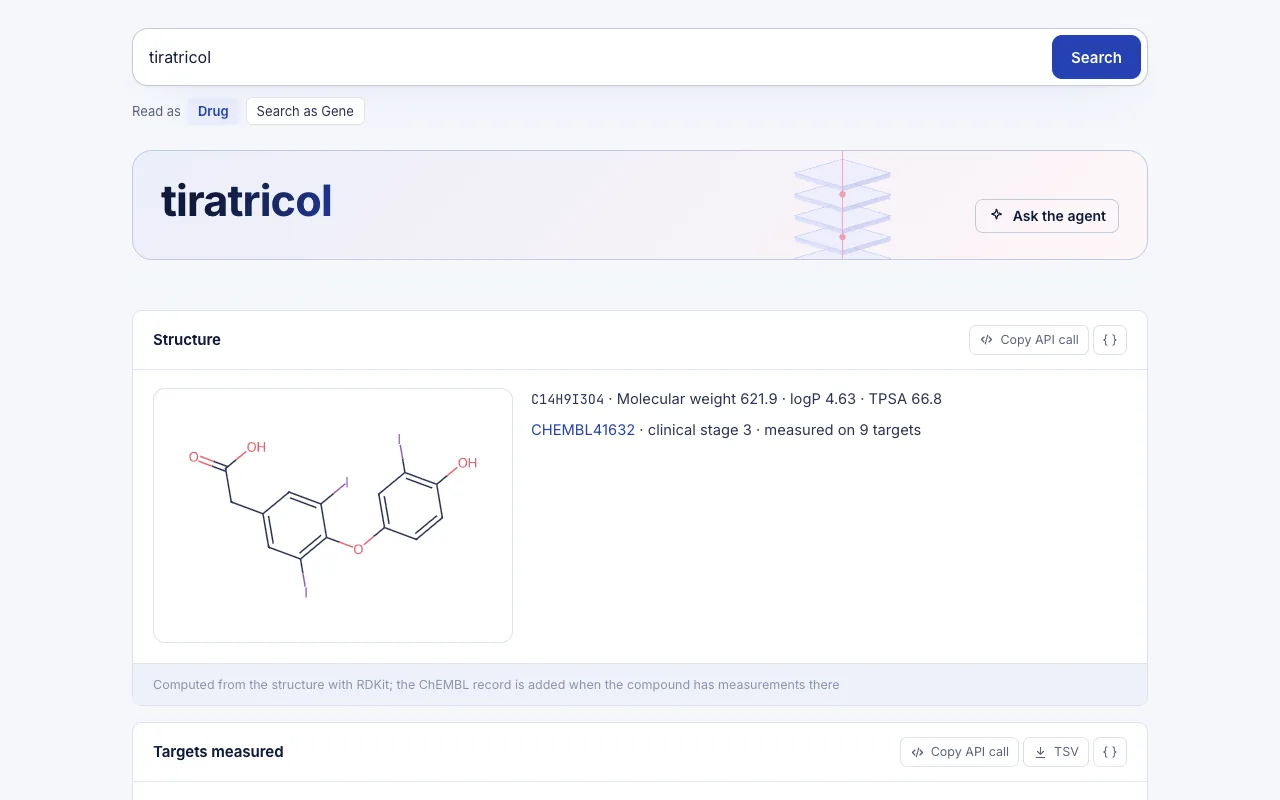
Tiratricol FDA approval: targets and potency in BioQ
Tiratricol FDA approval (Emcitate): ChEMBL shows 68 targets, THRB and THRA top by pChEMBL, and 3 registered trials on ClinicalTrials.gov, as of 2026-11-17.
CD4 new study: CAR-NK cells and HIV rebound in context
A CD4-based CAR-NK paper on HIV rebound, placed in context with BioQ data on CD4: DepMap dependency, Open Targets diseases, drugs and Reactome pathways.