

PRMT5 dependency and drugs in one query
PRMT5 is a common-essential gene in DepMap Chronos data, has 3 listed drugs, and 453 Open Targets diseases; one BioQ query joins all the layers.
Data as of November 6, 2026 · By the BioQ team
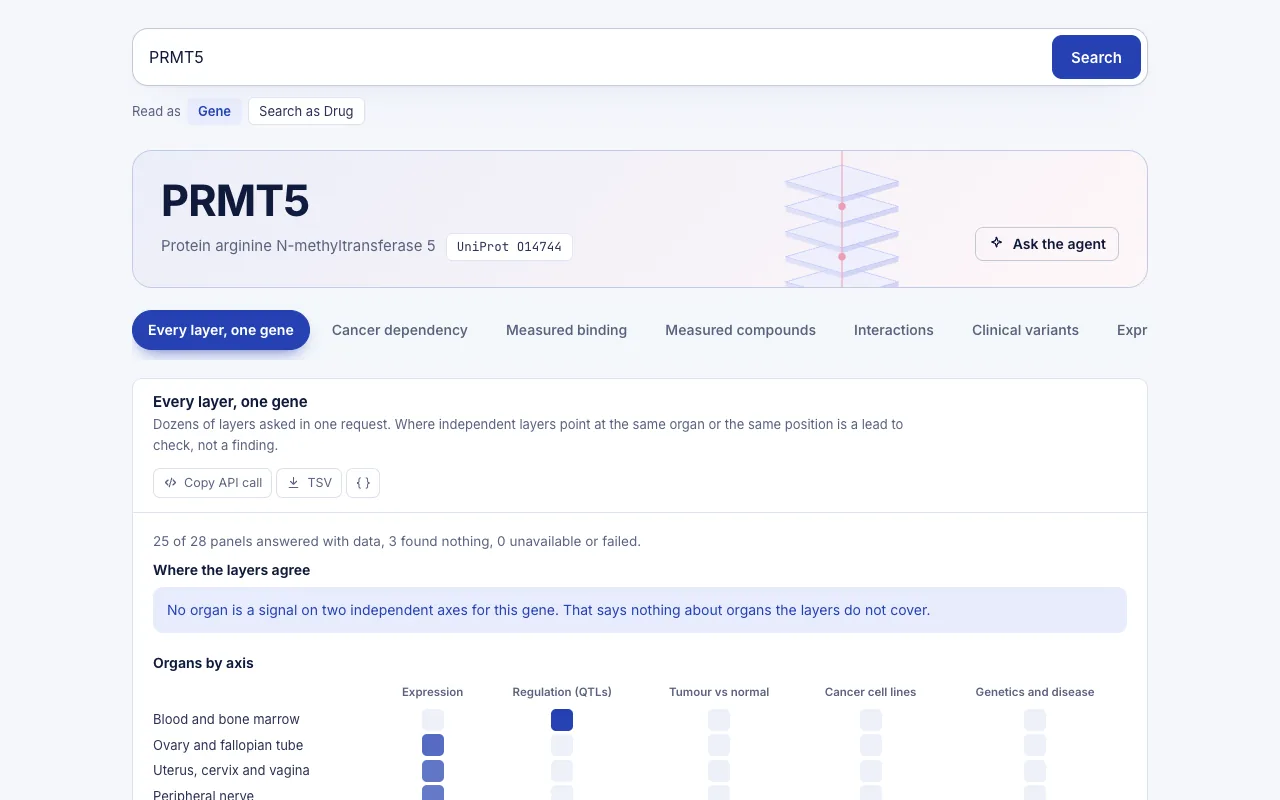
PRMT5 is classed as common essential in DepMap: 1109 of 1178 cell lines (94.1%) depend on it, with a mean Chronos gene effect of -1.004. The same query returns 3 drugs, 453 Open Targets diseases and 12 Reactome pathways. All values are as of 2026-11-06.
What we asked
We typed one word, PRMT5, into BioQ and asked what the combined public layers say about this gene today. The questions were:
- How strongly do cancer cell lines depend on it?
- Which drugs are on record, and how potent are they?
- Which diseases does it link to, and on how much evidence?
- Does tumour tissue express it differently from normal tissue?
- Which pathways and protein partners does it sit in?
The answers come from six distinct resources: DepMap, ChEMBL with Open Targets and related drug sources, Open Targets, the TCGA/GTEx Toil recompute, Reactome and STRING. BioQ ran 7 engine queries in 0.56 engine seconds. Done by hand, the same picture means visiting each resource, finding the right gene identifier in each, and reconciling the output yourself.
What BioQ returned on PRMT5 dependency and drugs
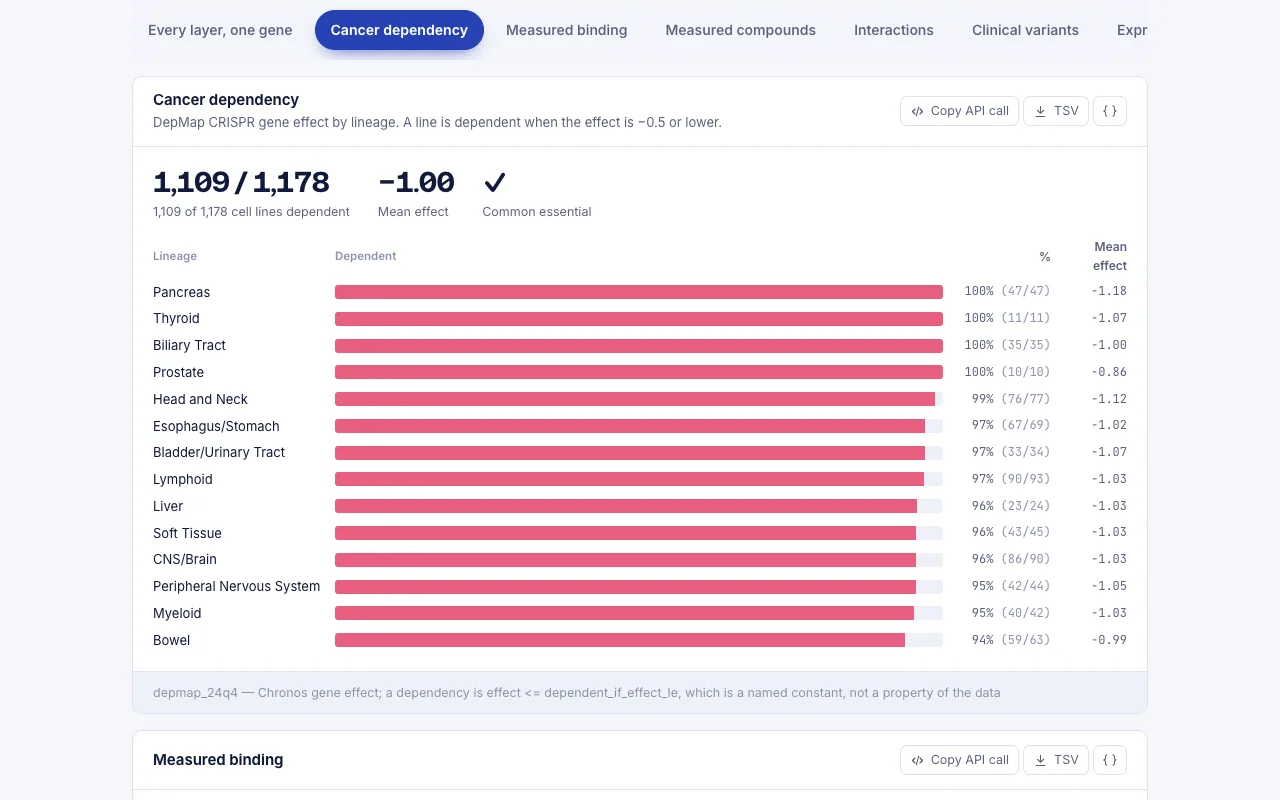
The dependency layer is DepMap Chronos, release depmap_24q4. A more negative gene effect means the knockout reduced viability more. The table lists the eight lineages with the most negative mean effect.
| Lineage | Cell lines | Dependent | % dependent | Mean gene effect |
|---|---|---|---|---|
| Pancreas | 47 | 47 | 100 | -1.178 |
| Head and Neck | 77 | 76 | 98.7 | -1.124 |
| Thyroid | 11 | 11 | 100 | -1.074 |
| Bladder/Urinary Tract | 34 | 33 | 97.1 | -1.072 |
| Peripheral Nervous System | 44 | 42 | 95.5 | -1.049 |
| Liver | 24 | 23 | 95.8 | -1.033 |
| Lymphoid | 93 | 90 | 96.8 | -1.033 |
| Soft Tissue | 45 | 43 | 95.6 | -1.032 |
The drug layer combines Open Targets, ChEMBL, the Drug Repurposing Hub and ClinicalTrials.gov. The pChEMBL value is the negative log10 of the molar potency, so higher means stronger.
| Drug | Max clinical stage | Mechanism | Best exact pChEMBL | Type | Trials by name |
|---|---|---|---|---|---|
| Pemrametostat | PHASE_2 | Protein arginine N-methyltransferase 5 inhibitor | 8.7 | EC50 | 0 |
| 3Xv | UNKNOWN | — | 8.22 | IC50 | 0 |
| Hlcl-61 | UNKNOWN | — | — | — | 0 |
The disease layer is the Open Targets association score, which runs from 0 to 1.
| Disease | Association score | Evidence items |
|---|---|---|
| neurodegenerative disease | 0.208 | 3 |
| breast cancer | 0.14 | 187 |
| neoplasm | 0.119 | 668 |
| hepatocellular carcinoma | 0.117 | 120 |
| colorectal carcinoma | 0.116 | 78 |
| lung carcinoma | 0.116 | 139 |
Three more layers are summarised here rather than tabulated:
- Expression. TCGA and GTEx data cover 24 cancer types with both tumour and normal samples. In the six types shown, the log2 fold change is small. Cholangiocarcinoma is at 0.12 (36 tumours, 9 normals), and lung squamous cell carcinoma and lung adenocarcinoma are both at 0.1. Pheochromocytoma and paraganglioma is at -0.11, but with only 3 normal samples.
- Pathways. Reactome lists 12 pathways. The most specific are Regulation of TP53 Activity through Methylation (R-HSA-6804760, 19 genes) and RMTs methylate histone arginines (R-HSA-3214858, 48 genes). snRNP Assembly (R-HSA-191859) is also listed.
- Interactions. STRING v12 reports 1794 partners. The top scores are WDR77 and CLNS1A at 999, then H4C6 at 997, and SNRPD3 and RIOK1 at 996. PRMT1 scores 993.
What it means and how to read it
Three facts are worth reading before the rest.
1. The dependency is broad, so it does not separate lineages. With 1109 of 1178 lines dependent, PRMT5 behaves like a core cellular gene in this dataset. Pancreas has 47 of 47 lines dependent (mean -1.178), and Head and Neck has 76 of 77 (98.7%). The differences between lineages in the table are small next to the overall pattern. Use the lineage ranking as a gradient, not as a selection list.
2. The drug layer is thin and mixes assay types. Pemrametostat is the only entry with a clinical stage, PHASE_2, and its mechanism is recorded as a protein arginine N-methyltransferase 5 inhibitor. Its value of 8.7 is an EC50, not an IC50. The compound 3Xv has an exact IC50-based pChEMBL of 8.22. Hlcl-61 has no exact value. Do not rank these three on potency alone, because the two numbers come from different assay types. The trial count by name is 0 for all three, but that is a name match, not a full trial search.
3. The disease evidence is led by volume, not by score. The top Open Targets score is neurodegenerative disease at 0.208, but it rests on 3 evidence items. Breast cancer scores 0.14 with 187 items, and neoplasm scores 0.119 with 668. If you care about oncology, the evidence counts tell you more than the order of the scores.
Where the layers agree: Reactome and STRING both place PRMT5 in histone arginine methylation and snRNP assembly. WDR77 is the top partner at 999, which fits a gene that most lines need for survival. Where they diverge: expression differs little between tumour and normal tissue, even though dependency is high. The essentiality does not appear to come from tumour-specific overexpression, at least at this level of resolution.
How to reproduce it in BioQ
- Open BioQ and make sure the search is not restricted to a single data layer.
- Enter the query below exactly as written.
PRMT5- Read the dependency block first and check the release label (depmap_24q4) and the dependent-line count.
- Open the drug block and check the type column (IC50 or EC50) before comparing pChEMBL values.
- In the disease block, compare the evidence-item counts with the association scores.
- Use the source name printed under each block to go back to the original resource if you need the record behind a number.
Limits: what the data do not show
- Cell lines are not patients. DepMap measures knockout in cultured lines. It does not say how a tumour or a normal tissue responds to partial inhibition.
- Dependency is not a drug response. A CRISPR knockout removes the protein. Pharmacological inhibition may behave differently, and these layers do not connect the two.
- Common essentiality limits interpretation. A gene needed by most lines may be hard to target selectively. The data here cannot say whether any context gives a therapeutic window.
- The drug list is short and uneven. It has 3 entries, one assay type per compound, and no exact value for Hlcl-61. It is not a full survey of PRMT5 chemistry.
- A trial count of 0 reflects name matching. It does not exclude trials registered under other names or listed by target only.
- Association scores are not effect sizes. Open Targets scores combine many evidence types, and the neurodegenerative disease score rests on 3 items.
- Expression differences are small and uneven in sample size. Some normal groups have very few samples, so a single fold value should not be over-read.
- STRING scores measure confidence, not function. A score of 999 means strong support for an association, not a mechanism.
Data and method
The numbers on this page were read from the BioQ engine on 2026-11-06 (7 queries, 0.6 s of engine time in total). The tables are generated by code from the engine's answers; the text only restates them.
/depmap, /drugs, /interaction, /ot_association, /pathway, /tcga
Run the same query yourself: PRMT5
For research use only. This page summarises public data and is not medical advice.
BioQ is an AI search engine and agent with one goal: making biology research 100X faster. Ask in the web app, over the REST API, or from Claude, ChatGPT or Cursor through MCP.
Queries used
Frequently asked questions
Is PRMT5 a common essential gene in DepMap?
In DepMap Chronos release depmap_24q4 it is flagged as common essential. 1109 of 1178 cell lines (94.1%) are dependent, with a mean gene effect of -1.004.
Which lineages depend most on PRMT5?
Pancreas has the most negative mean gene effect at -1.178, with 47 of 47 lines dependent. Head and Neck follows at -1.124, with 76 of 77 lines dependent.
What PRMT5 inhibitors does BioQ list, and how potent are they?
BioQ lists 3 drugs. Pemrametostat is at PHASE_2 with an EC50-based pChEMBL of 8.7. 3Xv has an exact IC50-based pChEMBL of 8.22, and Hlcl-61 has no exact value.
Which diseases does Open Targets link to PRMT5?
Open Targets lists 453 diseases. The top score is neurodegenerative disease at 0.208 with 3 evidence items, and breast cancer follows at 0.14 with 187 items.
Is PRMT5 overexpressed in tumours compared with normal tissue?
Across 24 cancer types with both tumour and normal samples, the fold changes shown are small. Cholangiocarcinoma is at 0.12 and lung adenocarcinoma at 0.1 in log2 units.
Sources
Results come from public databases as of the date shown and may change. BioQ gives research information, not medical advice.
More from the blog
MDM2 vs MDM4: dependency and drugs side by side
MDM2 vs MDM4 in DepMap 24q4 Chronos data and drug annotations: 384 of 1178 cell lines depend on MDM2, 142 on MDM4; 12 drugs listed for MDM2, 1 for MDM4.
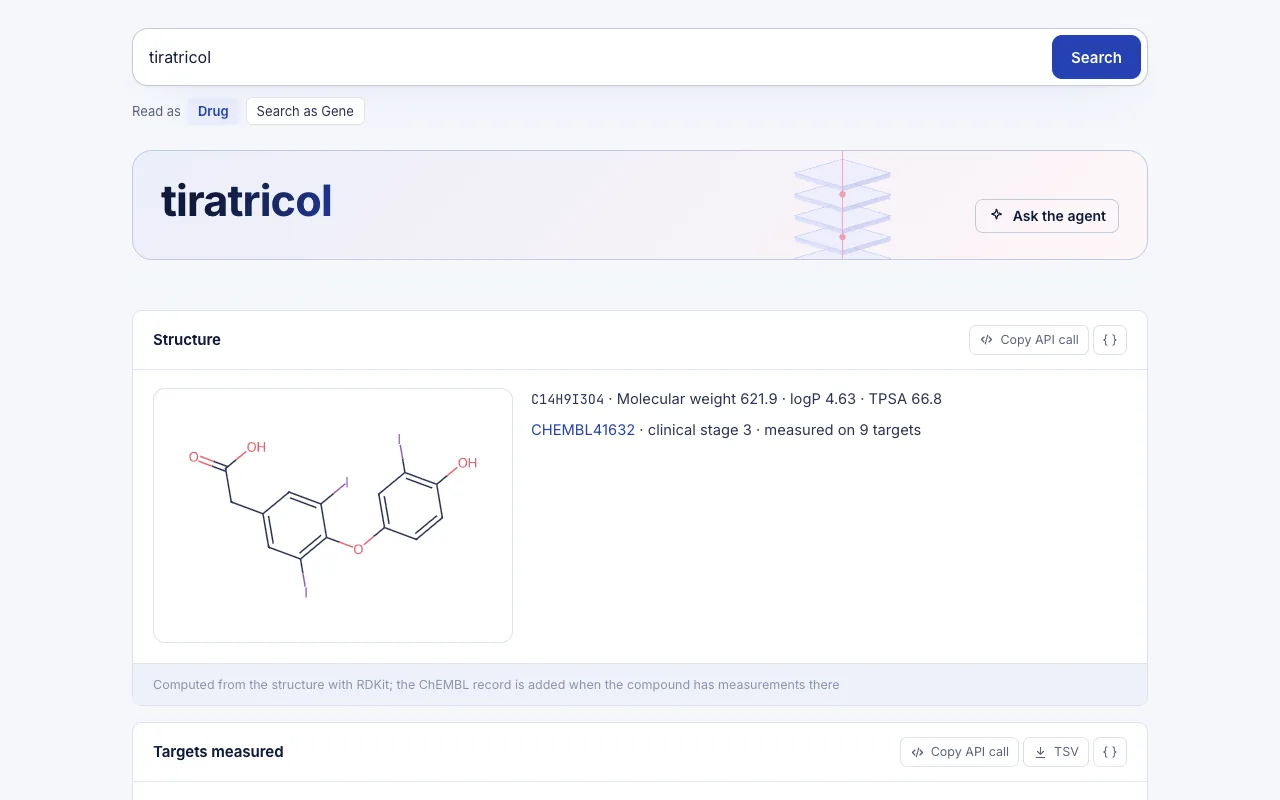
Tiratricol FDA approval: targets and potency in BioQ
Tiratricol FDA approval (Emcitate): ChEMBL shows 68 targets, THRB and THRA top by pChEMBL, and 3 registered trials on ClinicalTrials.gov, as of 2026-11-17.
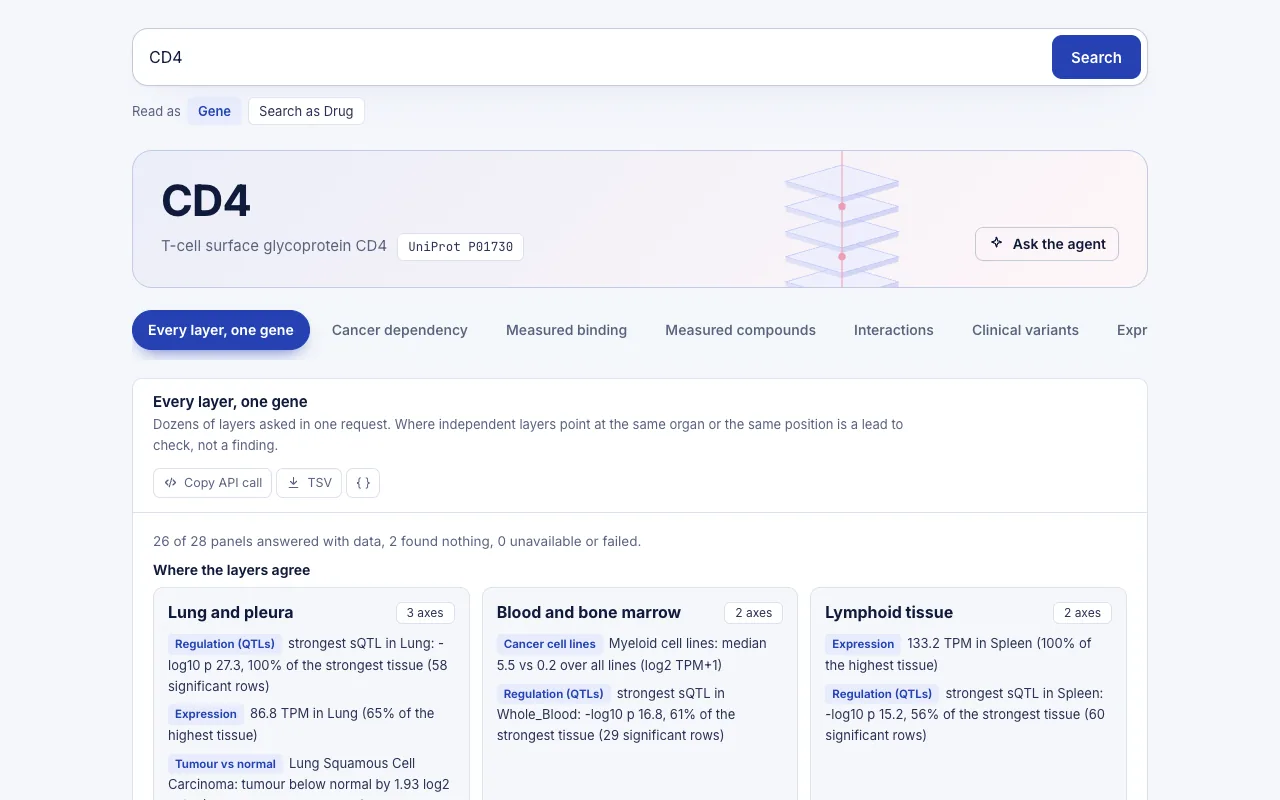
CD4 new study: CAR-NK cells and HIV rebound in context
A CD4-based CAR-NK paper on HIV rebound, placed in context with BioQ data on CD4: DepMap dependency, Open Targets diseases, drugs and Reactome pathways.