

CDK2 dependency and drugs in one query
CDK2 is common essential in DepMap Chronos, has 37 known drugs and ties most to neurodegeneration in Open Targets; one BioQ query, data as of 2026-11-06.
Data as of November 6, 2026 · By the BioQ team
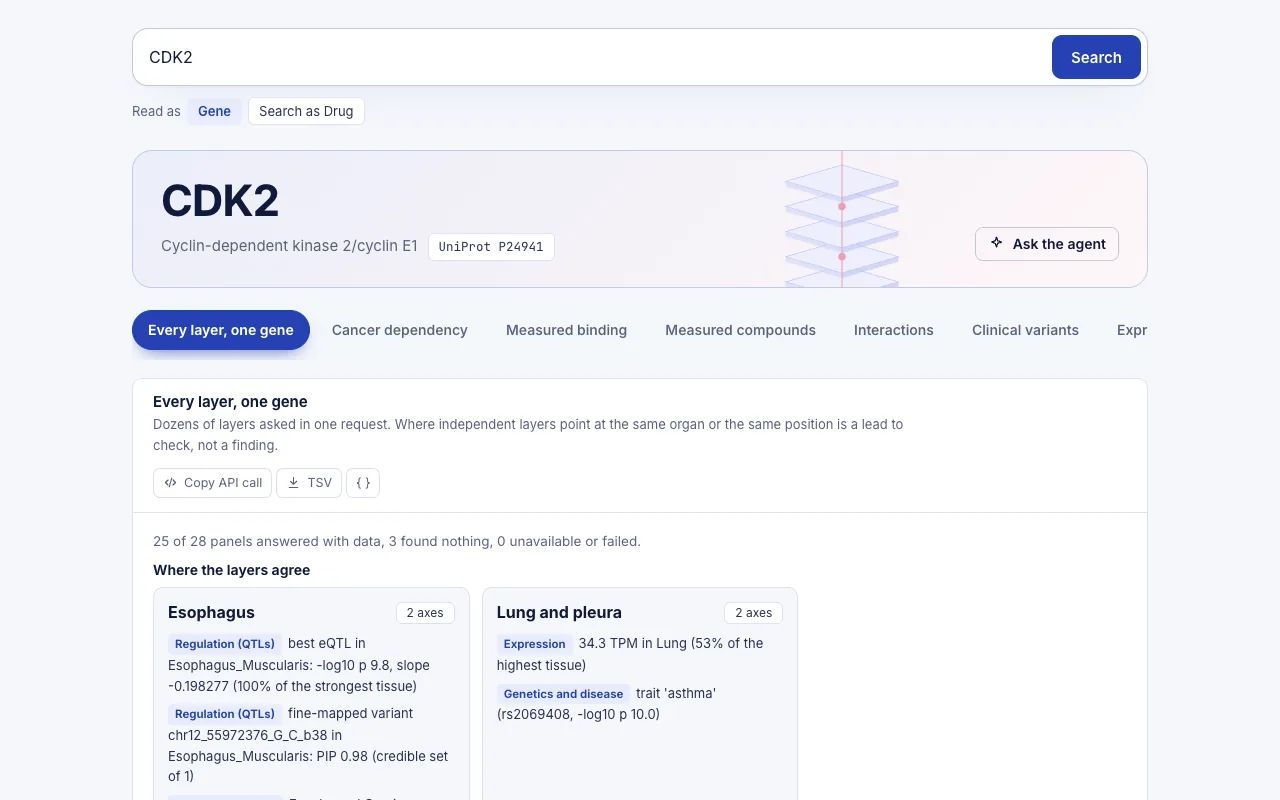
CDK2 dependency and drugs line up in the combined layers. DepMap Chronos marks CDK2 as common essential, with 811 of 1178 cell lines dependent (68.8%), and 37 drugs are listed against the gene. Open Targets, however, ranks neurodegenerative diseases highest. All data are as of 2026-11-06.
What we asked
We ran one query, CDK2, and asked what each public layer says about this gene today. The questions were: how much do cancer cell lines depend on it, which drugs and trials exist, which diseases carry the strongest evidence, whether tumours express more of it than normal tissue, and where it sits in pathways and interaction networks. The aim is to pick the two or three facts worth reading first and to see where the layers agree or disagree.
What BioQ returned for CDK2 dependency and drugs
BioQ drew on 6 distinct resources through 7 engine queries, which took 1.52 engine seconds in total. Each block below names its source and release.
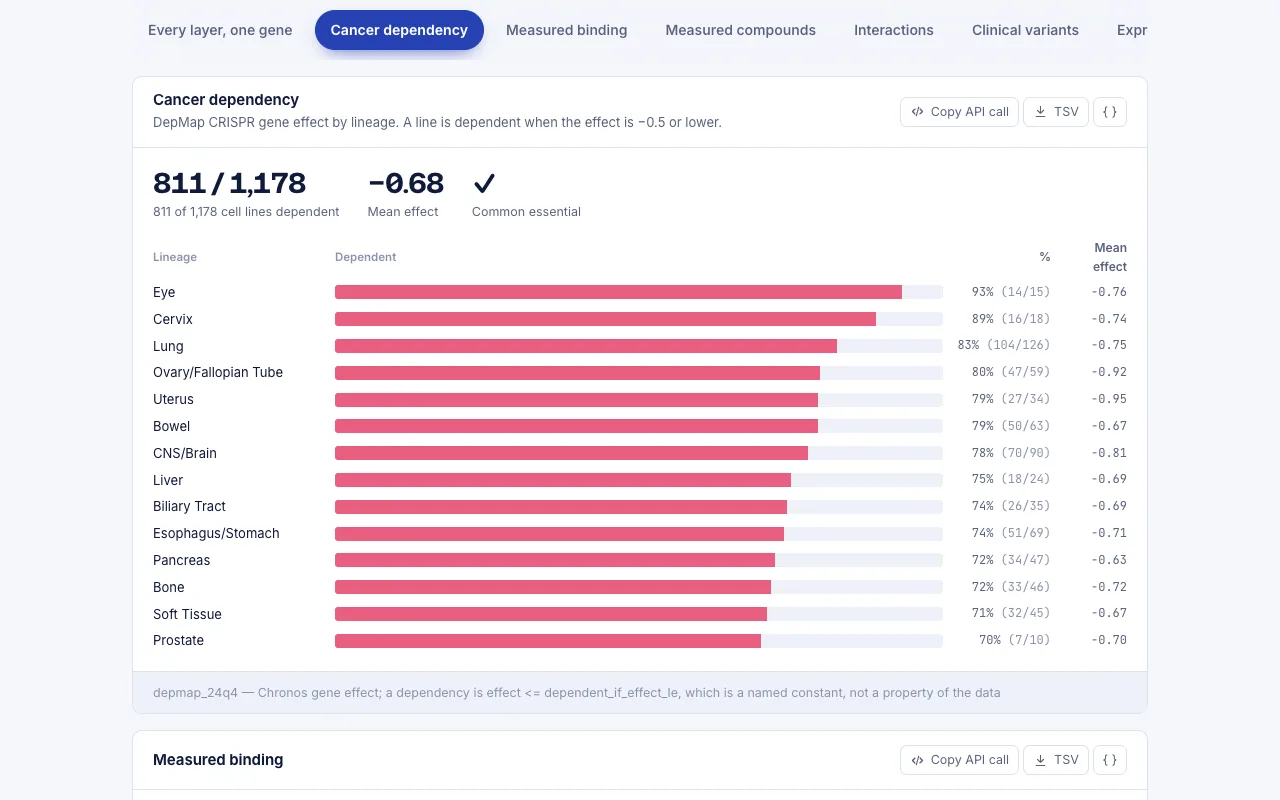
Dependency (DepMap, release depmap_24q4, Chronos). Of 1178 cell lines, 811 are dependent, which is 68.8%. The mean gene effect is -0.678, and the gene is flagged common essential. A more negative Chronos value means the knockout reduced viability more. The table shows the eight lineages with the most negative mean effect.
| Lineage | Cell lines | Dependent | % dependent | Mean gene effect |
|---|---|---|---|---|
| Uterus | 34 | 27 | 79.4 | -0.953 |
| Ovary/Fallopian Tube | 59 | 47 | 79.7 | -0.924 |
| CNS/Brain | 90 | 70 | 77.8 | -0.806 |
| Eye | 15 | 14 | 93.3 | -0.759 |
| Lung | 126 | 104 | 82.5 | -0.748 |
| Cervix | 18 | 16 | 88.9 | -0.743 |
| Bone | 46 | 33 | 71.7 | -0.718 |
| Esophagus/Stomach | 69 | 51 | 73.9 | -0.707 |
Drugs (Open Targets, ChEMBL, Drug Repurposing Hub, ClinicalTrials.gov). 37 drugs are linked to CDK2, and the table shows 8. pChEMBL is the negative log10 of the molar potency, so a higher value means a stronger measurement. The "Trials by name" column counts trials that mention the drug name. It does not count CDK2-specific trials.
| Drug | Max clinical stage | Mechanism | Best exact pChEMBL | Type | Trials by name |
|---|---|---|---|---|---|
| Bosutinib | APPROVAL | — | — | — | 43 |
| Dinaciclib | PHASE_3 | Cyclin-dependent kinase 2 inhibitor | 9 | KI | 13 |
| Alvocidib | PHASE_3 | Cyclin-dependent kinase 2 inhibitor | 8 | IC50 | 55 |
| Seliciclib | PHASE_2 | Cyclin-dependent kinase 2 inhibitor | 9.15 | IC50 | 3 |
| Milciclib | PHASE_2 | Cyclin-dependent kinase 2 inhibitor | 8.3 | IC50 | 0 |
| Roniciclib | PHASE_2 | Cyclin-dependent kinase inhibitor | 8.3 | IC50 | 0 |
| At-7519 | PHASE_2 | Cyclin-dependent kinase inhibitor | 8 | IC50 | 0 |
| Ucn-01 | PHASE_2 | Cyclin-dependent kinase 2 inhibitor | 7.52 | IC50 | 0 |
Disease evidence (Open Targets). 693 diseases are associated with CDK2. The six top-scoring ones are shown below.
| Disease | Association score | Evidence items |
|---|---|---|
| neurodegenerative disease | 0.374 | 10 |
| Alzheimer disease | 0.364 | 36 |
| autoimmune disorder of central nervous system | 0.352 | 2 |
| Parkinson disease | 0.352 | 7 |
| multiple sclerosis symptom measurement | 0.351 | 5 |
| lysosomal storage disease | 0.349 | 2 |
Expression (TCGA tumours against GTEx normals, Toil recompute). 24 cancer types have both tumour and normal samples. The largest difference among the rows shown is in Glioblastoma Multiforme: a mean of 10.28 in 153 tumours against 6.84 in 5 normals, a log2 fold of 0.59. The next rows are smaller: Sarcoma at 0.23 (2 normals), Cervical & Endocervical Cancer at 0.21 (3 normals) and Esophageal Carcinoma at 0.17 (13 normals).
Pathways and partners. Reactome lists 75 pathways. The most specific is "Phosphorylation of proteins involved in G1/S transition by active Cyclin E:Cdk2 complexes" (R-HSA-69200), with 4 genes. Others include G2 Phase and "Aberrant regulation of mitotic G1/S transition in cancer due to RB1 defects" (R-HSA-9659787). STRING v12 lists 3648 partners, and the top six (CDC6, CCND1, CDKN1B, SKP1, CCNA1, CCNB1) all have a combined score of 999.
What it means and how to read it
Three facts are worth reading first.
- The dependency is broad, not confined to one lineage. The mean gene effect of -0.678 and the common-essential flag fit CDK2's role in the G1/S transition, which Reactome and STRING both reflect. The most negative lineage means are in Uterus (-0.953) and Ovary/Fallopian Tube (-0.924). Eye has the highest share dependent among the rows shown, 93.3% of 15 lines, but that is a small group. Compare the lineage rows by both the mean effect and the cell line count.
- The drug layer is crowded but uneven. Seliciclib has the highest exact pChEMBL in the table (9.15, IC50), followed by Dinaciclib (9.0, reported as KI). Alvocidib reaches PHASE_3 with a value of 8.0 and 55 trials by name. Bosutinib is the only drug listed at APPROVAL, but the row has no CDK2 mechanism and no exact pChEMBL value. Its 43 trials by name should not be read as CDK2 trials. Several compounds are described as inhibiting cyclin-dependent kinases generally, so potency against CDK2 is not selectivity for CDK2.
- The layers disagree on disease. Cell-line dependency and pathway membership point to cell-cycle biology in cancer. The top Open Targets associations are neurodegenerative disease (0.374), Alzheimer disease (0.364, 36 evidence items) and Parkinson disease (0.352, 7 items). These scores are modest, and the table does not show which evidence types drive them. A score near 0.35 is not the same claim as a DepMap dependency, because the two layers measure different things.
Expression adds a third, quieter signal. The tumour-versus-normal fold changes are small for most cancer types shown, and the largest rests on 5 normal samples. Together with the dependency data, this suggests that CDK2 matters through activity and wiring more than through overexpression. The expression data alone cannot establish that.
The manual route would mean visiting DepMap, ChEMBL, Open Targets, ClinicalTrials.gov, TCGA/GTEx and Reactome separately and reconciling gene identifiers and releases by hand. BioQ ran the same set in 1.52 engine seconds and kept each source and release attached to its block.
How to reproduce it in BioQ
- Open BioQ and make sure the search box is empty.
- Enter the query below exactly as written.
CDK2- Read the dependency block first, then the drug block, then the disease and expression blocks.
- Check the release line under each block, because the DepMap release and the Open Targets release differ.
- For the lineage or drug you care about, ask a narrower follow-up, for example the same gene restricted to one lineage.
Limits: what the data do not show
- Dependency is not a therapeutic window. Chronos measures cell viability after CRISPR knockout in cell lines. It says nothing about toxicity in normal tissue or about patient benefit. The dependent call uses a named threshold, not a natural boundary.
- Knockout is not inhibition. Loss of the protein differs from partial inhibition by a compound. Several CDK inhibitors act on other kinases too, so the drug table cannot attribute a cell effect to CDK2 alone.
- Potency types are mixed. Exact pChEMBL values come from different assay types (IC50 and KI), so close values should not be ranked against each other.
- Trial counts are name matches. They include trials unrelated to CDK2, and they say nothing about outcomes.
- Association scores are not effect sizes. Open Targets scores combine evidence of several kinds. The table does not say whether the neurodegeneration signal is causal, correlative or literature-driven.
- Expression comparisons are thin in places. Some cancer types have only 2 or 3 normal samples, and TCGA/GTEx batches were recomputed jointly rather than matched per patient.
- Protein activity is not measured. None of these layers measures CDK2 kinase activity or cyclin availability, which is what the pathway biology depends on.
Data and method
The numbers on this page were read from the BioQ engine on 2026-11-06 (7 queries, 1.5 s of engine time in total). The tables are generated by code from the engine's answers; the text only restates them.
/depmap, /drugs, /interaction, /ot_association, /pathway, /tcga
Run the same query yourself: CDK2
For research use only. This page summarises public data and is not medical advice.
BioQ is an AI search engine and agent with one goal: making biology research 100X faster. Ask in the web app, over the REST API, or from Claude, ChatGPT or Cursor through MCP.
Queries used
Frequently asked questions
Is CDK2 a common essential gene in DepMap?
In the depmap_24q4 Chronos data CDK2 is flagged common essential. 811 of 1178 cell lines are dependent (68.8%), and the mean gene effect is -0.678. The dependent call depends on a named threshold.
How many drugs are linked to CDK2?
BioQ lists 37 drugs for CDK2 from Open Targets, ChEMBL, the Drug Repurposing Hub and ClinicalTrials.gov. The top eight include Dinaciclib and Alvocidib at PHASE_3 and Bosutinib at APPROVAL, though the Bosutinib row has no CDK2 mechanism or exact pChEMBL value.
Which CDK2 inhibitor has the highest pChEMBL in the table?
Seliciclib has the highest exact pChEMBL among the eight rows shown, 9.15 (IC50). Dinaciclib follows at 9.0, reported as KI. The values come from different assay types, so they are not strictly comparable.
Which diseases does Open Targets associate with CDK2?
Open Targets lists 693 diseases. The top scorers are neurodegenerative disease (0.374), Alzheimer disease (0.364) and Parkinson disease (0.352). The scores are on a 0 to 1 scale.
Is CDK2 overexpressed in tumours?
Among the six rows shown, the largest log2 fold is 0.59 in Glioblastoma Multiforme, based on 153 tumours and 5 normals. The other rows range from 0.14 to 0.23. Of 24 cancer types with both sample kinds, only the top six are shown.
Sources
Results come from public databases as of the date shown and may change. BioQ gives research information, not medical advice.
More from the blog
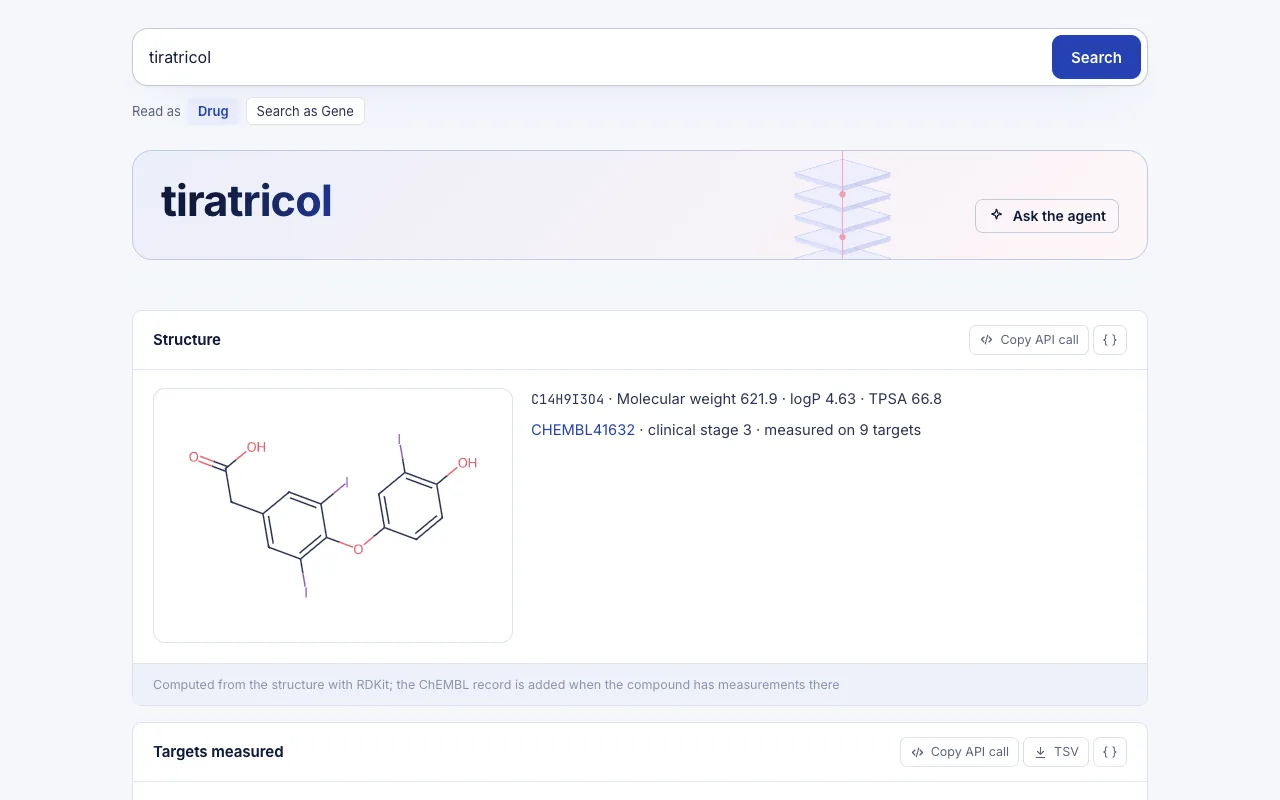
Tiratricol FDA approval: targets and potency in BioQ
Tiratricol FDA approval (Emcitate): ChEMBL shows 68 targets, THRB and THRA top by pChEMBL, and 3 registered trials on ClinicalTrials.gov, as of 2026-11-17.
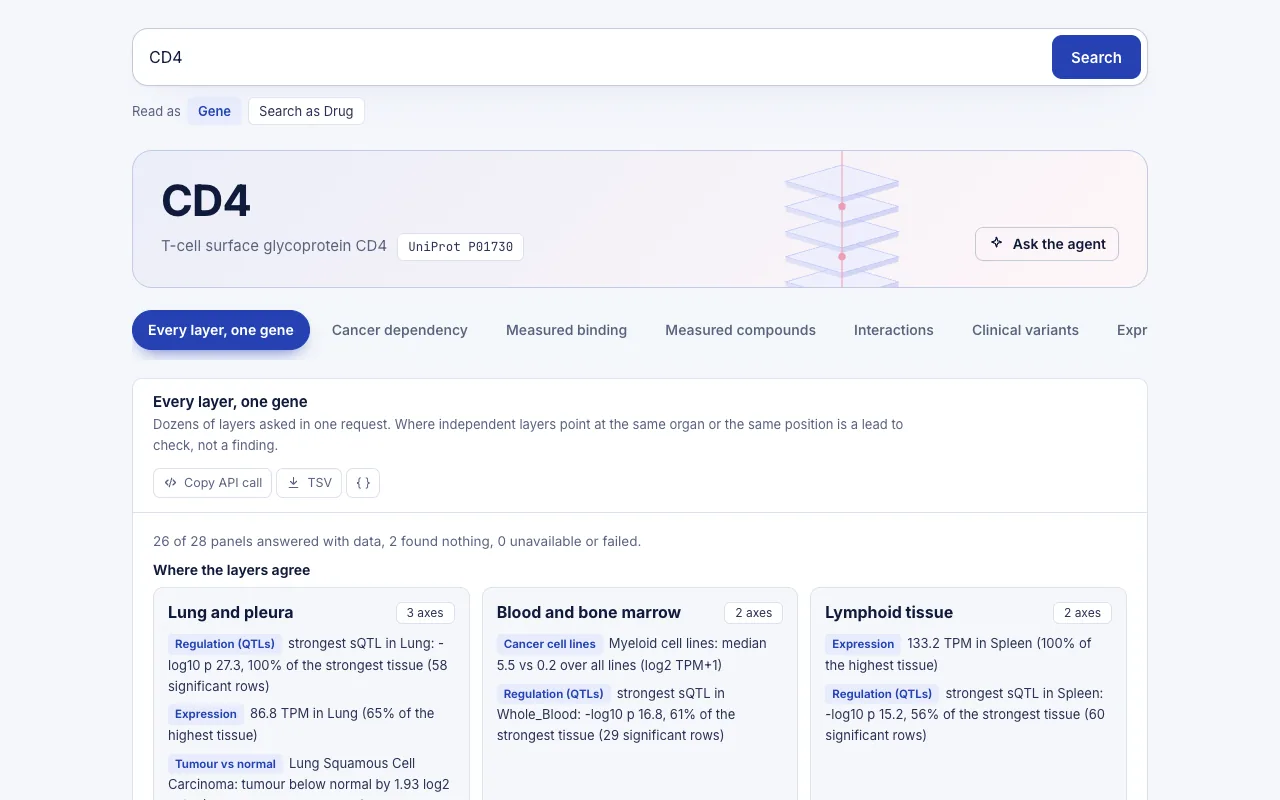
CD4 new study: CAR-NK cells and HIV rebound in context
A CD4-based CAR-NK paper on HIV rebound, placed in context with BioQ data on CD4: DepMap dependency, Open Targets diseases, drugs and Reactome pathways.
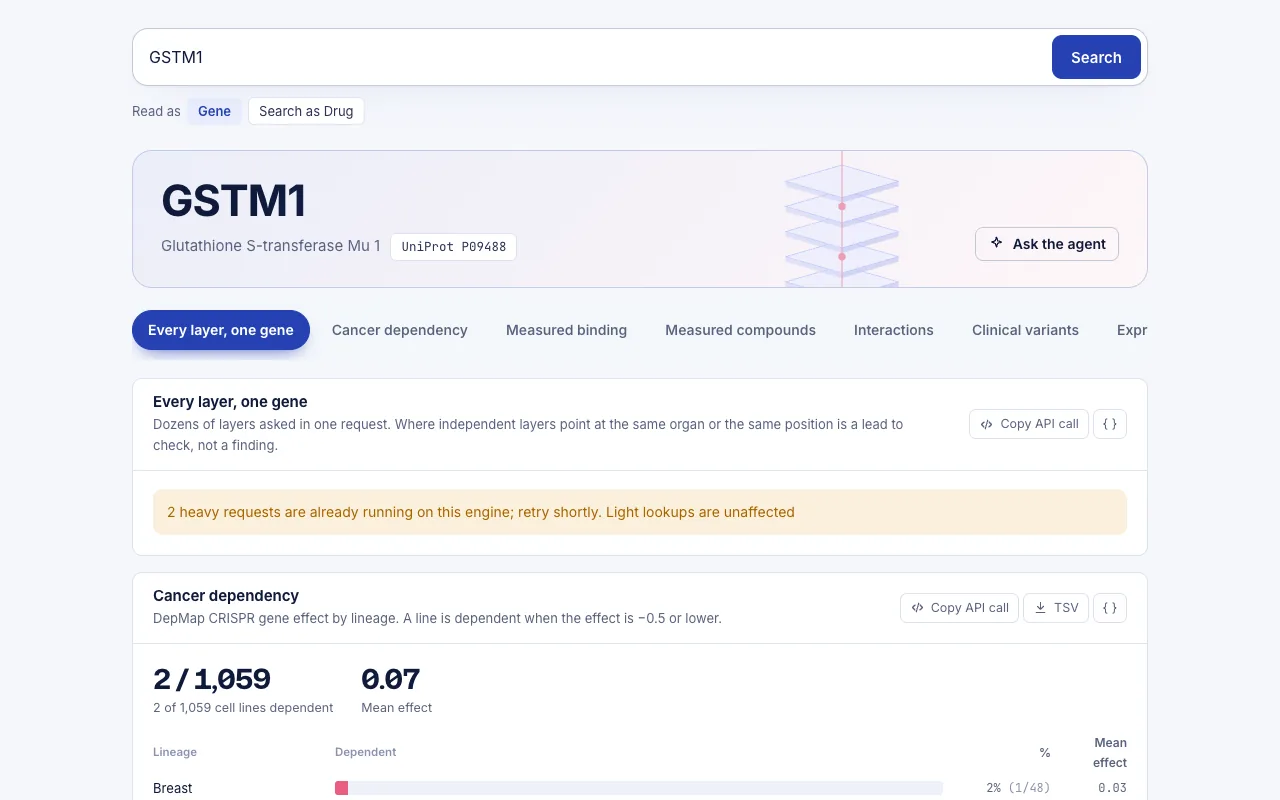
GSTM1 new study: cisplatin kidney injury in context
A 2026 paper links GSTM1 loss to worse cisplatin kidney injury; BioQ shows what DepMap, Open Targets, ChEMBL, Reactome and STRING say about GSTM1 today.