

CALR new study: HLA class I and what BioQ shows
A 2026 JCI Insight paper links CALR mutations to HLA class I expression in MPN; BioQ data show CALR dependency, disease links and partners across 7 resources.
Data as of November 11, 2026 · By the BioQ team
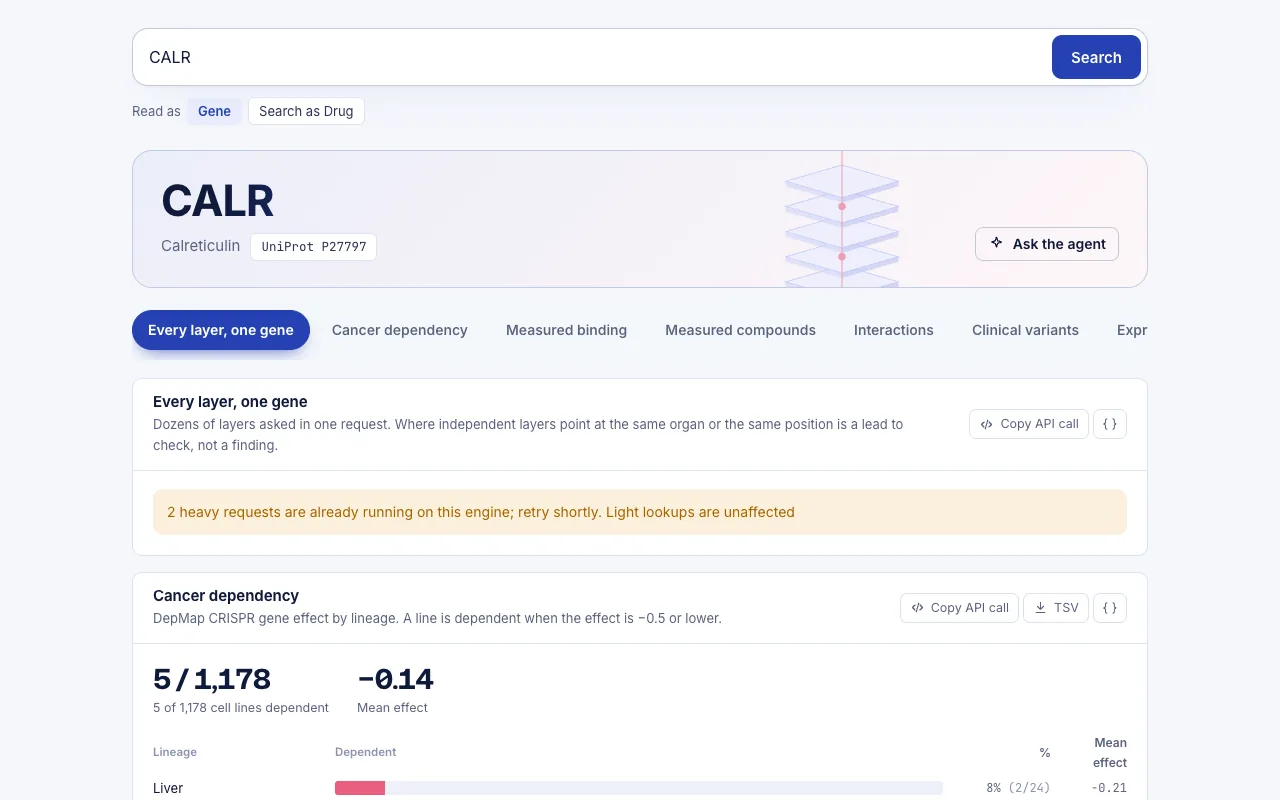
A new JCI Insight paper asks how CALR mutations change HLA class I expression in myeloproliferative neoplasms. As of 2026-11-11, BioQ shows CALR as not common essential: 5 of 1178 cell lines are dependent (0.4%), with a mean Chronos gene effect of -0.141. Open Targets lists 1269 diseases for the gene, and myeloproliferative disorder carries 1032 evidence items.
What we asked: placing a CALR new study in context
The paper (Effects of calreticulin mutations on HLA class I expression in myeloproliferative neoplasms, JCI Insight, 2026, DOI 10.1172/jci.insight.208950) touches a question that matters for essential thrombocythemia and myelofibrosis. Calreticulin (CRT) is both the protein mutated in many of these cases and a chaperone in the assembly of HLA class I molecules. The authors compare what happens to HLA class I when CALR is mutated on one copy, on both, or lost. The experimental results, the cell models and the patient measurements belong to the paper. BioQ did not run them and does not restate them here.
We asked a narrower, complementary question: what do public data layers say about CALR today, so that a reader can place the paper in one minute? We ran the single query CALR and read seven blocks: dependency, drugs, disease association, tumour expression, clinical evidence, pathways and interaction partners.
What BioQ returned for CALR
The query drew on 7 distinct resources through 7 engine queries, in 0.84 engine seconds in total. Doing the same by hand means opening each resource separately, matching gene identifiers and reading seven differently structured outputs.
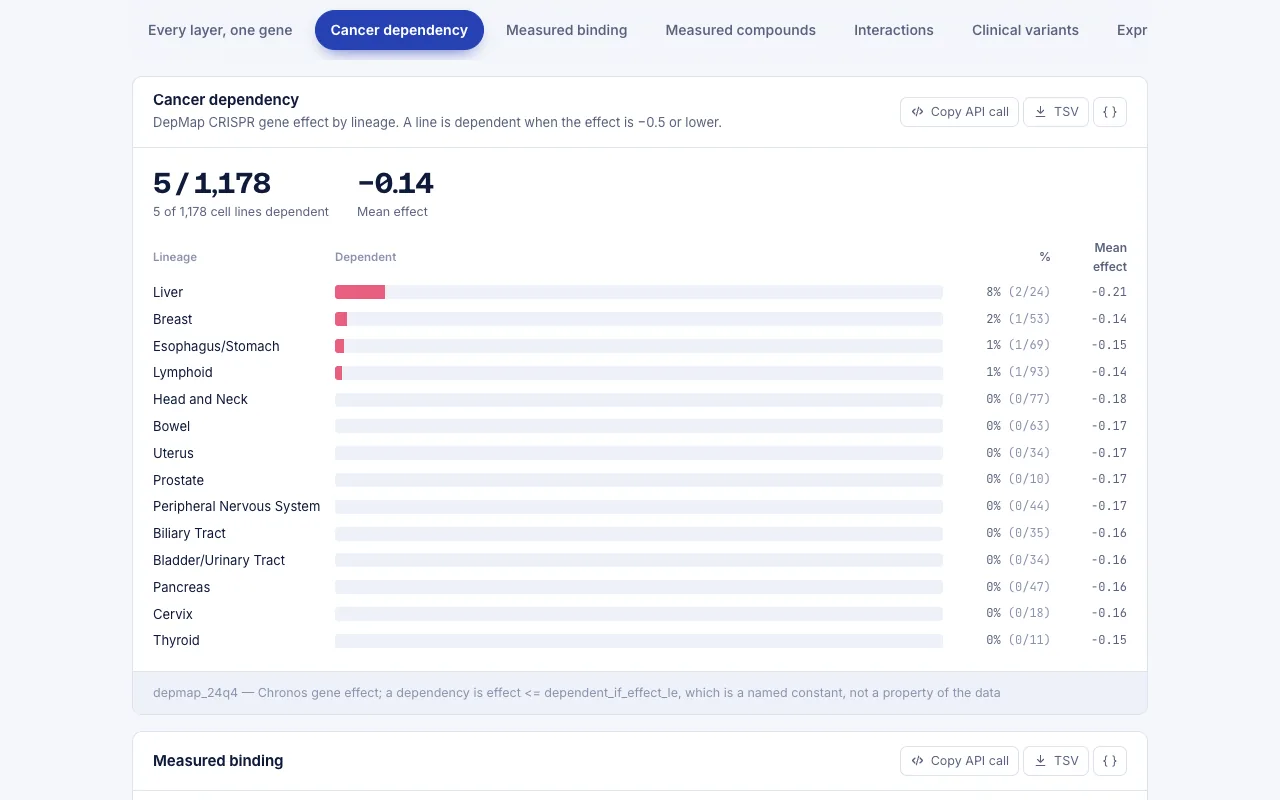
Dependency. In DepMap (release 24q4, Chronos gene effect), CALR is not flagged as common essential. Of 1178 cell lines, 5 count as dependent, which is 0.4%. The mean gene effect is -0.141; a more negative value means the knockout reduced viability more. The liver lineage stands out: 2 of 24 lines are dependent (8.3%), with a mean of -0.21. Head and Neck (77 lines) and Bowel (63 lines) have no dependent lines, with means of -0.183 and -0.168.
Disease association. Open Targets links CALR to 1269 diseases. The top of the list is dominated by blood-count traits and myeloproliferative terms:
| Disease | Association score | Evidence items |
|---|---|---|
| platelet count | 0.616 | 11 |
| platelet crit | 0.615 | 10 |
| myeloproliferative disorder | 0.594 | 1032 |
| erythrocyte count | 0.588 | 34 |
| neoplasm | 0.585 | 2157 |
| thrombocythemia 1 | 0.567 | 5 |
Clinical evidence. CIViC holds 4 records for CALR, all in myelofibrosis or essential thrombocythemia:
| Molecular profile | Disease | Therapies | Evidence level | Significance |
|---|---|---|---|---|
| CALR EXON 9 FRAMESHIFT | Myelofibrosis | — | A | Better Outcome |
| CALR EXON 9 FRAMESHIFT | Essential Thrombocythemia | Peginterferon Alfa-2a | B | Sensitivity/Response |
| CALR EXON 9 FRAMESHIFT | Myelofibrosis | — | B | Better Outcome |
| CALR Mutation | Essential Thrombocythemia | — | A | Positive |
Interaction partners. STRING v12 reports 2605 partners. The top of the list reads like the HLA class I loading machinery:
| Partner | UniProt | STRING combined score |
|---|---|---|
| CANX | P27824 | 999 |
| HSP90B1 | P14625 | 999 |
| PDIA3 | P30101 | 999 |
| TAPBP | O15533 | 999 |
| B2M | P61769 | 999 |
| LRP1 | Q07954 | 998 |
Other layers. Reactome assigns CALR to 29 pathways; the most specific ones shown include ATF6 (ATF6-alpha) activates chaperone genes (R-HSA-381183) and Scavenging by Class F Receptors (R-HSA-3000484). In TCGA/GTEx Toil data, 24 cancer types have both tumour and normal samples. The largest log2 fold among the six shown is 0.14 in Uterine Corpus Endometrioid Carcinoma (180 tumours, 23 normals), and Glioblastoma Multiforme follows at 0.13. For drugs, the combined sources list 1 entry: Melatonin, at maximum stage APPROVAL, with no mechanism and no exact pChEMBL value recorded, and 256 trials matched by name.
What it means and how to read it
The paper's subject is a chaperone function, and the interaction data fit that framing. CANX, HSP90B1, PDIA3, TAPBP and B2M all have a STRING combined score of 999, and LRP1 has 998. B2M and TAPBP are part of the HLA class I assembly and peptide-loading context. STRING scores summarise evidence for association, so they place CALR next to this machinery but do not show how a given mutation changes it. That question is the paper's.
The dependency numbers give a background for a gene that is mutated in disease. Across the cell-line panel, losing CALR is not broadly lethal, so a lack of strong dependency in DepMap says little about whether a mutant allele drives a neoplasm. The panel is also built mostly from solid-tumour and other cancer lines, and the lineage rows shown are the eight with the most negative means, not a ranking of relevance to myeloproliferative disease.
The Open Targets and CIViC rows agree with the disease setting of the paper. Myeloproliferative disorder (score 0.594) and thrombocythemia 1 (score 0.567, 5 evidence items) sit among the top associations, and the CIViC records concern CALR exon 9 frameshift variants and a CALR mutation, with evidence levels A and B. One record pairs a variant with Peginterferon Alfa-2a in essential thrombocythemia at level B. That is a database annotation of evidence, not guidance for any patient.
On drugs, the data do not show a CALR-directed compound with a measured exact potency. The single Melatonin entry has an empty mechanism and potency field, and the trial count is a name match that should not be read as testing CALR. Searches for CALR inhibitors in ChEMBL exact IC50 data return nothing usable here.
How to reproduce it in BioQ
- Open BioQ and enter the gene symbol as the query, exactly as below.
CALR- Read the dependency panel first. Check the DepMap Chronos gene effect, the number of dependent lines and the lineage table.
- Open the disease association panel and compare the Open Targets scores with the number of evidence items, not the score alone.
- Check the interaction and pathway panels for the partners and Reactome entries, and the drug panel for stage and potency fields.
- Follow the source name beside each answer to the underlying resource and release before citing a number.
Limits: what the data do not show
- BioQ does not contain the paper's measurements. Nothing here tests whether heterozygous or homozygous CALR mutations change HLA class I levels, or whether NK cells respond.
- The facts are for the CALR gene as a whole. They do not separate wild-type from mutant calreticulin or heterozygous from homozygous states.
- DepMap tests knockouts in cell lines, which is not the same as a knock-in of a mutant allele, and hematopoietic lines are not the lineages listed in the table above.
- Open Targets scores and STRING scores summarise evidence and co-occurrence; they do not give direction or mechanism.
- The tumour-versus-normal differences in TCGA/GTEx are small in log2 terms and are not tied to mutation status.
- CIViC evidence levels describe the quality of curated evidence. They are not recommendations, and the data say nothing about treatment choice.
- All values are as of 2026-11-11 and will change with new releases.
Data and method
The numbers on this page were read from the BioQ engine on 2026-11-11 (7 queries, 0.8 s of engine time in total). The tables are generated by code from the engine's answers; the text only restates them.
/civic, /depmap, /drugs, /interaction, /ot_association, /pathway, /tcga
Sources
- Effects of calreticulin mutations on HLA class I expression in myeloproliferative neoplasms (2026) — doi:10.1172/jci.insight.208950
Run the same query yourself: CALR
For research use only. This page summarises public data and is not medical advice.
BioQ is an AI search engine and agent with one goal: making biology research 100X faster. Ask in the web app, over the REST API, or from Claude, ChatGPT or Cursor through MCP.
Queries used
Frequently asked questions
Is CALR a common essential gene in DepMap?
No. In DepMap release 24q4, CALR is not flagged as common essential. 5 of 1178 cell lines are dependent (0.4%), and the mean Chronos gene effect is -0.141.
Which diseases does Open Targets associate with CALR?
Open Targets lists 1269 diseases. Platelet count has the top score (0.616), and myeloproliferative disorder scores 0.594 with 1032 evidence items. Thrombocythemia 1 scores 0.567.
Does BioQ list CALR inhibitors with an IC50?
No. The drug block returns 1 entry, Melatonin at stage APPROVAL, with no mechanism and no exact pChEMBL value. Its 256 trials are matched by name, not by CALR as the target.
Which proteins does CALR interact with according to STRING?
STRING v12 reports 2605 partners. CANX, HSP90B1, PDIA3, TAPBP and B2M each have a combined score of 999, and LRP1 has 998.
Do these BioQ results confirm the paper's findings on HLA class I?
No. The paper's results are the paper's. BioQ shows gene-level context from public resources, such as partners including B2M and TAPBP, but it holds no data on how mutations change HLA class I expression.
Sources
- Paper Effects of calreticulin mutations on HLA class I expression in myeloproliferative neoplasms (2026) DOI 10.1172/jci.insight.208950
- Dataset DepMap CRISPR Chronos gene effect (24Q4)
- Dataset Open Targets Platform; ChEMBL; Drug Repurposing Hub
- Dataset TCGA pan-cancer expression (UCSC Xena Toil recompute)
- Dataset CIViC: Clinical Interpretation of Variants in Cancer
- Dataset Reactome pathway knowledgebase
- Dataset STRING v12 protein-protein interactions
Results come from public databases as of the date shown and may change. BioQ gives research information, not medical advice.
More from the blog
MDM2 vs MDM4: dependency and drugs side by side
MDM2 vs MDM4 in DepMap 24q4 Chronos data and drug annotations: 384 of 1178 cell lines depend on MDM2, 142 on MDM4; 12 drugs listed for MDM2, 1 for MDM4.
CD4 new study: CAR-NK cells and HIV rebound in context
A CD4-based CAR-NK paper on HIV rebound, placed in context with BioQ data on CD4: DepMap dependency, Open Targets diseases, drugs and Reactome pathways.
GSTM1 new study: cisplatin kidney injury in context
A 2026 paper links GSTM1 loss to worse cisplatin kidney injury; BioQ shows what DepMap, Open Targets, ChEMBL, Reactome and STRING say about GSTM1 today.