

BioQ MCP server for Claude, ChatGPT and Cursor
Connect the BioQ MCP server to Claude, ChatGPT or Cursor and run a FLT3 target and drug question in three calls; results are from data as of 2026-11-06.
Data as of November 6, 2026 · By the BioQ team
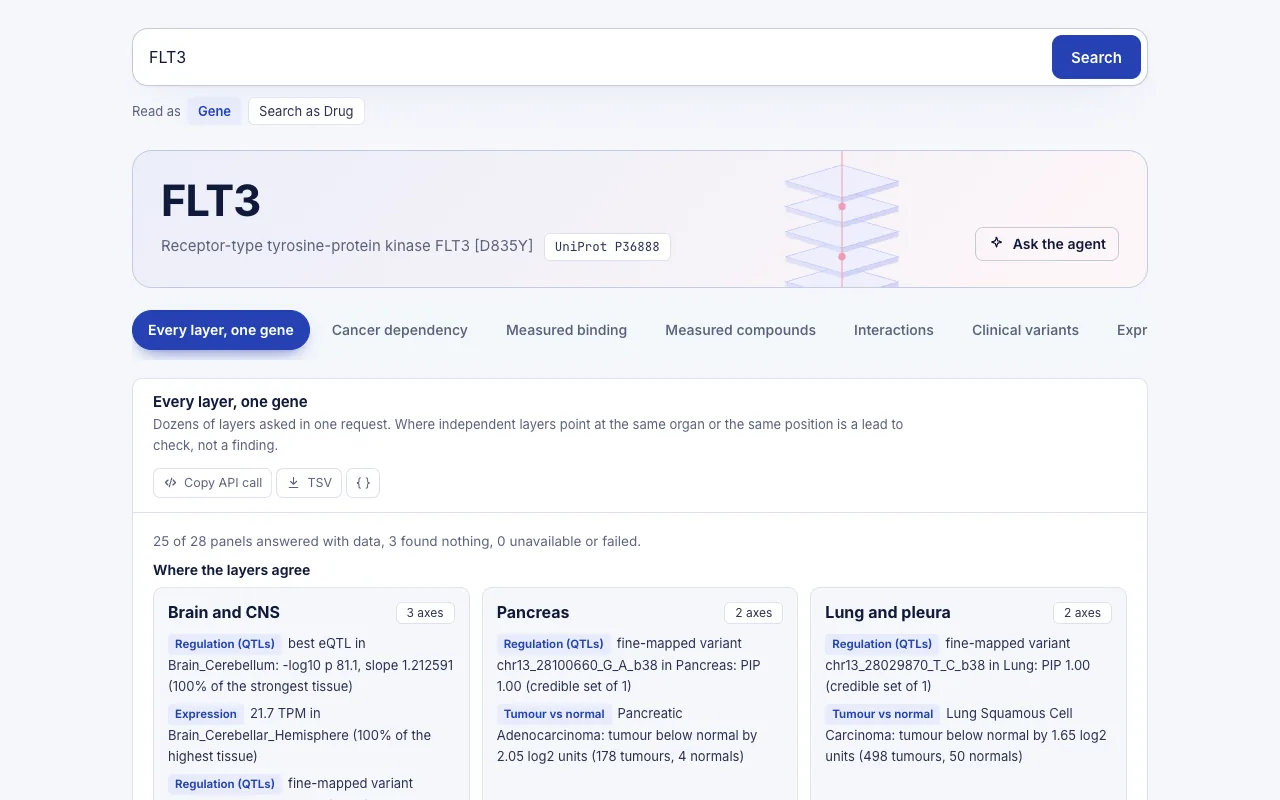
With the BioQ MCP server in Claude, ChatGPT or Cursor, or with scripted REST calls, one FLT3 question comes back in three queries and 0.34 engine seconds. The answer draws on 3 distinct resources: 66 drugs, 9 of 1178 DepMap cell lines dependent, and 83 CIViC records. All data are as of 2026-11-06.
What we asked
We asked one question about one gene: what is known about FLT3 as a drug target? We split it into three parts that each map to a route:
- Which drugs are linked to FLT3, and at what clinical stage (route
drugs)? - Which cell lineages depend on FLT3 in CRISPR screens (route
depmap)? - Which FLT3 variants have clinical evidence, and for which disease (route
civic)?
The same three parts work whether you call the routes from a script or let an AI assistant call them through MCP. Only the caller changes. The query to run in BioQ is FLT3.
What BioQ returned
The first block lists drugs known for FLT3, by clinical stage. BioQ found 66 drugs and the call returned the 6 shown here. The sources are Open Targets, ChEMBL, the Drug Repurposing Hub and ClinicalTrials.gov. pChEMBL is the negative log10 of the molar potency, so a higher value means stronger.
| Drug | Max clinical stage | Mechanism | Best exact pChEMBL | Type | Trials by name |
|---|---|---|---|---|---|
| Quizartinib | APPROVAL | Tyrosine-protein kinase receptor FLT3 inhibitor | 11.7 | IC50 | 33 |
| Gilteritinib | APPROVAL | Tyrosine-protein kinase receptor FLT3 inhibitor | 9.8 | IC50 | 54 |
| Sunitinib | APPROVAL | Tyrosine-protein kinase receptor FLT3 inhibitor | 9.66 | KD | 221 |
| Ponatinib | APPROVAL | — | 9.52 | IC50 | 50 |
| Midostaurin | APPROVAL | Tyrosine-protein kinase receptor FLT3 inhibitor | 9 | IC50 | 38 |
| Sorafenib | APPROVAL | Tyrosine-protein kinase receptor FLT3 inhibitor | 8.89 | IC50 | 363 |
The second block is the CRISPR dependency by lineage from DepMap Chronos (release depmap_24q4). Across 1178 cell lines, 9 are dependent and the mean gene effect is -0.136. BioQ reports FLT3 as not common essential. A more negative effect means the knockout reduced viability more.
| Lineage | Cell lines | Dependent | % dependent | Mean gene effect |
|---|---|---|---|---|
| Myeloid | 42 | 5 | 11.9 | -0.217 |
| Cervix | 18 | 0 | 0 | -0.193 |
| Prostate | 10 | 0 | 0 | -0.185 |
| Lymphoid | 93 | 3 | 3.2 | -0.17 |
| Bladder/Urinary Tract | 34 | 0 | 0 | -0.161 |
| Soft Tissue | 45 | 0 | 0 | -0.155 |
The third block is clinical evidence from CIViC. There are 83 records for FLT3, and the call returned 5. Evidence levels run from A to E, with A the strongest.
| Molecular profile | Disease | Therapies | Evidence level | Significance |
|---|---|---|---|---|
| FLT3 ITD | Acute Myeloid Leukemia | — | B | N/A |
| FLT3 ITD | Acute Myeloid Leukemia | — | B | Poor Outcome |
| FLT3 ITD | Acute Myeloid Leukemia | Tretinoin | B | Resistance |
| FLT3 ITD | Acute Myeloid Leukemia | — | B | Poor Outcome |
| FLT3 ITD | Acute Myeloid Leukemia | — | B | Poor Outcome |
What it means and how to read it
The three blocks agree on where to look. Among the lineages returned, Myeloid has the most dependent lines (5 of 42, 11.9%) and the most negative mean effect (-0.217). Lymphoid follows with 3 of 93 dependent lines (3.2%). The other lineages shown have none. The five CIViC rows are all FLT3 ITD in Acute Myeloid Leukemia at evidence level B. Their significance is mostly Poor Outcome, with one row marked Resistance and linked to Tretinoin. That fits the AML framing behind searches for FLT3 inhibitors in AML.
In the drug table, Quizartinib has the highest exact pChEMBL (11.7, IC50). Sunitinib's value (9.66) is a KD, so compare it with the IC50 values only with care. Ponatinib has no mechanism text in the table, while the other five carry the FLT3 inhibitor mechanism.
The reason to script this is that the three questions normally sit in three separate resources, each with its own format. Here they come back with their sources named, from 3 distinct resources and 3 queries in 0.34 engine seconds. That figure is the engine time only. It does not include your model's reasoning or your network.
How to reproduce it with the BioQ MCP server in Claude, ChatGPT or Cursor
BioQ runs a remote MCP server over Streamable HTTP. It is read-only, and there is no /sse endpoint. You sign in with OAuth using your BioQ account, or you send an API key as Authorization: Bearer bq_…. Create a key in the BioQ app under keys. The server address is on the BioQ docs page under MCP.
- Connect your assistant.
- claude.ai or Claude Desktop: open Customize > Connectors, choose Add custom connector, name it
BioQ, paste the server address, then Connect and Allow. The Free plan allows one custom connector. - Claude Code: run
claude mcp add --transport http bioq <server address> --header "Authorization: Bearer $BIOQ_KEY". Then checkclaude mcp listfor a Connected status. - ChatGPT: with a plan that has developer mode, add a custom MCP server. Choose Public endpoint, set authentication to OAuth, create the plugin and install it. In a chat, type
@and select BioQ. - Cursor: add a
bioqentry withurland aheadersobject to~/.cursor/mcp.jsonor.cursor/mcp.json. The header value isBearer ${env:BIOQ_KEY}.
- Ask in plain language, for example: "For FLT3, list the drugs by clinical stage, the DepMap dependency by lineage and the CIViC evidence." Check the tool calls in the transcript so you know what the assistant fetched. The excerpt of the docs used here does not say which MCP tool maps to which route.
To run the same question directly in BioQ, use this query:
FLT3- To script it over the REST API instead, make the three calls below in this order. They are the same three parts as above.
curl -s -H "Authorization: Bearer $BIOQ_API_KEY" \
  "https://bioq.bio/api/v1/drugs?gene=FLT3&limit=6"
curl -s -H "Authorization: Bearer $BIOQ_API_KEY" \
"https://bioq.bio/api/v1/depmap?gene=FLT3&top=6"curl -s -H "Authorization: Bearer $BIOQ_API_KEY" \
"https://bioq.bio/api/v1/civic?gene=FLT3&limit=5"- Keep the sources the answers name. Every answer carries them, so you can cite the resource and its release.
Mind the quotas. search only finds ids and is not counted. fetch and the other tools count as queries against your plan's limits, the same counters as the API. A call from an account without access is refused and not counted.
Limits: what the data do not show
- The tables do not advise on treatment, dosing or patient selection. A stage of APPROVAL says where a drug stands in the sources, not whether it suits a patient.
- The 6 drugs shown are a slice of 66. The 5 CIViC rows are a slice of 83. All five rows shown are one variant in one disease, so the full record set may be broader.
- pChEMBL values mix assay types (IC50 and KD), and one measurement stands for each drug. They do not rank clinical performance.
- "Trials by name" counts by drug name. It can include trials unrelated to FLT3, so a large count such as 363 for Sorafenib says little about FLT3 itself.
- DepMap measures cell lines, not patients. A dependency is a Chronos effect at or below a named threshold, a constant and not a property of the data.
- Which MCP tool an assistant picks, and how it phrases the result, depends on the assistant. Verify the numbers against the tables and the named sources.
Data and method
The numbers on this page were read from the BioQ engine on 2026-11-06 (3 queries, 0.3 s of engine time in total). The tables are generated by code from the engine's answers; the text only restates them.
/civic, /depmap, /drugs
Run the same query yourself: FLT3
For research use only. This page summarises public data and is not medical advice.
BioQ is an AI search engine and agent with one goal: making biology research 100X faster. Ask in the web app, over the REST API, or from Claude, ChatGPT or Cursor through MCP.
Queries used
Frequently asked questions
How do I add the BioQ MCP server to Claude, ChatGPT or Cursor?
In claude.ai, add a custom connector under Customize > Connectors. In ChatGPT, add a custom MCP server with OAuth. In Cursor, add a bioq entry with a url and an Authorization header to mcp.json. Claude Code takes one `claude mcp add` command. Sign-in is OAuth with your BioQ account or an API key.
Is the BioQ MCP server read-only?
Yes. Each call counts against your plan's limits, the same counters as the API. `search` only finds ids and is not counted, while `fetch` and the other tools count as queries.
How many drugs does BioQ list for FLT3?
The drugs route found 66 drugs for FLT3 as of 2026-11-06 and returned 6 in the example. Quizartinib has the highest exact pChEMBL there (11.7, IC50).
Is FLT3 a common essential gene in DepMap?
No. In depmap_24q4, 9 of 1178 cell lines are dependent and the mean gene effect is -0.136. BioQ reports common_essential as false. Myeloid lines show 5 dependent of 42.
How long does the FLT3 question take across the three routes?
The three queries drew on 3 distinct resources and took 0.34 engine seconds in total. This is engine time only and excludes the assistant's own processing.
Sources
Results come from public databases as of the date shown and may change. BioQ gives research information, not medical advice.
More from the blog
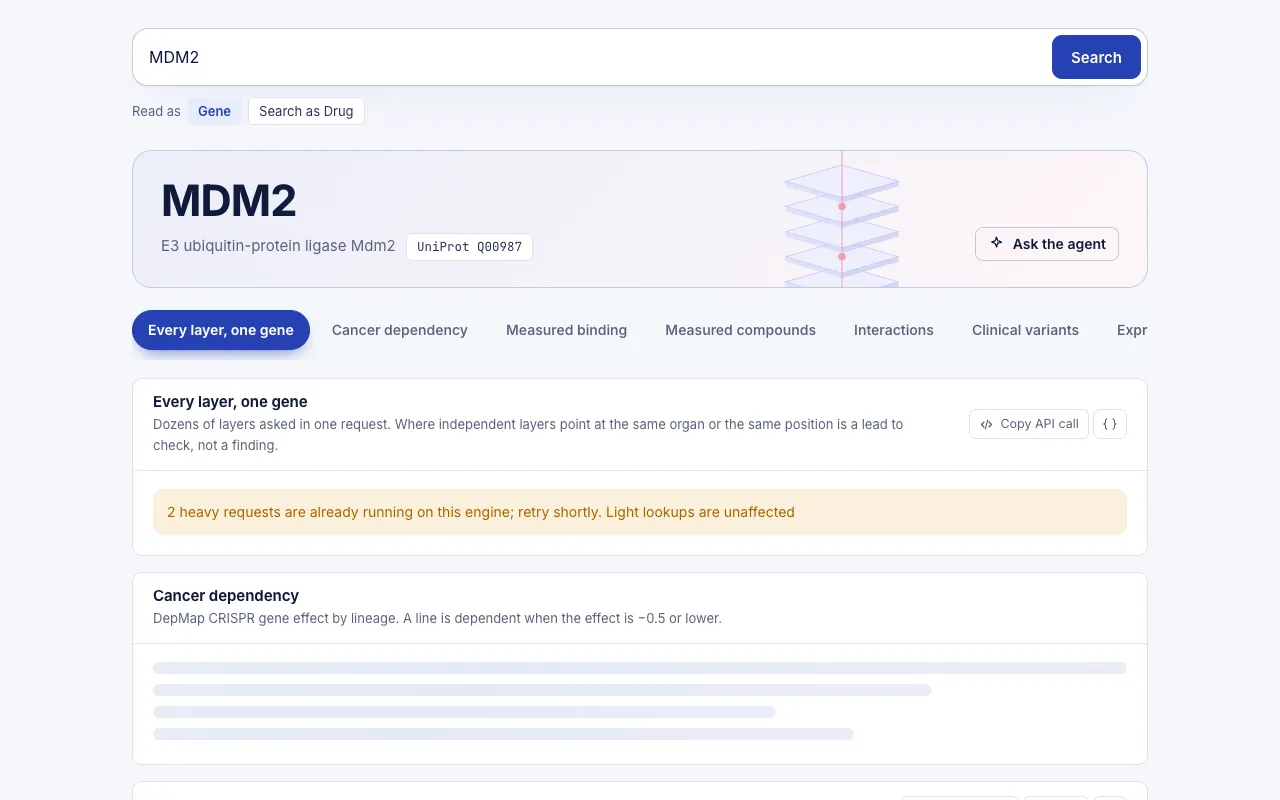
MDM2 vs MDM4: dependency and drugs side by side
MDM2 vs MDM4 in DepMap 24q4 Chronos data and drug annotations: 384 of 1178 cell lines depend on MDM2, 142 on MDM4; 12 drugs listed for MDM2, 1 for MDM4.
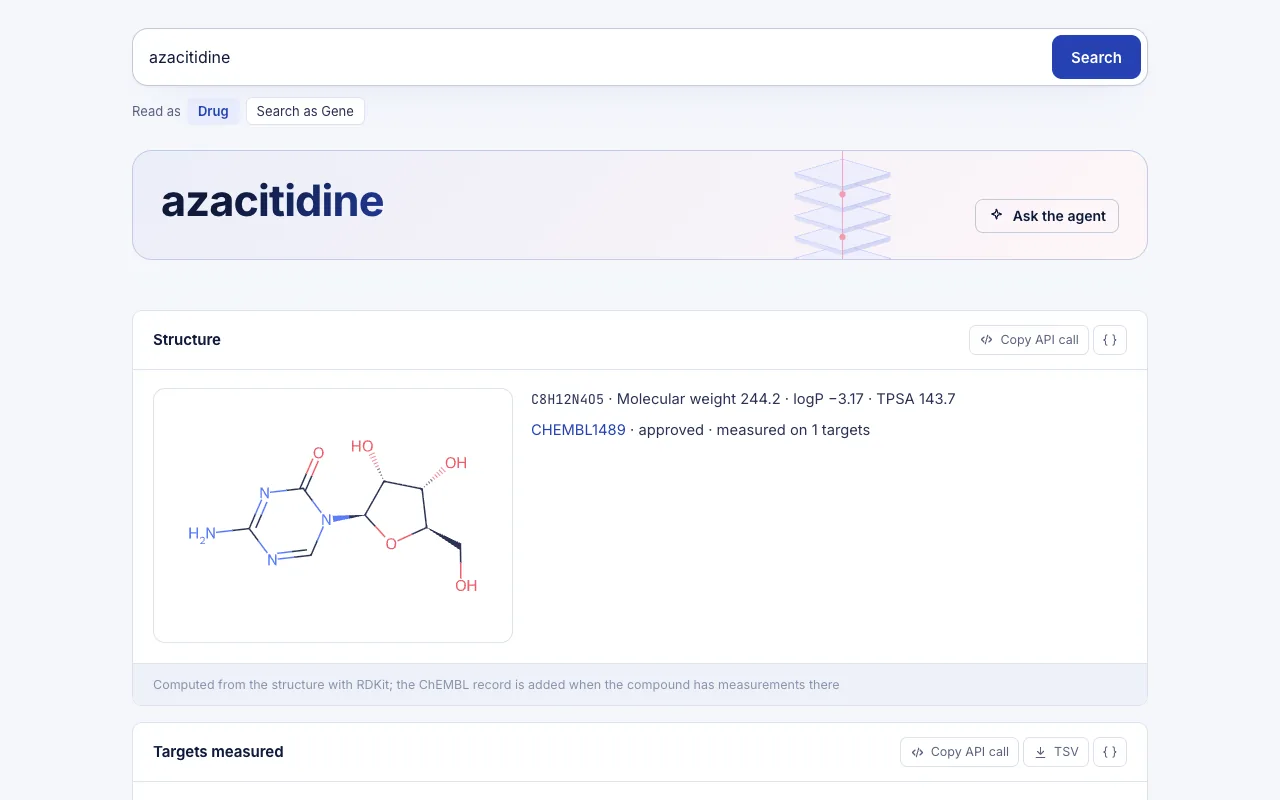
Azacitidine Ropeginterferon trial NCT07646821
Phase 1b/2 trial NCT07646821 adds ropeginterferon alfa-2b to azacitidine in TP53-mutated MDS/AML; ChEMBL, ClinicalTrials.gov and DepMap data as of 2026-11-15.
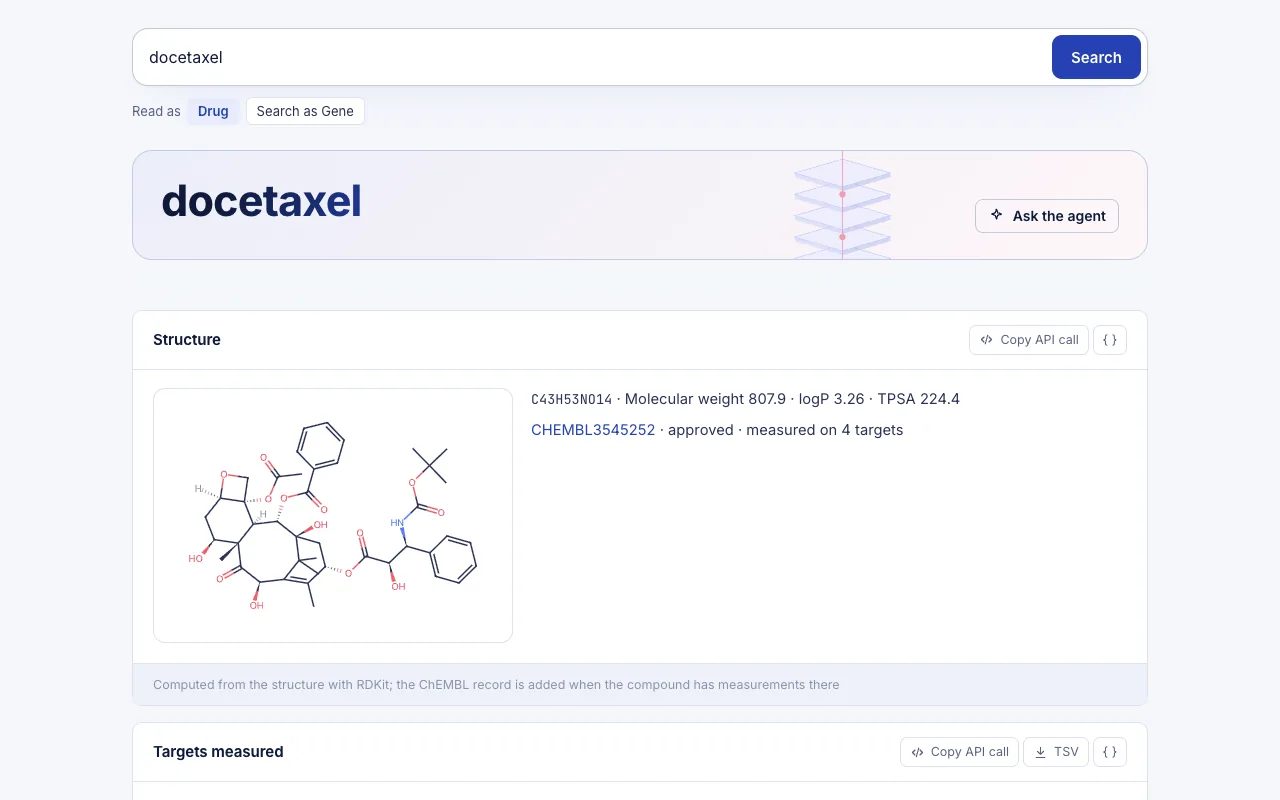
Docetaxel Non-Squamous Non-Small Cell Lung Cancer Trial
NCT07821684 is a phase 3 trial in non-squamous NSCLC; we pair it with docetaxel potency in ChEMBL, 1628 registered trials and EGFR dependency in DepMap.